Renault knew its way around a rear-engine layout. The company had already cut its teeth on the 4CV, a compact runabout that launched post-WWII and proved the formula worked. It was small. It was practical. And it sold.
By the mid-1950s, the French automaker was ready to scale up. They needed something bigger. Something better.
Enter the Renault Dauphine.
Released in 1956 and sold through 1958, this wasn’t just an incremental step. It was a statement. The Dauphine took the rear-engine concept and stretched it. It added space. It improved refinement. And yes, it made enough money to prove that Renault had truly found its footing in the mass market.
It wasn’t just a successor to the 4CV. It was a leap forward. And for a brief, bright moment in automotive history, it was everywhere.
How the Renault Dauphine Rose from Ashes
The 1955 Renault Dauphine didn’t just appear. It emerged from the wreckage of a nation that had barely survived the war. Ferdinand Porsche bears some of the blame for that. Without his original design for the Volkswagen Beetle, the trend for small, rear-engine cars might have never caught on. No Beetle meant no Chevrolet Corvair. No Beetle probably meant no Renault 4CV. And without that predecessor, there is no Dauphine.
But how did a country with factories in ruins and a spirit broken by four years of Nazi occupation build such a charming little car? It seems impossible. Yet here it is.
When US troops liberated Paris in August 1944, France was on its knees. Resistance fighters had sabotaged factories. Allied bombers had pounded the rest. Louis Renault, the company’s founder, was in prison as a suspected collaborator. He died shortly after. The company he built was shattered. Up to a third of its machinery was gone.
Pierre Lefaucheux took over the wreckage. He nationalized the company. He got the lights on. In 1947, the Renault 4CV went on sale. It was a cute, rear-engined four-door. It looked nothing like the cars that would follow. Snub-nosed. Beetle-tailed. Performance was marginal. Roadholding was poor. But it was cheap. It was reliable. It was available.
More importantly, every aspect of that design would be reused. Developed. Improved. But still recognizable.
Why the Porsche Connection Matters
The 4CV owed its existence to Porsche. Renault’s team had studied German specs during the war. They wanted something similar. The Nazis forced the Paris plant to make military trucks, but that kept the engineers busy.
Irony of ironies. Porsche himself helped. While in French custody in 1946, he looked over the 4CV drawings. He suggested changes to improve weight distribution and roadholding. He even worked in Renault’s own engineering workshops for a time.
It was a small car. But it proved the concept. France needed mobility. The 4CV delivered.
The Long Road to the R1090
In 1951, the state-backed Régie Nationale des Usines Renault decided it was time to try again. They started the R1090 project. It took forever.
The first prototype ran in July 1952. That was just the beginning. They clocked more than 2 million miles of testing. Renault didn’t cut corners.
“Arctic conditions were sampled in the North Cape area [of Europe] by one car, another car was sent to work in the Swiss mountains, and a third to the United States. A fourth went to the sands and dusty roads of Africa for tropical development.”
That level of testing explains why the car felt so solid when it finally arrived. But the wait had a cost. By the time the first car rolled off the new Flins assembly line in December 1955, the market had shifted.
Naming the Dauphine
Renault almost called the new car the “Corvette.” General Motors beat them to the punch. So they looked inward. France was a republic, but it still liked its royal titles.
A dauphin was the eldest son of the king. The dauphine was the feminine equivalent. It sounded pretty. It appealed to the French sense of hierarchy. It stuck.
The car was ready. The testing was done. The war was long over. The Dauphine was finally here. And it would go on to become one of the most successful small cars of the post-war era.
1956 Renault Dauphine
Renault called it the “princess.” When the 1956 Renault Dauphine hit the streets in March, the French public lost its mind. It was sleek. Curvaceous. A stark departure from the utilitarian boxes preceding it.
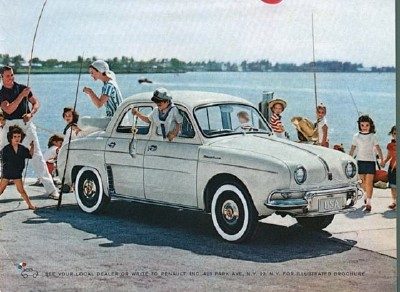
Underneath that pretty skin lay a conventional Ventoux ohc inline four-cylinder water-cooled engine. Renault kept the removable cylinder sleeves from the previous model but stretched the wheelbase to 89 inches. That is 6.3 inches longer than the 4CV. The total length grew by a full foot. It was wider and slightly lower. The result? A people’s car that looked more expensive than it actually was. It swallowed passengers and luggage with impressive ease and cruised France’s Routes Nationales at over 60 mph without breaking a sweat.
Then came the handling reality check.
Renault had zero experience managing the physics of a tail-heavy, rear-engine layout. Dr. Porsche knew better. Renault did not.
Mounting the heavy engine and gearbox in the rear meant nearly 62 percent of the car’s weight sat on the back axle. The front sheetmetal surrounded nothing but empty space for a front trunk. This weight distribution was terrifyingly unbalanced. The rear suspension relied on simple, high-pivot swing axles. Those wheels struggled for traction constantly.
Did it skid? Yes.
Everything you have heard about the Dauphine’s nervousness is true. Passing a semi on the highway? Risky. Crossing a high, exposed bridge? Skittish. Engineers tried to tame the beast with weird tire pressures: 15 psi in the front and 23 psi in the rear. It helped a little. It did not solve the physics.
Early U.S. road tests gave it a pass. Then came 1960. Motor Trend dropped the hammer: “There is nothing in the handling at normal speeds to indicate that the engine is stowed in the rear but push up to some high-speed cornering and the rear end becomes quite skittish, requiring skilled control of an oversteer condition that presents itself.”
You need skilled control. Or you end up in a ditch.
The Glamorous Dauphine
The Renault Dauphine unit-construction bodyshell was a clever bit of engineering wrapped around a bizarre mechanical layout. It was a conventional body structure reinforced with perimeter-shaped longitudinal box sections and substantial cross-bracing.
The 845cc four-cylinder engine was essentially the 4CV powerplant with larger bores. It lived in the extreme tail. Cooling outlets pierced the engine lid—I hesitate to call it a “trunklid” since it was at the front. Neat air intakes in each rear passenger door gave away the engine’s location to anyone paying attention. Power went to the rear wheels through a three-speed transaxle mounted ahead of the engine. Even back in 1956, Road & Track and Motor Trend were begging for a fourth gear.
One technical oddity was the optional Ferlec clutch. It used automatic electromagnetic operation. No clutch pedal. You just drove.
The front-hinged trunklid flipped up to reveal a seven-cubic-foot cargo hold. The spare tire sat sideways under the front bumper, hidden behind a pivoting panel below the center section.
The suspension was a mix of sensible and bizarre.
Up front, you got a conventional coil-spring/wishbone layout. Antiroll bar included. Rack-and-pinion steering. All neatly packaged on a detachable front cross-member.
At the rear? Chaos.
A high-pivot swing axle of the simplest nature. Concentric coil-spring and telescopic dampers sat atop the swing tubes. Renault called them “trumpet casings.” Fore-and-aft location? Except for the trunnion arms in the transaxle housing itself, there was none. The entire pressed engine/transaxle/suspension mounting member was detachable from the main body structure.
“The whole of the pressed engine/transaxle/suspension mounting member was detachable from the main body structure.”
Then there were the wheels. This oddity carried over from the 4CV. The axle hubs at front and rear were quite large. Five very widely spaced bolt locations for the road wheels. The wheels themselves were sturdy rims with five mounting lugs. The space in the middle? Pure fresh air.
It looked elegant. It was cheap to build. But it was not built to last decades.
The front end looked flimsy. In a head-on crash, that hollow nose would fold up to the windshield in no time flat. Customers quickly noticed the alarming tendency for body panels to rust away.
None of that mattered commercially. The timing was perfect. France’s economy was picking up. The world wanted modern-looking cars. The Dauphine became fashionable almost overnight. Paris and other French cities teemed with these little four-seaters.
By 1957, the French were pumping out 700 Renault Dauphines daily. The 100,000th unit rolled off the line in March, marking a production speed that signaled the car was no longer a niche curiosity. It was a mass-market phenomenon.
Renault knew how to play the game. They didn’t just sell cars; they sold imagery. Brigitte Bardot was photographed in one. The brand’s motorsport team ran five modified examples at the 1956 Mille Miglia. Five-speed gearboxes and tweaked engines swept the first four spots in their class. The fourth-place car didn’t just finish; it survived a tumble into a ravine. That’s not just durability. That’s brute force wrapped in elegance.
The US Import Debacle
Assembly lines opened in England and Italy. But the real gamble was the United States. Renault debuted the Dauphine at the New York Auto Show in April 1956.
Were they serious?
They pitched a 30-horsepower machine to a market dominated by V8s and chrome. The Dauphine took roughly 31 seconds to hit 60 mph. It struggled to pull away from stoplights. It certainly couldn’t argue with a Checker cab for road space. The idea that this tiny French hatchback would conquer Main Street USA was optimistic to the point of delusion.
They were wrong. Swiftly.
American drivers found the reality of daily use frustrating. You couldn’t comfortably exceed 45 mph in second gear. The car felt small. Vulnerable. Sharing the highway with heavy American trucks made the Dauphine feel like a tin can in a wind tunnel.
There was only one advantage: cost and efficiency.
At $1,645 at introduction, it was only $150 more than a base Volkswagen Beetle. But the numbers didn’t lie. Magazine tests showed mixed-use fuel economy reaching 39.1 mpg. In an era before gas was cheap but still affordable, that frugality was a hard sell against the sheer indifference of the average American motorist.
Enter Gordini
Renault needed speed. They needed prestige. They turned to Amédée Gordini.
The French race-car builder had just abandoned Grand Prix racing. He was looking for work. Renault hired him and set him to work on the Dauphine’s performance limitations. The result arrived in September 1957: the Dauphine Gordini.
This wasn’t just a sticker job. Gordini installed a different cylinder head and bumped output to 38 bhp. He also fitted a four-speed gearbox. The peak power increase seems modest on paper, but it represented a 27 percent improvement over the standard model.
The Gordini variant delivered a top speed of 74 mph, enough to keep pace with larger-engined cars, particularly on the wider American highways.
The performance credentials were validated on the track. The Dauphine won the punishing 1958 Monte Carlo Rally. That’s not a charity event. It’s a test of mechanical integrity under extreme stress.
The Floride Coupes
A year later, Renault tried to capture the glamour market. They introduced the Floride models, marketed as Caravelles in the US.
Styling came from Frua. Bodyshell manufacture was handled by specialist coachbuilders Brissonneau et Lotz. The result was a 2+2 coupe or a two-seat convertible. Both sat on the Dauphine platform but featured more powerful engines.
In Paris and at French seaside resorts, the Floride became the car to be seen in. It was fashionable. It was distinct. It separated the Dauphine from its utilitarian roots.
Suspension Evolution: The Aerostable System
The Renault Dauphine models of the Sixties began with a technical twist. For the 1960 model year, Renault introduced a new suspension setup called Aerostable.
Don’t expect a complete overhaul. This wasn’t a replacement for the agricultural swing-axle rear end. Instead, it was an additive layer of complexity.
The system added:
– Extra rubber springs up front.
– Auxiliary air spring units mounted inboard of the conventional coils at the rear.
The effect was nuanced. In most conditions, the ride softened. As payload increased, the setup firmed up rapidly. This prevented the sag that often plagued light cars.
For the sporty driver, the benefit was geometric. When carrying only two people, the rear wheels gained a small degree of negative camber. This improved grip when cornering. It was a subtle fix for a fundamental chassis weakness, but in the hands of a keen driver, it made the Dauphine feel less like a grocery getter and more like a proper sports car.
The Dauphine didn’t conquer America. But it didn’t disappear either. It carved out a specific niche. It proved that a small, slow car could still win rallies, break speeds records, and look good doing it. The Aerostable suspension was just one step in a long evolution of trying to make a small car handle like a big one. The engineering challenges remained. The style only got sharper.
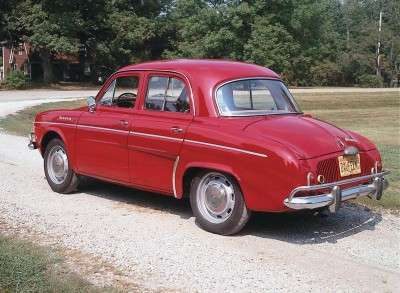
The 1964 Renault Dauphine Sport Brakes and Specs
Renault didn’t sit on its laurels. They churned out more than 200,000 Dauphines annually. The one-millionth unit rolled off the line in 1960. You might expect the Régie to get lazy after that kind of volume. They didn’t.
Power figures climbed steadily. The standard 845cc engine pushed 32 bhp. The Gordini version? It hit 40 bhp. That higher output came from adopting the Caravelle’s engine block rather than using special castings. Performance numbers reflected that gain. The Gordini did 0-60 mph in roughly 20 seconds. Top speed hovered around 80 mph.
Mid-Century Refinements and Options
The lineup expanded to catch different buyers. The 1961 Ondine Dauphine arrived first. It was a standard model with a twist—the four-speed gearbox from the Gordini. That gave it sharper acceleration.
By mid-1961, the DeLuxe models entered the chat. They added comfort. Front seat backrests reclined. The luggage container got a proper lining. Trim quality improved significantly. Whitewall tires became standard equipment. It was subtle, but it mattered.
The Rare R1093 Rally Edition
1962 brought mechanical updates and rare hardware. The base Dauphine finally received an all-synchromesh three-speed gearbox. Shifting became smoother. But the real headline was the Dauphine R1093 (R for Rally).
This was a limited-edition beast. It produced 55 bhp. It could beat 90 mph. Most of these cars never left France. Export enthusiasts missed out entirely. You rarely see one in the wild today.
Why the 1964 Renault Dauphine Disc Brakes Matter
The Renault R8 sedan changed the game in mid-1962. It had a larger engine. It was boxier. It used updated suspension derived from the Dauphine. The Dauphine soon looked dated next to the R8.
But Renault kept the little car alive. In 1964, the Dauphine inherited the R8’s four-wheel disc brakes. This was a major safety upgrade for a small rear-engine car. Stopping power improved drastically.
New options for that year included air conditioning. A three-speed automatic transmission with pushbutton controls on the dash also arrived. The automatics were niche, but available.
Handling Critiques and Final Thoughts
Here was a mature product. The 1964 Renault Dauphine looked good. It was brisk enough for city duties. It stopped very well indeed. The disc brakes were the standout feature.
But the handling remained a point of contention. The rear-engine layout posed challenges. Critics pointed out the instability under hard cornering. If only Renault heeded that criticism. Porsche found ways to tame similar issues in their sports cars. Why not here?
If they had solved the handling quirks, the package
The Unavoidable Decline of the Dauphine
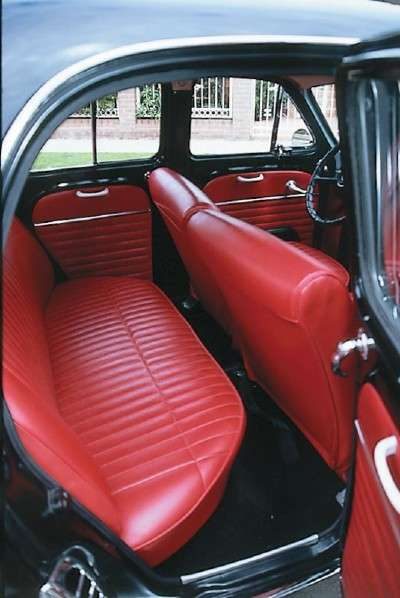
The rear half of the back windows slid forward for ventilation. It was a clever touch. But by the mid-Sixties, time was running out for the 1964 Renault Dauphine. Nearly a decade had passed. The styling hadn’t changed. Performance remained largely static.
Serious body-corrosion problems emerged with age. Critics called the construction light. Some said fragile. The Dauphine was under attack from within Renault itself.
The new front-wheel-drive R4 came from below. The more spacious, capable R8 came from above. The Dauphine was squeezed.
In America, demand cooled. Renault’s U.S. sales had skyrocketed in the late Fifties. More Americans bought small, economical European cars. The Dauphine led the charge. Renault sold 91,073 cars in the States in 1959. Then the numbers plummeted. Just 12,106 sold in 1966.
New domestic compacts hit the market in 1960. Ford, Chrysler, and Chevrolet joined Rambler and Studebaker. Even Volkswagen suffered. A price cut for 1961 failed to help the Dauphine.
Service support in the U.S. was a growing pain. Renault admitted it. In advertising for the 1967 R8 successor, the 10, the company confessed.
“Our [earlier] cars were not fully prepared to meet the demands of America. . . . More than a fair share of things went wrong with our cars. Less than a fair share of our dealers were equipped to deal with what went wrong.”
They begged former customers to consider the new model. Renaults would sell well in the U.S. again. Not until the early Eighties. Then, they were made in American Motors Corporation plants. Sold by AMC dealers.
The last base-model Dauphine rolled off the line in December 1966. Gordini types lasted until 1968. About 2 million little sedans were built. A commercial success by any standard.
Renault never produced anything that looked quite as cute again.
Why the 1964 Renault Dauphine Failed in America
You might wonder why a car with nearly 2 million units sold globally struggled so hard in the States. The answer lies in the timing. And the competition.
The Dauphine entered a market that was rapidly changing. Americans wanted more space. More power. Better reliability. The Dauphine offered none of these in 1966.
The Specs That Defined the Little French Car
The Renault Dauphine specifications tell a story of simplicity. And limitations. Here is what made up the mechanical heart of the car.
General Dimensions
- Wheelbase: 89 inches
- Overall length: 155 inches
- Overall width: 60 inches
- Overall height: 57 inches
- Tread, front/rear: 49/48 inches
- Curb weight: 1,324 lbs
- Weight distribution: 39% front / 61% rear
- Cargo space: 7 cu ft
The weight distribution was heavily rear-biased. A trait of the rear-engine layout.
Construction and Layout
- Layout: Rear-engine, rear-wheel drive
- Type: Unitized construction
- Body material: Steel
Unitized construction was modern for the time. But the steel body proved prone to rust. Especially in the American Northeast.
Engine Performance
- Type: Inline OHV 4-cylinder
- Material: Cast-iron block, aluminum head
- Bore x stroke: 58mm x 80mm (2.288″ x 3.15″)
- Displacement: 845cc / 51.5 cid
- Horsepower: 30 hp @ 4,250 rpm (U.S. spec)
- Torque: 48.5 lb-ft @ 2,000 rpm
- Compression ratio: 7.25:1
- Main bearings: 3
- Valve lifters: Mechanical
- Carburetor: 1-bbl Solex downdraft
- Electrical system: 6-volt
Note the 6-volt system. It was archaic by the mid-Sixties. Many American cars used 12-volts. The 30-horsepower figure was modest. Even for a microcar.
Drivetrain
- Transmission: 3-speed manual, synchromesh, floor-mounted
- Gear ratios: 1st-3.70:1; 2nd-1.81:1; 3rd-1.07:1; reverse-3.70:1
- Axle ratio: 4.37:1
The 3-speed gearbox was simple. Reliable, perhaps. But not fast.
Suspension
- Front: Independent coil-spring-and-wishbone with antiroll bar and tubular shock absorbers
- Rear: Independent swing axle with coil springs and tubular shock absorbers
The swing axle rear suspension was common in small rear-engine cars. It offered independent travel. But it could be tricky to handle at the limit.
Brakes and Tires
- Brake type: 4-wheel hydraulic drum
- Brake diameter, front/rear: 8.9 inches
- Brake swept area: 133 sq in
- Tire size: 5.00 x 15
Drum brakes were standard. The 29-foot turning diameter made it incredibly agile. A key selling point for city driving.
Steering
- Type: Rack and pinion
- Turns, lock to lock: 4
Rack and pinion was advanced for a small French car in 1956. It stayed with the Dauphine until the end.
Legacy of a Cute Little Car
No matter how hard Renault tried in the next few years, it never again produced anything that looked quite as cute. The Dauphine had charm. It had simplicity. But it couldn’t survive the American market’s appetite for bigger, faster, and more reliable cars.
The last ones rolled off the line. The numbers climbed to 2 million. A success in Europe. A footnote in America.
For more information on cars, see:
- Classic Cars
- Muscle Cars
- Sports Cars
- Consumer Guide New Car Search
- Consumer Guide Used Car Search