Franklin sits in a rarefied air among American car manufacturers. While most Detroit heavyweights clung to water-cooled blocks, Franklin went all-in on air-cooled power. It wasn’t a gimmick. The brand established its reputation on the very first 1902 model. That early reputation for quality stuck. It lasted until the company folded in 1934.
The secret was weight. Or rather, the obsession with shedding it.
In an era when cast iron was the default material for engine blocks, pistons, and heads, Franklin used high-grade aluminum. They weren’t just dipping a toe in the water. At one point, Franklin was the world’s largest consumer of the metal. This wasn’t just about performance. It was about building something lighter and smarter than the competition.
Suspension and Comfort
Mechanical innovation extended to the chassis. Most cars of the period used half-elliptic springs. Franklin went with full-elliptic springs all around. The result was a noticeably smoother ride. Tire wear dropped. Drivers spent less time fighting the road.
They also used a flexible wood frame to further dampen shocks. It sounds archaic today. Back then, it was advanced engineering.
By 1920, Franklin was serving up features other brands would take decades to adopt. Full-pressure lubrication was standard. Automatic spark control came along. Electric chokes were already familiar fare. They also ditched four-cylinder engines after 1914, committing fully to six-cylinder powertrains.
The Lindbergh Effect
Air-cooling gained massive credibility in 1927. Charles Lindbergh crossed the Atlantic in the Spirit of St. Louis. That plane ran on an air-cooled engine. Franklin marketers didn’t miss the beat. They drew a direct line between their cars and the “Lone Eagle.”
Some 1928 models were branded “Airman” to honor the feat. That same year saw other major updates. Four-wheel Lockheed hydraulic brakes replaced the outdated systems. A steel chassis replaced the previous construction. By 1929, Franklin introduced a standard “silent second” synchromesh gearbox. It made shifting smoother. It made the car easier to drive.
The 1930 Models
Wall Street crashed in late 1929. Detroit was optimistic anyway. Franklin had just posted record sales. Interest in aviation was peaking. Air-cooling was hot. The company rolled out the 1930 lineup with this momentum in mind.
The “145” and “147” models arrived with new styling. Wheelbases stretched to 125 and 132 inches respectively. They featured a new “hood front.” Franklin refused to call it a radiator. They believed a visible radiator was essential for sales. This new design included shutters. A thermostat connected to the number-one cylinder controlled airflow automatically.
The engine itself told the story of Franklin’s philosophy. Six individually cast cylinders. Overhead valves. Cooling air was directed to the sides of the block, moving left to right. Engineers called this “side-blast” cooling. It was a distinct departure from the front-to-back airflow used by others.
Output sat at 95 horsepower from a 274 cubic-inch displacement. Not huge by modern standards. But effective. And reliable.
Franklin had built something different. They had a product that matched the spirit of the age. The crash would soon change everything. But in 1930, the road ahead looked clear. The Airman was ready to fly.
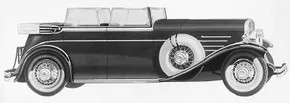
Franklin didn’t need to chase trends. As a premium brand, its rolling chassis were prime real estate for coachbuilders. Derham, Dietrich, Locke, and Brunn all built custom bodies on Franklins. It was a logical pairing. The result was a lineup that felt exclusive.
The 1930 open models were particularly striking. Dietrich’s four-door Pirate stood out. It came as a five-passenger phaeton or a seven-seater touring. The design detail was subtle but effective. Flared door bottoms hid the running boards completely. Clean lines. No clutter.
Also new that year was the Pursuit. A dual-cowl phaeton with a focus on aesthetics. It had no external door handles. The designers wanted a smoother look. The upholstery in the front compartment wrapped over the outer edge of the doors. It mimicked the cockpit style of contemporary aircraft. Aviation influences were everywhere at the time.
Dietrich also made a popular four-door, four-seat speedster. The body was abbreviated. It ended midway over the rear wheels. Most featured permanent canvas tops. Closed styles were the norm. But if you wanted a full convertible, you paid extra.
Aviators and Professionals
It is no surprise that famous aviators drove Franklins. Charles Lindbergh. Amelia Earhart. Frank Hawks. These pioneers chose Franklins as their personal transport. The company publicized this heavily. It was good marketing.
But Franklin never marketed itself purely as a sports brand. The sales figures didn’t support that angle. The typical buyer was different. Physicians. Attorneys. Business executives. Professionals with steady incomes.
Their preferences reflected that demographic. Paint colors were conservative. Blackwall tires were standard. They didn’t want flashy accessories. They wanted reliability. And status.
Franklin was ahead of the curve by 1920. They sold more sedans than open cars. This trend continued into the 1930s. Sedans remained the model of choice. The brand was elegant. Fairly expensive. Conservative in taste.
The customer base was loyal. Repeat buyers were common. They knew what they were getting. An air-cooled engine with few moving parts. A smooth ride. A badge that signaled success without shouting.
Sinking Franklin Creates Cheaper Models
By the early 1930s, the Great Depression hit hard. The luxury market shrank. Franklin couldn’t sustain its high price points. The company needed volume. It needed to lower costs.
The solution was a new, smaller engine. The existing 237 cubic-inch flat-twin was expensive to build. It required complex machining. The new engine was simpler. Smaller displacement. Cheaper materials.
This wasn’t just a minor tweak. It was a strategic pivot. The new models, often referred to as the “Junior” or “Senior” lines depending on the year and configuration, aimed at a broader audience. The air-cooling advantage remained. Reliability was still the selling point. But the entry price dropped.
Did it save the brand? Not entirely. The shift to cheaper models diluted the exclusivity that Franklin had cultivated. The core luxury buyers felt alienated. The new buyers wanted economy, not elegance. Franklin was caught in the middle.
The company
The Descent: Depression, Price Hikes, and Empty Showrooms
Franklin’s math didn’t add up. In the first quarter of 1930, the company reported its “fine car business” had doubled compared to the same period in 1928. It sounded like a victory lap. Then reality hit. The Great Depression had essentially erased the market for luxury automobiles. By the end of the calendar year, Franklin’s total sales were less than half of what they had been in 1929.
Desperate to keep the assembly lines moving, Franklin rolled out the Transcontinent Six (Series 141) in May 1930. It sat on the familiar 125-inch wheelbase and came in closed coupe, convertible coupe, victoria brougham, and four-door sedan body styles.
The economics were brutal. The sedan was the entry-level model, yet it carried a sticker price of $2,395. To put that in perspective, a brand-new Ford Model A cost roughly $500. Franklin was asking four times the price of the people’s car. In 1930, that sum represented a solid annual salary for a working family. The market responded with silence. Model-year production collapsed to a dismal 5,744 units.
Cutting Costs and Dreaming in V12s
For 1931, Franklin stripped its lineup. The Transcontinent Six returned with the same body options, but prices were slashed to the $1,800–$1,900 range. Above that, the DeLuxe Six occupied the $2,400–$2,700 bracket. This group featured four distinct models with sweeping body lines by Ray Dietrich and distinctive clamshell fenders. All shared a 132-inch wheelbase and an engine tuned to 100 brake horsepower.
Marketing copy continued to lean heavily on aviation metaphors, promising “riding like gliding.” It didn’t matter. The Depression was vicious. Production withered further to just 2,851 vehicles.
So Franklin did the unthinkable: an air-cooled V-12.
The engine was a beast. It displaced 398 cubic inches and produced 150 bhp. Advertisements called it “supercharged,” but technically, it was a ram-air system powered by a duct attached to the cooling fan. It was a clever, if slightly misleading, engineering trick.
Originally slated for the 1931 DeLuxe Six chassis, the V-12 was delayed to 1932 due to cash flow problems. Franklin had missed payments on certain notes. Banks sent managers to oversee operations. President Edwin McEwen used the delay to redefine the car entirely. The Franklin Twelve would not just be a new engine in an old body. It would be a new car.
The Twelve: Magnificent and Unsold
The 1932 Franklin Twelve looked nothing like its predecessors except for the air-cooled engine. The old full-elliptic rear springs and tubular front axle were replaced by semi-elliptics and an I-beam front end. Coachbuilder Walker of Massachusetts was dropped. Instead, every Twelve was hand-built in-house at the Syracuse factory.
LeBaron handled the styling. The result was sharp. A deeply Vee’d hood cover stretched back to an angled windshield. On a 144-inch wheelbase, the car was physically imposing. By 1932 standards, it was exotic, beautiful, and utterly unaffordable for most.
Sales reflected the disconnect. Roughly 200 Twelves were sold for the model year. For context, 1,700 six-cylinder Airmans moved off the lot on the shorter 132-inch chassis. The company was bleeding out.
The Olympic: A Reo Lifeboat
Franklin needed volume. It needed cheap metal. So it made a deal with Reo, another manufacturer teetering on the brink of collapse.
The result was the Olympic. It was a Reo Flying Cloud—featuring a 118-inch wheelbase—shipped from Lansing, Michigan, in batches of 30 bodies per day. These shells arrived in Syracuse, where Franklin installed its own six-cylinder engine. The next day, the finished Olympic rolled out of the Syracuse plant.
The investment was minimal. The price tag was aggressive. Coupes and sedans listed for $1,385. Convertible coupes went for $1,500. It was an attempt to buy survival through volume and shared manufacturing. Whether it was enough remains the quiet question hanging over the factory floors.
The Olympic was a genuinely competent machine, but timing is a cruel mistress. It arrived too late to bail out Franklin. Only 1,218 examples rolled off the line in 1933. The following year, the 1934 model, the company’s swan-song, saw just 109 units built. Production volumes were collapsing.
Franklin didn’t abandon its lineup entirely in those final two years. They still offered the mechanically unchanged Twelve and Airman Six. Both models came with four body styles. But volume was nonexistent. Combined totals for the Twelve sat at a meager 98 units. The Airman Six managed 468. These numbers tell you everything you need to know about the brand’s market position on the eve of its demise.
Yet the Franklin story didn’t end with bankruptcy. This is where the narrative gets interesting for aviation geeks. A group of former Franklin engineers bought the assets. They pivoted hard. Instead of cars, they focused on air-cooled airplane engines. It was a logical transition given their heritage.
By the 1940s, they expanded into helicopter engines. Their engineering expertise found new life in the skies. Then came 1948. A water-cooled variant of their helicopter engine powered the Tucker car. That’s right. The same people who built the Franklin engines supplied the heart for Preston Tucker’s controversial automotive venture.
Aircraft engine production continued for decades. They were still cranking out powerplants in the 1970s. The car division died. The engine division lived on. It’s a rare survival path for an American automaker. Most just vanish into history. Franklin’s components kept flying long after its badges were removed from sedans.
For more on defunct American cars, see:
-
AMC
-
Duesenberg
-
Oldsmobile
-
Plymouth
-
Studebaker
-
Tucker