“If anything truly has a soul… it’s far more likely to be a engine than a human.”
Enzo said that. Maybe.
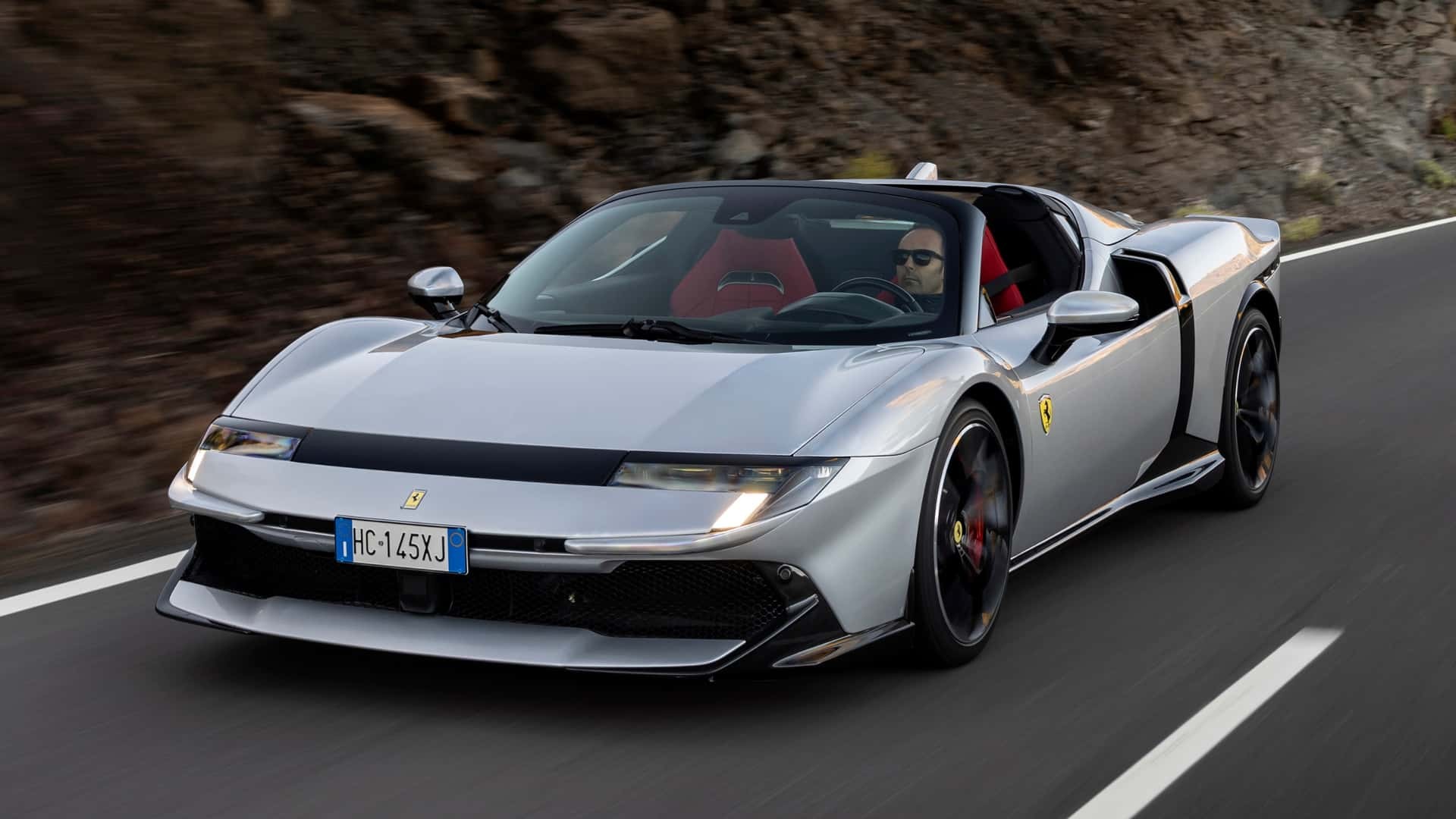
The quote sits heavy in Maranello air as I stand next to the 849 Testarossa Spider. It is eight-cylinders of aluminum and intent.
The team wanted a challenge. They wanted a rear-engine V8 wearing the Testarossa badge again. I asked the engineers what they were thinking. They didn’t flinch. Engineers like that are rare. They want the truth, even when the truth is sharp.
I didn’t care about the history then. I just wanted to press the red button.
Paper Tigers & Real Steel
Photo by: Ferrari
Look at the spreadsheet first if you must. 1,050 horsepower. Zero to sixty in under 2.3s. Zero to a hundred-twenty-four in 6.5s.
It is the fastest Ferrari ever built in series production.
Then there is the lap time. The Spider set 1:18.10 around Fiorano.
Stop looking at the paper.
Numbers lie if you only read the headlines. The magic here isn’t the torque curve. It’s the feel. The electronics don’t smooth the ride. They make it louder, clearer. More connected.
This is plug-in hybrid. 7.5 kWh battery. You can whisper out of the hotel lobby. Silent. Ghost-like. But when the three electric motors engage—one front axle, two up front, one sandwiched between engine and transmission—you realize silence was never the goal.
Heart and soul. That is the point.
The V8 is the anchor. Twin-turbocharged 4. liter. It makes 830 hp on its own. That is fifty more than the SF90. Big turbos. Not tucked in a hot V. Just sitting there. Exposed. Honest.
The rest comes from electric muscle. Front motors do the vectoring. The rear one bridges the gap. Total output: 1,050 hp.
But power is easy. Controlling it? That’s the trick.
Mustaches And Aerodynamics
The car looks fast while parked.
Front end copies the 499P Le Mans winner. A mustache. Big splitter. Grille that breathes air with purpose. Rear end? Split tails. It honors the 512 S. Ignazio Giunti. Mario Andretti. Sebring 1970.
Doors are patented single-piece aluminum. Hot formed. Stamping couldn’t make these. They guide air into intercoolers. Same intercoolers as the F80 hypercar.
Downforce? 915 lbs at 155 mph.
35% comes from under the front nose. Splitter and tail take another 20% combined. The rear wing flips. Low drag to high downforce. One second. That wing alone adds 220 lbs.
The Spider roof folds in 14 seconds. Up to 28 mph.
No penalty for openness.
Wind deflector kills buffeting. Bridge behind the cabin shunts air to the spoiler when closed. It matches the coupe.
Inside feels like a race cockpit. Horizontal dash. Central spine. Classic gated shifter inspiration.
Physical buttons return.
Touchscreens died a quiet death on this steering wheel. Red start button. Real switch. Click.
Tenerife Rules
Photo by: Ferrari
Tenerife roads are smooth. Mountain passes are tight.
I kept within the limits. Still, the car surprised me.
Acceleration? Expected. You buy a Ferrari. You get acceleration.
Turn-in? That resets your brain.
I test motorcycles too. I know twitchy handling. The torque-vectoring works so hard you don’t feel it work. You just feel the nose dip. Sharp. Instant. Go-kart behavior at highway speeds.
Exit? Electric motors fill the turbo lag gap. The car launches before the combustion kicks in fully.
Body roll is down 10% versus SF90. Springs lighter by 35%. Tuned for roads, not just circuits.
Dynamic camber improves. Tires stick where they should. Grip when it matters.
Throttle feels sharper. Steering bites harder. Third gear above 5,50 RPM and the 849 out-accelerates the SF90.
The gearbox is tuned for noise now. Downshifts bang harder. Race mode makes it scream. Software borrowed from the SF90 XX. Combustion pressure spikes for sound.
Digital Twins
Overseeing the chaos is FIVE.
A real-time digital twin. Six-axis inertial sensors. Like modern superbikes watch every millimeter of lean angle.
Sophisticated? Yes.
Complicated? No.
Test driver Raffaele De Simone gets it. Complex engineering. Simple feel.
You don’t think about the sensors. You just drive.
Verdict
The name started fights before I saw the car.
Testarossa.
Everyone sees the 80s wedge. The icon. But the red cylinder heads? 1956. The 500 TR. Then the 250 TR. Buenos Aires. Sebring. Le Mans. First World Sportscar title.
Then the road car. 1984. The one we all remember.
Now, back. Rear V8 flagship.
First time in years Ferrari puts the engine behind the driver.
Price tag is ~$540k. Expensive? Yes.
But it drives. Actually drives.
Admiring it in a museum is one thing. Taking it through a blind corner is another.
Does the name matter?
Try driving it. The debate usually ends there.
“We wanted a challenge.”
It’s a good one.
- Lamborghini Revuelto
- McLaren 788 HS
The road remains open. The engine is warm.
Where to next? 🏎️💨