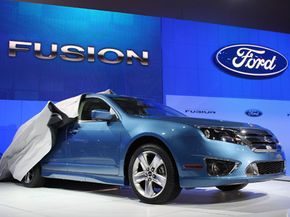
The 2006 Ford Fusion arrived as a midsized sedan that was essentially a 21st-century update of the Ford Taurus. It wasn’t built to turn heads or chase cornering records. It was another in a long line of dependable, affordable Ford sedans designed to get you from point A to point B without fuss.
Some might assume that practicality means sacrificing efficiency. With gasoline engines facing intense scrutiny over carbon emissions and their role in global warming, the push for cleaner technology has never been louder. While alternative fuel options exist, hybrid drivetrains have emerged as a pragmatic compromise. Electric motors handle the low-speed grunt and produce zero tailpipe emissions, while the internal combustion engine steps in to provide the cruising power needed for longer hauls.
Competitors like Toyota and Honda have found significant success with their hybrid offerings. Ford, by contrast, appeared to lag behind the curve. That changed in March 2009. Ford took a decisive step forward with the introduction of the 2010 Ford Fusion Hybrid, signaling to the public that the automaker was no longer sleeping on electrification. This model represents Ford’s first major entry into the sophisticated hybrid sedan segment. Its arrival carries weight, particularly regarding the future of production vehicles manufactured in the United States.
But how efficient will it actually be? Does the design break new ground, or is it just another sedan with a hidden battery? And most importantly, is it affordable enough to matter?
Ford Fusion Hybrid Design
The exterior styling of the Fusion Hybrid is nearly identical to the standard gasoline model. This wasn’t an accident. Ford wanted the car to look like a normal sedan, not a quirky experiment. The goal was to make hybrid technology feel mainstream, not marginal.
Under the hood, the story changes. The Fusion Hybrid pairs a 2.5-liter Atkinson-cycle four-cylinder engine with an electric motor. The system produces a combined 191 horsepower. That’s enough to move the car without feeling sluggish, but it isn’t trying to be a sports car. The transmission is a continuously variable automatic (CVT), which helps keep the engine in its most efficient range.
Inside, the differences are subtle. The dashboard layout is familiar, but the gauge cluster features a hybrid energy flow monitor. This screen shows power being generated, stored, or used in real-time. It’s a simple tool, but it gives drivers immediate feedback on their efficiency. The seats are the same as in the standard Fusion, offering decent support for a daily commute.
The trunk space remains usable, though slightly reduced due to the placement of the battery pack beneath the rear seat. Still, it’s enough for groceries or a weekend getaway. The suspension tuning is also similar to the gas model, prioritizing comfort over sharp handling. This is a car built for efficiency, not thrills.
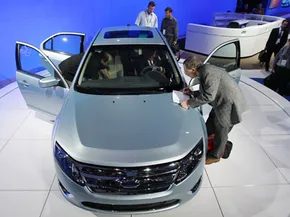
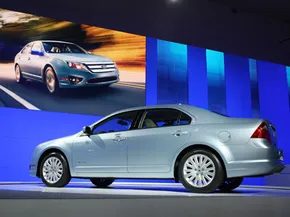
The silhouette doesn’t lie. From the curb, the 2010 Ford Fusion Hybrid is just another gray sedan in a sea of gray sedans. It’s unassuming. Bland, even. There’s no aggressive stance or flashy chrome to scream for attention. It blends in so well you might overlook it entirely if you weren’t looking for it.
But appearances are a distraction. Under the sheet metal, Ford applied the same facelift they gave the standard Fusion, sharpening the profile without breaking the mold. The front fascia is wider, giving it a planted look. A subtle character line runs across the hood, a slight boxy indent that lifts the visual weight. It’s a minor tweak, sure. But it ages the design better than a total redesign might have.
Inside, the blandness vanishes. That’s where the hybrid identity actually lives.
The Digital Dashboard Experience
The heart of the interior isn’t the stitching or the leather. It’s the SmartGauge with EcoGuide system. This isn’t just a gauge cluster; it’s a customizable LCD interface that replaces traditional analog dials. It’s designed to gamify your fuel efficiency.
The centerpiece is a digital tachometer that changes color based on your input. Press the gas lightly, and you see green. Step on it, and it shifts to white, then red. But the real gimmick is the “leaf” animation. The better you drive, the more leaves grow on a virtual tree on the screen. It’s elementary school psychology, but it works. It nags you into being efficient.
You can cycle through four distinct display modes:
- Inform: The basics. Fuel level, battery charge status, and range. No fluff.
- Enlighten: Adds the tachometer and an indicator for when the car is running in pure electric mode.
- Engage: Shows real-time power output from both the engine and the battery. You can see exactly how much energy is being harvested or deployed.
- Empower: The most detailed view. It breaks down power flow to the wheels and other drivetrain components.
It’s a lot of data for a commuter car. Most people will probably stick to Enlighten or Inform. But for the gearhead, Engage offers a window into the hybrid system’s logic.
Materials and Options
Ford didn’t just change the software; they changed the fabric. The standard seats are upholstered in polyester fiber derived from 85 percent post-industrial recycled materials. It’s soft. It’s durable. And it’s green.
If you want to step up, the options list is familiar but robust. You can swap the cloth for heated leather seats. Add the GPS navigation system. Upgrade the audio to a Sony premium sound system. Or just add Sirius satellite radio for the long hauls.
Ford Fusion Hybrid Specs
Here is what actually powers this unassuming box.
Engine Configuration
The Fusion Hybrid uses a 2.5-liter Atkinson-cycle inline-4 gasoline engine. It’s not the most powerful engine on paper, but it’s tuned for thermal efficiency. It’s paired with an electric motor integrated into the transmission.
Combined Horsepower
The system produces a total of 191 horsepower.
Powertrain Anatomy and the Atkinson Advantage
Gimmicky interior tech is fine for showroom floors, but the real story of the 2010 Ford Fusion Hybrid lies beneath the hood. Ford didn’t just slap a battery into a standard sedan. They engineered a specific powertrain architecture designed to prioritize efficiency without sacrificing driveability.
The heart of the system is a 2.5-liter four-cylinder Atkinson-cycle gasoline engine. You might wonder why Atkinson. The short answer: it’s built for efficiency over brute force, using late intake valve closing to compress less air-fuel mixture, wasting less energy on pumping losses. This engine produces 155 horsepower and 136 pound-feet of torque. But it doesn’t work alone.
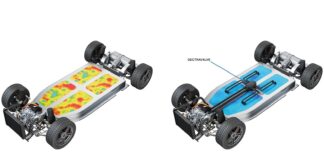
Coupled to it is a nickel-metal hydride (NiMH) battery pack and an electric motor. These aren’t bolted together; they’re integrated into a single unit with an electronic continuously variable transmission (e-CVT). Unlike a traditional automatic with fixed gears, the e-CVT offers infinite gear ratios. This allows the engine to stay in its most efficient RPM band regardless of vehicle speed.
The magic happens in the transition. The system’s software manages the handoff between electric and gas power so smoothly you often won’t notice the switch. And here is the differentiator: Ford claims this setup allows the Fusion Hybrid to run in all-electric mode up to 47 miles per hour.
Real-World Efficiency and Driving Dynamics
Most competitors in the hybrid space throttle back their electric-only range much earlier, usually around 25 to 30 mph. The Fusion’s ability to hit 47 mph on pure electricity changes the daily driving experience. It means quieter operation in city traffic and on slower arterial roads. It also means burning zero gasoline for a significant portion of urban commuting.
The implications for fuel economy are substantial. The EPA estimates 41 mpg in the city and 36 mpg on the highway. For context, that 36 mpg highway figure is notably high for a midsize sedan of this era.
Ford’s internal projections suggest you could squeeze up to 700 miles from a single tank of gas. That’s not a marketing fluff number; it’s a calculation based on the efficiency gains of the Atkinson cycle and the e-CVT. If your commute involves stop-and-go city streets or neighborhood driving, you might rely almost exclusively on the electric motor, slashing emissions and refueling costs.
Pricing and Market Position
At the time of its launch, the base price sat around $27,000. Is that cheap? Not really. But when you factor in the potential fuel savings over the life of the vehicle, the value proposition shifts. For buyers looking for a reliable, efficient hybrid sedan that doesn’t feel like a science experiment, the Fusion Hybrid offered a compelling middle ground.
It wasn’t the fastest hybrid on the market. It wasn’t the cheapest. But it was one of the few that could actually drive at moderate highway speeds using only electric power, making it a practical choice for those who want hybrid benefits without being tethered to ultra-low-speed zones.
For those digging deeper into the mechanics of alternative fuels or the specific tax incentives available for these vehicles, the underlying technology relies on the same principles found in other major hybrid systems like the Toyota Prius or the Toyota A-BAT. Understanding how the e-CVT manages power split versus a traditional gear-based transmission is key to understanding why the Fusion Hybrid performs the way it does.
The sources for these specs and test drives range from official Ford press releases to reviews by USA Today and Jalopnik, all pointing to a vehicle that prioritized a seamless driving experience over raw performance metrics.