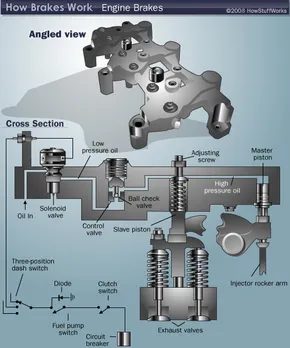
Most drivers think of brakes as the system that stops a car. That’s only half the story. The other half happens inside the engine cylinder, where kinetic energy is converted into heat through compression. This mechanism is known as a compression release engine brake, often called a Jake brake after Jacobs Vehicle Systems, the company that popularized the technology in the 1960s. It doesn’t use friction pads or rotors. Instead, it turns the diesel engine itself into an air compressor.
How the Compression Release Engine Brake Works
The process begins when the driver activates the brake system. Normally, in a four-stroke diesel cycle, the exhaust valve opens to let spent gases out as the piston moves upward. This is the power stroke’s end. In a standard engine, the exhaust valve stays closed during the compression stroke. Air is compressed, creating resistance that actually helps move the piston forward.
An engine brake changes this sequence. When activated, the exhaust valves open prematurely. Just as the piston reaches the top of its compression stroke, the exhaust valves pop open. This releases the compressed air before it can push back against the piston. But here is the catch. The piston doesn’t stop. The vehicle’s momentum drives it down the exhaust stroke. Now, the piston moves downward while the intake valve is still closed. This creates a vacuum in the cylinder.
The piston has to work to pull air back in during the next intake stroke. This resistance absorbs energy from the drivetrain. That energy is what slows the vehicle down. The engine isn’t making power. It’s consuming it to create drag.
Why Heavy Vehicles Need This
Passenger cars don’t typically need this level of intervention. Their mass is low enough that friction brakes can handle the load without overheating. Trucks, however, are different. A fully loaded semi-trailer can weigh up to 80,000 pounds. Downhill, gravity accelerates that mass. If the driver relies solely on friction brakes, the pads and rotors will overheat. Brake fade occurs. Stopping power drops. This is dangerous.
An engine brake reduces the reliance on friction brakes. It keeps the service brakes cool and ready for final stops. It also allows drivers to maintain a safe, controlled speed without riding the clutch or shifting gears constantly. The system is most effective at higher RPMs. That’s where the compression force is strongest.
The Noise Factor
The distinctive bark of a Jake brake is its most famous trait. It sounds like rapid-fire gunshots. This happens because of the sudden release of pressurized air into the exhaust manifold. The exhaust pulse is sharp and loud. It’s not the engine firing; it’s the air escaping.
This noise has led to regulations. Many municipalities have banned or restricted the use of compression release brakes on certain roads or during specific hours. The concern is noise pollution in residential areas. Some states require exhaust brake systems to mitigate the sound. These systems redirect exhaust gases through a muffler-like chamber before they exit the tailpipe. This dampens the sharp pulse without significantly reducing braking efficiency.
Integration with Friction Brakes
Engine brakes are supplemental. They don’t replace friction brakes. They work in tandem. When a driver engages the engine brake, the friction brakes are typically disengaged to prevent unnecessary wear. However, the system allows for combined braking. If the speed drops too low, the engine brake becomes less effective. Friction brakes take over to bring the vehicle to a complete stop.
The interaction between these systems requires skill. A good driver modulates both seamlessly. They use the engine brake to control speed on descents and apply friction brakes only when necessary. This preserves the friction brake components for emergencies. It also improves fuel economy on long hauls by reducing the need for gear changes.
Modern Variations
Older engines used purely mechanical systems. Camshafts directly operated the exhaust valves via rocker arms. Modern diesel engines are electronically controlled. Sensors monitor engine speed, load, and temperature. The ECU decides exactly when to open the exhaust valves. This precision improves performance and reduces noise. Some systems offer multiple levels of braking intensity. Drivers can select low, medium, or high settings based on road conditions.
Electric retarders and exhaust brakes are alternatives. Exhaust brakes restrict exhaust flow, creating backpressure. They are quieter but less powerful than compression release brakes. Electric retarders use magnetic fields to create drag on the transmission output shaft. They are silent but expensive to install. The compression release brake remains the most cost-effective and powerful option for heavy-duty applications.
Safety and Maintenance
Proper maintenance is essential. Worn valve seats or blown head gaskets can ruin the compression release function. If the cylinders can’t hold air, the braking effect disappears. Drivers should listen for changes in engine sound. A quieter Jake brake might indicate a problem. Regular inspections of the valve train and exhaust system prevent failures.
Regulations vary by region. Some countries mandate specific noise limits.