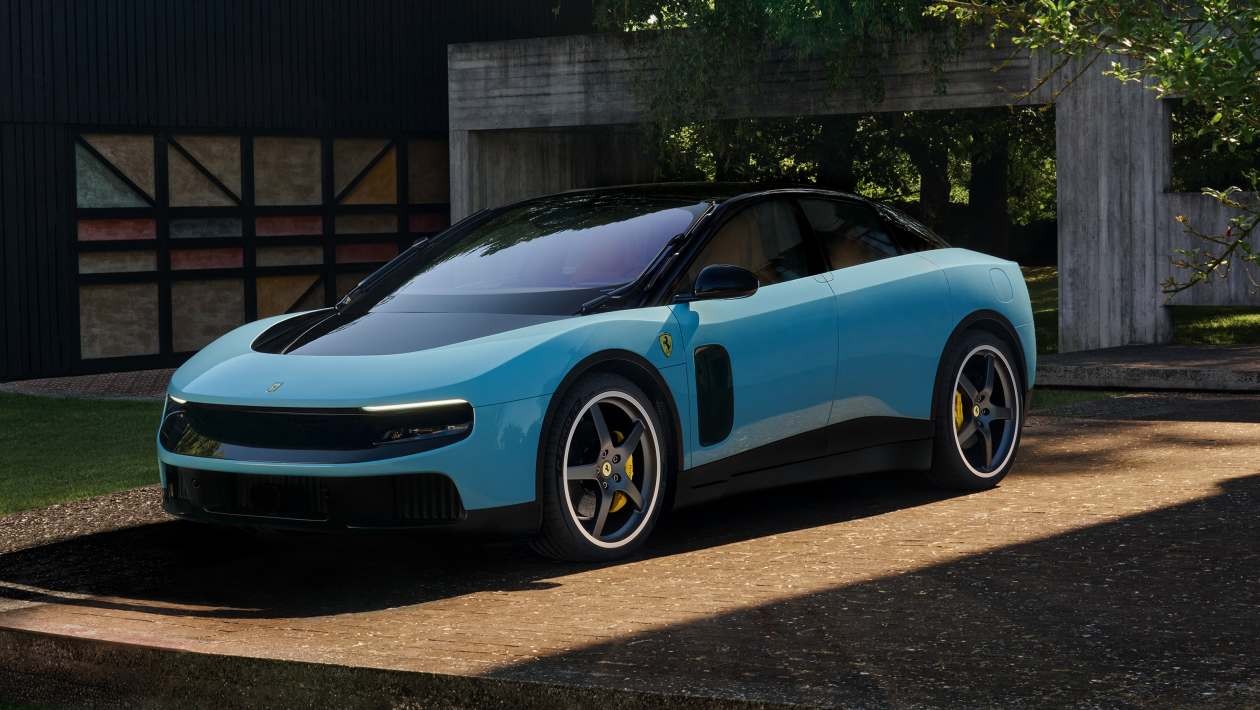
They said it would never happen. Or rather, they hoped it wouldn’t. Now, Ferrari has finally cut the cord. Meet the Ferrari Luce.
It’s their first fully electric vehicle. It’s loud about it, in terms of performance if not sound, and it costs nearly £440,000 before you even hand over the tax man his share.
Most people expected another SUV. Maybe a faster Purosangue in a lab coat. Instead, Maranello served us something radical. A four-door, five-seat sedan that looks like it fell out of a Jony Ive daydream and a 1960s racing sketch.
Design by Apple’s Ex-Creative Soul
Ferrari didn’t just design the Luce. They outsourced the soul of it.
The exterior and interior weren’t born in Pininfarina or Ferrari’s usual design caves. They came from LoveFrom, a creative studio co-founded by Marc Newson and Sir Jony Ive. The man who made the iPhone sleek. The man who hates clutter.
Ferrari wanted new blood. Literally. They needed a design that would pull in customers who’ve never walked into a red dealership before. So they handed Ive and Newson the keys and said “go”.
The result is clean. Shockingly clean.
There’s an enormous glasshouse running from nose to boot. No B-pillars. Just glass, interrupted only by floating aerodynamic wings. It’s smooth. Continuous. Pure. The drag coefficient is the lowest of any Ferrari ever made. Because why fight the wind when you can become the wind?
They hid the windscreen wipers in the A-pillars. Sneaky. And look at those wheels. 23-inch in the front. 24-inch in the rear. The biggest wheels ever put on a production Ferrari. They staggered. It looks unstable. It is stable.
Inside: Apple Watch Meets Nardi Racing
Get in the cabin, and you realize this isn’t just a car. It’s an iWatch scaled to human size.
No giant floating iPad dominating the dashboard. The hero is the steering wheel. Machined from single-piece recycled aluminium. Finished by hand. It channels the spirit of the old Nardi wood-rimmed wheels from the fifties, but stripped down. Minimalist.
Only a few buttons. Analog. Physical. A welcome shock after years of digital menus buried three taps deep.
Behind the wheel, the instrument cluster is magic. Two layered OLED screens creating a 3D effect through cutouts. It moves with the wheel, so your perspective stays fixed. Classic dials, rendered in pixel perfection. “Watch-like clarity,” Ferrari calls it. They aren’t lying.
Then there’s the Multigraph.
Tucked in the top corner of the main display, sitting under a piece of aluminum bezel. It’s a mechanical watch face inside an electric car. Hands move for time. Compass. Stopwatch. When you hit launch control, it counts down five seconds. Tick. Tick. Tick. It feels analog. It feels expensive. It feels unnecessary, but you’d sell a kidney to have it.
The main screen is mounted on a ball joint. Tilt it. Swivel it. There’s a palm rest below. Think of how you hold a phone. Now imagine the whole dashboard works that way. The software UI mimics iOS. Of course it does. Who else builds software that doesn’t suck?
And the key? Crystal. E-ink display changes color when you dock it. Low energy usage. It’s sci-fi stuff, arriving while BMW is still trying to figure out if your digital key battery needs charging every three hours.
1,035 Horsepower and “Shift” Paddles?
Yes. An electric car. With paddle shifters.
Why?
Because Torque Shift Engagement.
Pull the right paddle, and you don’t change gears. You change the torque delivery map. Five stages. Each one sharper. More violent. It tricks your brain into thinking a gear is changing. A rev spike without the noise. The left paddle mimics engine braking. It’s psychological engineering. Ferrari knows you miss the mechanical feel of petrol, so they faked it. Clever? Or sad? Both, probably.
Power? 1,035 horsepower. That’s the same as the V8-hybrid 849 Testarossa.
Torque? 11,500 Nm. The hybrid can’t touch this number.
0 to 62 mph in 2.5 seconds. 0 to 124 mph in 6.8 seconds. The four motors sit independent on each wheel. The front axle can disconnect itself to save battery. 500 milliseconds to engage. 70% lighter than previous disconnect systems. Efficient brutality.
Soundtrack: An Electric Guitar
You might think they’d fake the V12 roar.
They didn’t.
Ferrari rejected fake noise. Rejected digital beeps. Instead, they put an accelerometer inside the rear electric axle housing.
Think of a guitar pickup. The sensor feels the vibrations of the motors. Amplifies them. Sends them through the speakers. It’s the actual sound of electricity stressing out copper wire and magnets. It’s mechanical. It’s real. But mysterious. They haven’t even played the track at the launch. Maybe it sounds like a whale dying. Maybe it sounds like angels. We don’t know.
Normal driving? Silent. Relaxed. Until you stomp the pedal, and then… well, let’s see.
The Space and The Chassis
It’s a five-seater.
Actually fits five. No central transmission tunnel humps. The rear bench seats three adults. Yes. Really. Coach doors. Like a Rolls-Royce. Get in. Get out. Easy.
The boot? 597 litres. Bigger than a Mercedes S-Class. Practicality is a dirty word in Maranello, but they’ve swallowed it.
Underneath, there’s a 122 kWh battery. 15 modules. It’s heavy. 2,260 kg total. But it’s low. The center of gravity is 80 mm lower than a petrol counterpart. This allowed them to tweak the active suspension from the F80. Longer ball screws. Better damping for potholes. A separate subframe at the rear reduces noise, vibration, and harshness (NVH) using recycled aluminum casting.
Even the brakes are carbon-ceramic. Brembo. Huge discs. Because 11,500 nm of torque needs stopping. Regenerative braking does 0.68 G, but hydraulics save you from crashing.
Range? We don’t have a confirmed number yet, only the massive battery stat. But given the efficiency gains… who knows.
The Luce isn’t trying to be a V12 replacement. It doesn’t smell like burnt fuel. It doesn’t shake.
It’s sleek. It’s fast. It’s designed by the guy who made your desk clutter disappear. And for £440,00, it asks a question: Do you love Ferraris for the sound, or for the lines?
If it’s the lines, buy now.
If it’s the sound… maybe wait.