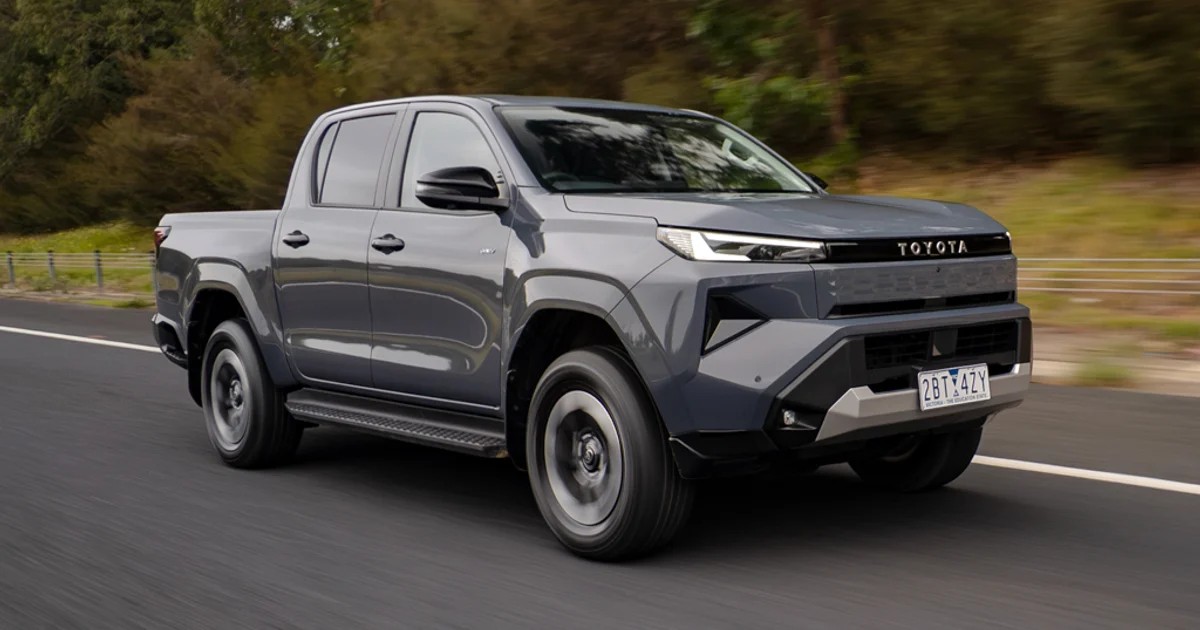
The 2026 Toyota HiLUX BEV just dropped. And no, it is not for you. Unless you wear a high-vis vest.
Toyota’s first fully electric utes isn’t designed for weekend campers or suburban dad-mobiles. It’s built for mine sites, government depots, and corporate fleets. The message is loud and clear. Go electric or stay invisible.
So why would anyone buy this thing? Early numbers give the game away. Around 300 units are already spoken for since May. Almost all of them belong to giants like BHP, Newcastle Coal Acciona Essential Energy.
Less than 10 went to private hands. That’s under three per cent. Toyota expects to move just 500 units this year. Tiny. A drop in the ocean of diesel HiLuxes.
The market speaks.
If you wanted a plug-in HiLux you’re stuck. Toyota says the technology isn’t ready for a PHEV yet. Not for payload. Not for towing. So you have the BEV. Or you have nothing.
Is the Toyota HiLux BEV worth the high price tag?
It costs more. A lot more.
Diesel HiLuxe top out at $71,000. The BEV starts significantly higher depending on spec. You are paying a premium for silence and zero tailpipe emissions.
Competition? Slim. You have the KGM Musso EV at $60k drive-away and the LDV eT70 around $92,000 plus on-roads costs. That is it right now.
MG’s U9 is coming soon. Isuzu D-MAX EV? Maybe later. But for now the electric ute field is wide open. And expensive.
Interior: Functional, not luxurious
Sit inside. It feels exactly like a diesel HiLux.
There is a small EV selector lever. That’s it. The rest is standard HiLux hardware. Hard plastics everywhere. They will survive mud and dust but they won’t win any beauty awards.
Even the SR5 trim which costs nearly $100k feels utilitarian. It has soft door trims. Carpeted floors. Leatherette seats. But compare that to a Kia Tasman which is plusher and cheaper. It stings a bit.
Fleet bosses don’t care about armrest softness. You might.
The driver seat though is a win. In the SR5 it has spill-resistant leatherette heating and power adjustment for everything including the base cushion angle. The steering wheel tilts reaches. Even if you are six-foot-two you can find a spot.
Tech that actually makes sense
Toyota is not usually known for tech excellence. They changed their tune here.
The digital dash is bright clear. Shows battery range charging stats. The central touchscreen sits high. Responsive. Wireless CarPlay Android Auto. Mandatory today. No native app ecosystem so you use what works.
Storage is a strong suit.
- Deep bin under the armrest.
- Cupholders front and center.
- Hidden compartment above the glovebox.
- Sunglasses holder overhead.
Even a 220-volt 1500-watt inverter sits in the center console. Useful for jobsites.
How does the 2026 Hilux EV drive compared to rivals?
It wakes up silently. No clatter. No roar. Just quiet power.
Disconcerting at first if you grew up with diesels. But the instant torque changes everything. 468Nm hits instantly. Smooth linear acceleration. Better than any ICE ute in traffic.
Fast charging works too. 150kW DC charge gets you from 10% to 80% in roughly 30 minutes. Home charging at 10kW AC takes 6.5 hours for a full top-up.
Here is the rub though.
Range caps at 245 kilometers. Cab chassis drop below 200. Put a heavy trailer on the hook. Load up the tray. Watch those numbers plummet.
Towing capacity? Just 2,000 kilograms braked. The diesel does 3,500. Payload tops at 725 kg. Musso EV beats it on both counts. Ford Ranger Hybrid matches it easily.
Ride comfort and off-road ability
Unloaded it bounces. Jiggles over ripples. Head toss is real in the cabin.
Load something in the back. It settles down. But you won’t enjoy long highway stretches without a load. Less comfortable than a Ranger Hybrid.
Off-road? It handles.
No low-range gearbox. But instant electric torque helps in mud and loose terrain. Full-time AWD six terrain modes. Ground clearance dropped slightly to 218mm (was 224mm). You have to watch your tires on sharp rocks.
Water fording depth is the same as diesel. Toyota claims the battery is protected against water ingress. Seems rugged enough for light trails.
But don’t take it deep. Not with that range anxiety.
What do you actually get?
Exterior changes are minor. Closed-off front grille. “Aerodynamic” 17-inch wheels. It still looks like a HiLux. Just one that doesn’t smell like diesel fumes.
Color options? Limited.
* Glacier White.
* Frosted White (+$675).
* Ash Slate (+$675).
That is it. No fancy blues or reds for your corporate fleet.
Base SR features include:
– LED headlights
– 12.3-inch dash screen
– Wireless CarPlay/Android Auto
– Adaptive cruise control
– 360-degree cameras
Step up to SR5 and you gain heated seats steering wheel power-folding mirrors better sound system. Standard safety is top-notch too. Five-star ANCAP rating. It is the first and only EV ute with this badge so far. Rivals like the LDV and Musso remain unrated.
Who really needs this ute?
Mine workers. Council employees. Construction managers.
For them noise vibration and harshness are the real enemy. Not range. Not payload limits.
This ute wins where the air needs to be clean and quiet. On site in urban centers with curfews on engine idling. It does the job. It just asks for specific conditions to thrive.
The question isn’t whether the HiLux BEV succeeds as an EV.
It is whether buyers accept the compromise.
Few will. That seems fine.
The engine doesn’t start. That is the whole point. 🌲🚚