


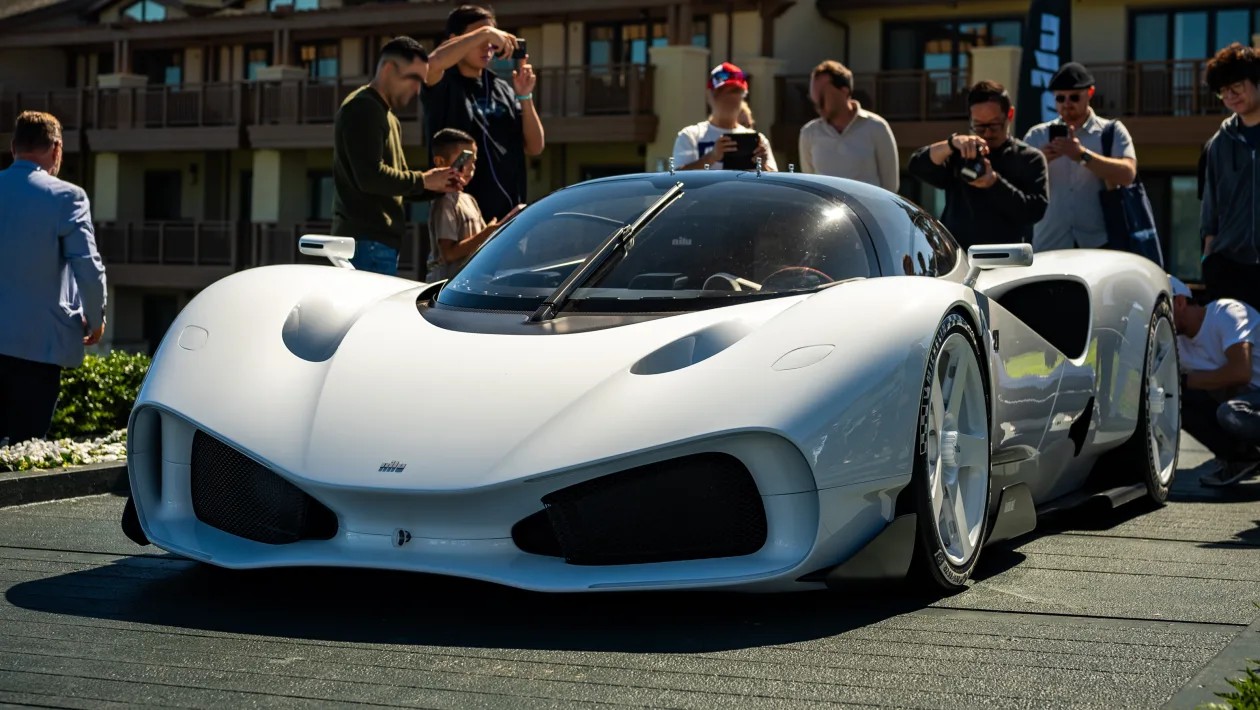
Silence is over.
For two years, the internet waited with bated breath. Nothing happened. No updates. Just rumors and concept art floating around digital spaces. That changed recently. The engine is breathing. Fire exists in the cylinder. The Nilu27 NILV hypercar just got its heart beating, and it is beating fast. Very fast.
We are talking about 11,000 rpm. Naturally aspirated. No turbos hiding behind forced induction masks. No hybrid buzzkilling the vibe. Just air and fire screaming through a 6.5-liter V12.
How the Hartley V12 outperformed its own targets
The noise matters, obviously. But so do the numbers. And those numbers broke the ceiling.
Originally, the spec sheet promised 1,055 bhp. A nice round figure for marketing purposes. Then the dyno ran. The projections were exceeded. Hard.
So now, the car holds nearly the same power output as the upcoming Ferrari F80. The F80, mind you, relies on complex hybrid systems to get there. The NILU? Pure gasoline chaos. It weighs about as much as a compact hatchback, like a Renault Clio. Put a V12 with over 1,000 horsepower in that mass equation, and things get terrifying. Quick.
The engineering credit goes to Hartley Engines. They are a small outfit based in New Zealand, which is exactly why they can make something this bonkers without corporate approval committees slowing them down. They built the bespoke mill with Hartley, and it worked.
Why choose a manual transmission in 2024
You want speed. Most people get dual-clutch boxes that shift before you think the word.
The NILU team went the other way. An open-gate, seven-speed stick. You pull the knob. You move your hand. You feel the gears engage.
It sits inside a ceramic-coated aluminum alloy subframe. All the power goes to the back wheels only. There are twelve individual throttle bodies. The layout is a hot-V design, which means the exhausts sit in the valley of the V. This swaps the traditional intake and exhaust positions to help cool the engine and make space for the “snakepit” headers. They flow directly into a tri-tip exit pipe.
Why do it this way? Packaging. Heat management. And because watching a driver shift 11,000-rev limits requires manual involvement. It’s a choice.
Hartley’s team described the first start-up moment as indescribable. They called it art. It isn’t just metal.
Design choices that prioritize driver interaction over comfort
Sasha Selipanov designed it. He has worked on the Bugatti Chiron and the Lamborghini Huracán before. Usually, he signs off on mass-produced luxury. Here, he started his own label: Nilu27. Hence the tongue-twisting full name: Nilu27 NILU
It looks wild. Gullwing doors swing up for access, much like the Aston Martin Valkyrie. Once you slide in, you are isolated. Fixed bucket seats. No adjustments.
There is no electronics on the steering wheel. Zero buttons. The wheel just steers. In front of you sit analogue dials. One screen exists inside the cabin, but only for the rearview camera. Everything else is mechanical.
This setup screams driver engagement. It asks you to be part of the machine. The chassis is a custom carbon fiber monocoque with double wishbone suspension pushed by rods. Brakes come from Brembo, carbon-ceramic because standard rotors would vaporize after three laps.
Where did the aesthetic come from? Classic American muscle mixed with modern drift cars. It makes no logical sense. That is the point.
Where production will take place and availability details
The engine lives in Germany now.
Hartley sent it to Nilu27’s facility in Lahr for final calibration. It gets installed in the first driving prototype there. This is where theory becomes pavement.
If you want one, you are in luck, and then immediately out of luck due to pricing. Only fifteen track-only versions are coming first. Fifty-four street-legal cars will follow. Total production? Sixty-nine cars.
Prices start around £3 million. That is the entry ticket. You will need more if you want any options, though the options list is likely empty given the stripped-back interior philosophy.
“This isn’t just an engine; it’s a piece of art that pushes boundaries.”
Does the name matter? Nilu27 NILU trips the tongue. It sounds clumsy. But when you hear 11,000 revolutions per minute echo off the concrete, nobody will care what the badge says. They will just feel the vibration.
The question remains. Who is driving this when they release the handbrake? And where is there enough straight road left to enjoy it before the limiter kicks in?
The engine is on. The wheels are spinning in anticipation. Wait for it.


