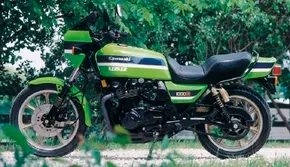
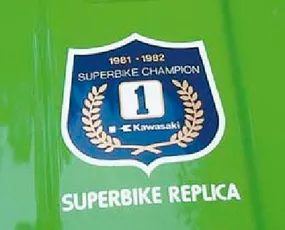
You might not know the name if you haven’t lived through the golden age of two-stroke racing, but Eddie Lawson was a monster on the track in the early 1980s. He was tearing up lap times on Kawasaki’s 250-cc competition rigs before the rules changed and he moved up to the street-based machines that would eventually birth the Superbike class. Lawson didn’t just compete. He dominated. And Kawasaki knew that winning sells bikes.
So they gave him his own badge.
The result was the 1982 Kawasaki KZ1000R. It wasn’t just a marketing stunt, though the “Eddie Lawson Replica” or ELR moniker sure felt like one. It was a direct response to the racer’s success on the track.
More Than Just a Paint Job
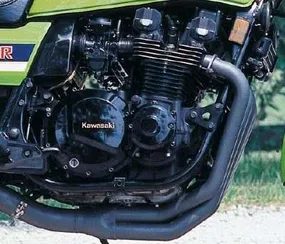
Under the tank, it was still the standard KZ1000 heart. A 1015-cc double-overhead-cam inline-four. Reliable. Punchy. But the real story was outside the metal.
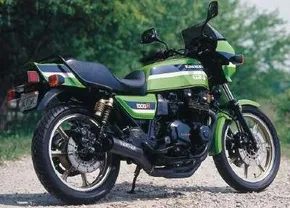
Kawasaki slapped on a special four-into-one Kerker exhaust header. Yes, Kerker. The name was so prominent it got second billing on the fuel tank, right next to Kawasaki’s own logo. It wasn’t just about noise, though. It was about presence.
The color? That classic Kawasaki racing green. It wasn’t a subtle shade. It was loud.
They also added a small bikini fairing. Did it actually help with aerodynamics at highway speeds? Probably not much. But it gave the bike a competition look that matched the racer who inspired it. The engine itself was blacked out. No chrome. Just raw, dark metal.
Suspension and Stops
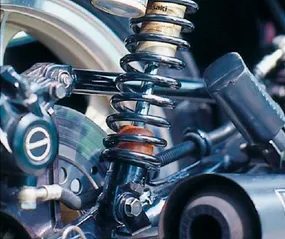
The ELR wasn’t just for show. Kawasaki stiffened the front suspension to handle the demands of serious riding. The rear shocks featured special “piggyback” reservoirs, a nod to the tech used in higher-end race bikes. This setup improved roadholding, which is fancy talk for keeping the bike planted when you’re leaning into corners at speed.
Stopping power came from triple disc brakes. Three discs. That’s a lot of rubber meeting asphalt. It brought the whole affair to a halt, quickly.
A Rare Gem
Not many of these were built. Relatively few KZ1000Rs rolled off the line in 1982. That made them rare when they were new. Today? They are virtually extinct. Finding one in original condition is like finding a needle in a haystack made of old exhaust pipes.
Kawasaki did try to revive the spirit of the ELR later on. They released the ZRX1100, an updated replica. In a way, it was a replica of a replica. But it never quite captured the raw, limited-edition feel of the original 1982 machine.
The ELR remains a specific moment in time. A bridge between Lawson’s two-stroke dominance and the rise of Superbike racing. It’s a bike that exists because a racer was too fast for his class.
Why do we still care about a bike that barely sold in its day?
Because it represents a time when manufacturers put their racers’ names on the tanks and
You cannot talk about the early eighties without mentioning the noise. Specifically, the specific, deafening roar of the 1982 Kawasaki KZ1000R. It was not just a motorcycle. It was a statement carved in steel and chrome. The name “Kerker” on the fuel tank was not a badge of honor. It was an admission of guilt. Guilt for having one of the loudest, most aggressive exhaust systems ever fitted to a street-legal Japanese superbike.
What is a Kerker Exhaust?
If you were walking the streets of Tokyo or Los Angeles in 1982, you knew it was coming before you saw it. The Kerker system was a four-into-one header. All four cylinders of the inline-four engine merged into a single, massive collector before exiting through a pair of megaphone-style mufflers. This design reduced backpressure. It also increased horsepower. But mostly, it created a sound that could be heard from three blocks away.
“The Kerker exhaust gave the KZ1000R its signature character. It was louder, faster, and far more distinctive than the stock setup.”
This was not a quiet cruiser. The KZ1000R was built for the track. And the track demands air flow. The factory understood this. They partnered with Kerker, a company known for high-performance exhausts, to create a package that blurred the line between street and race. The result was a bike that looked like it had just rolled off a pit lane.
The Engine: 1012cc of Inline-Four Power
Under the tank sat a 1012cc liquid-cooled inline-four. In 1982, liquid cooling was still a luxury. Most rivals were air-cooled. This gave the KZ a thermal advantage. It meant consistent power delivery over long stretches. The engine produced roughly 90 horsepower at 8,000 rpm. That was significant. It was enough to make you rethink your life choices if you let off the throttle too early.
The powerband was wide. You could ride it in traffic. Or you could twist the grip and watch the speedometer climb. The four-into-one exhaust was not just for show. It optimized scavenging. It helped pull exhaust gases out faster. This improved mid-range torque. It made the bike feel eager. Responsive. Alive.
Handling and Chassis Dynamics
A fast bike is useless if it cannot turn. The KZ1000R featured a double-cradle steel frame. It was not a perimeter frame like later models. But it was stiff. The suspension consisted of a telescopic fork up front and a swingarm with dual shocks in the rear. The travel was modest. The damping was firm. This was a sportbike. It was not a comfort machine.
Braking power came from dual front discs. Solid rotors. Calipers that clamped down with authority. The tires were narrower than today’s standards. But they were sticky. They gripped the asphalt. The handling was nimble. Agile. You could lean it over. Feel the tire slip. Then catch it. It was raw. Unfiltered
Where to Ride Next
The road ends here. But it shouldn’t.
Classic motorcycles aren’t museum pieces. They demand asphalt. They crave the kind of attention you get when you lean into a curve at sixty miles an hour. If you want to keep those vintage engines warm, you need a place that matches their soul.
Classic Motorcycles
Start with the archives. Not the dry specs, but the stories. Look for issues that focus on the machine itself. The smell of oil. The rattle of a carburetor. The specific click of a kickstarter. These aren’t just photos. They’re blueprints for a lifestyle. You’ll find models that defined eras. The Honda CB750. The Norton Commando. They didn’t just ride. They ruled.
How Motorcycles Work
Understand the heartbeat. A modern rider knows fuel injection. A classic rider knows the float bowl. Learn how a Mikuni carburetor breathes. Study the difference between a parallel twin and a V-twin. It’s not just engineering. It’s poetry in motion. When you know how the parts interact, you stop fighting the bike. You start dancing with it.
Other Classic Motorcycles
Don’t limit yourself to the big brands. The obscure matter. Look for the German racers. The Italian track legends. The British roadsters that survived the factory floor. Each has a quirk. Each has a secret. Find the one that feels wrong in your hands until it feels right. That’s the magic.