Modern luxury sedans are basically computers with wheels.
Processing power matters as much as horsepower. You’ve got AI assistants, digital dashes, touch-sensitive surfaces, and connectivity that feels invasive rather than inviting. Physical knobs? Gone. Mechanical purity? Extinct. Even the engines are tuned by software for maximum efficiency rather than raw joy.
Buyers accept this. Mostly.
The cabins are quieter. Safer, sure. But the car starts to feel like a tablet. No more fiddling in the driveway with mechanical bits that you could fix or adjust. The analog dream died. Or so we thought.
There’s one hiding in plain sight.
The V-8 powered luxury sedan.
Why V-8 Sedans Disappeared
For a century, luxury meant craftsmanship.
Comfort. Effortless speed that didn’t ask permission.
Then the shift happened. Tech became the proxy for prestige. More computer control equated to “better.” Sedans got squeezed by SUVs anyway, which offer that same tech feel plus headroom for kids and luggage. And V-8s?
Fuel sippers. Inefficient. Replaced by four-cylinder turbocharged units and smaller sixes. The engine bay shrank. The dashboard bloated into screens. Touch controls. Gestures. Even voice commands.
Safety is the argument. Distractions must be minimized.
But it creates a disconnect.
You feel less connected to the machine. More connected to the internet.
Younger drivers never knew the satisfying click of a toggle switch or the resistance of a rotary dial. They swipe menus. Some concepts even want to delete pedals.
To think the last tactile luxury car is gone.
It feels final.
The Digital Trap
History matters here.
Analog sedans competed on ride quality. On how good the seats were. On the silence of insulation. Today, they compete on screen size. On lighting effects.
Complexity has a cost. Not just in money but in longevity.
High-quality materials age gracefully. Digital systems decay. Software gets old. Screens need calibration. Sensors fail.
Every camera added is another point of failure. Every electronic module is a potential headache. Repairing a screen costs more than fixing a seat motor. Specialized tools needed. Dealerships charge more for this work.
Mechanical simplicity isn’t maintenance-free. But it’s predictable.
Naturally aspirated engines. Standard automatics. Straightforward drivetrains. These parts last. They are proven. They don’t require over-the-air updates to fix basic functionality. Luxury hasn’t ever been cheap, but simpler means fewer expensive variables.
The Forgotten Flagship: Infiniti Q70
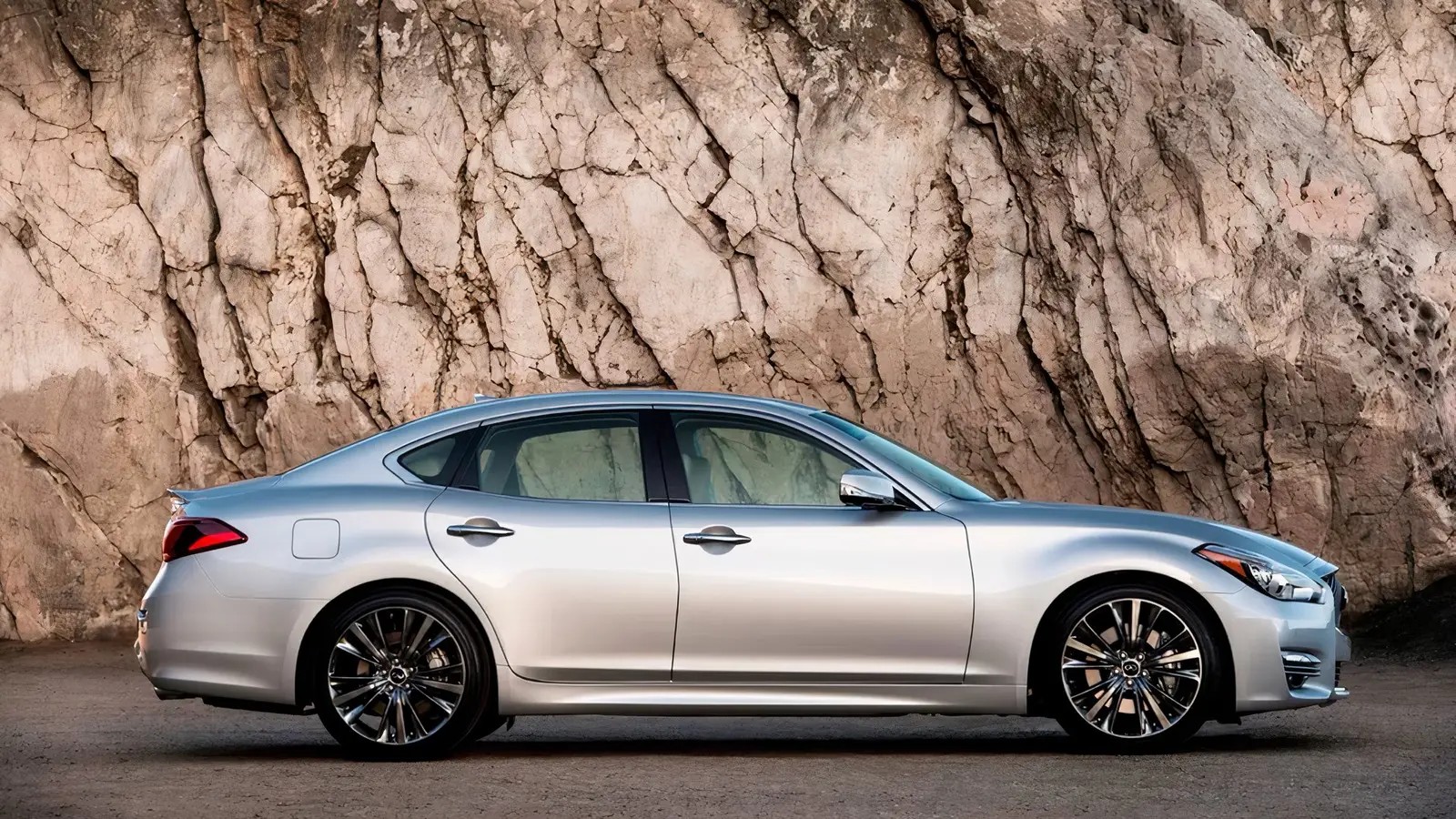
The Infiniti Q70.
You probably don’t know it well.
Launched in 2013 as a refresh of the M-Series, it became the brand’s flagship in 2015 when the Q45 ghost faded away completely. It stayed until 2019. Then Nissan pulled the plug to chase SUV profits. The sedan is dead, unless Nissan revives the Q50 concept later.
If the Q70 existed today, it would be smaller. Turbocharged. Full of screens.
Instead, we got a car that bridges the gap. It had tech-forward safety aids. Yes. But it also held onto nostalgic controls.
It didn’t shout “prestige.”
It didn’t brag about horsepower.
It just worked. And it felt good.
2019 Q70: Traditionalism Wins
The 5.6-liter version.
That’s the key. A naturally aspirated V-8 delivering smooth, linear power. No turbo lag. Just throttle in, speed out.
Inside? Restraint.
Physical buttons for the functions you use. Real dials for volume and climate.
It’s stark compared to the buried sub-menus in modern rivals.
The seats are thick, plush, and inviting. Not upright racing buckets. Not rigid sport thrones.
Serenity.
This was the goal. And after seven years, the materials hold up. The driving tech remains relevant. It’s a worthy alternative to the software-heavy cars dominating the segment now.
Pricing and Ownership Reality
Did people want it?
Initially, maybe not enough to stop the decline. Depreciation was brutal early on.
That’s good for us.
Today, prices are attractive. Range is roughly $6,525 to $26,905, depending on condition and trim.
Compare that to new German rivals? Roughly half the cost.
And repairs? RepairPal estimates about $683 per year for the Q70.
The BMW 5 Series averages $1,000.
The Mercedes S-Class hits $1,300.
Premium fuel is a factor. Tires aren’t cheap. But the mechanical complexity is lower. The risk is lower.
Sizing Matters
Where did it sit in the lineup?
Squeezed in the middle.
The Q45 was gone, leaving Infiniti without a top dog. The M56 stepped up, but it really aimed at the Audi A6 and BMW 5 Series territory. Executive cars, not flagships.
Then came the Q70L in 2 more roomier variant. Long-wheelbase.
It was bigger.
Still shorter than the S-Class.
Smaller than the BMW 7 Series.
It occupied a strange gap. Bigger than E-segment, smaller than F-segment.
But the rear seat space? Best in class for that price point. Comfort over ego.
The Comparison Game
VS BMW 540i (2019)
The Infiniti started higher in price then. Now, the used market balances it.
BMW offered choices: turbo fours, sixes, eights. Even hybrids.
Infiniti offered the 5.6L V8. Simpler. Smoother.
Interior-wise? Infiniti won on ergonomics and materials. Real buttons vs buried screens. More room, generally. The Bimmer is faster off the line, but the Infiniti is easier to live with daily.
VS Mercedes S 560 (2019)
The S-Class is the benchmark. Complex. Electronic wizardry.
The Q70L undercut the V-8 S 560 by $40,005 when new. By about $9,050 today.
Mercedes has an adaptive suspension. A more sophisticated electronic architecture.
But it is also more fragile. The Infiniti is mechanically straightforward. If you like gadgetry, buy the Merc. If you want to just drive without debugging software, pick Infiniti.
Modern Context
How does a 2019 sedan compare to a 2025 model?
Let’s say the 2025 BMW 540i.
Priorities shifted. The BMW uses a smaller electrified engine to meet emissions rules.
Inside? Big screens. Software-driven menus. You have to learn the interface.
The Q70 is driver-focused in an analog sense. Simple layout. No learning curve.
Power delivery in the Infiniti feels more effortless, more refined. Less “urgent” than the turbo-buzz of modern engines.
It’s about the ride.
The S-Class 2026 S 505 4MATIC brings more tech than ever. Adaptive systems that adjust every second.
The Infiniti brings silence. Wood grain. Leather that smells like leather.
It’s not innovative in the tech sense. But innovation isn’t always improvement.
On long highway drives, both excel. The S-Class pampens. The Infiniti resets.
Worth The Dig?
The Infiniti Q70 never got the fame.
No BMW driving badge. No Mercedes prestige aura.
That’s its advantage now.
While tech features become outdated annually, the simple mechanical comforts don’t age poorly. The leather still feels good. The buttons still work. The V8 still purrs.
As a used buy, it makes sense.
Craftsmanship. Space. Power. Reasonable repair bills.
We’re losing the physical connection to cars fast. Screens take over. Subscriptions lock features. Electrification changes the sound forever.
The Q70 offers a reprieve.
A reminder that luxury isn’t always about being smarter than the car. Sometimes, it’s about the car just being there, ready to take you somewhere comfortable, without asking you to log in first.
You lose the badge recognition. You gain the experience.
Maybe that’s a better deal than anyone expected.
Or maybe it’s just the past, politely knocking on the door before it slides shut.