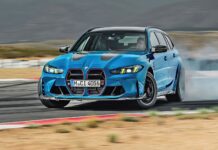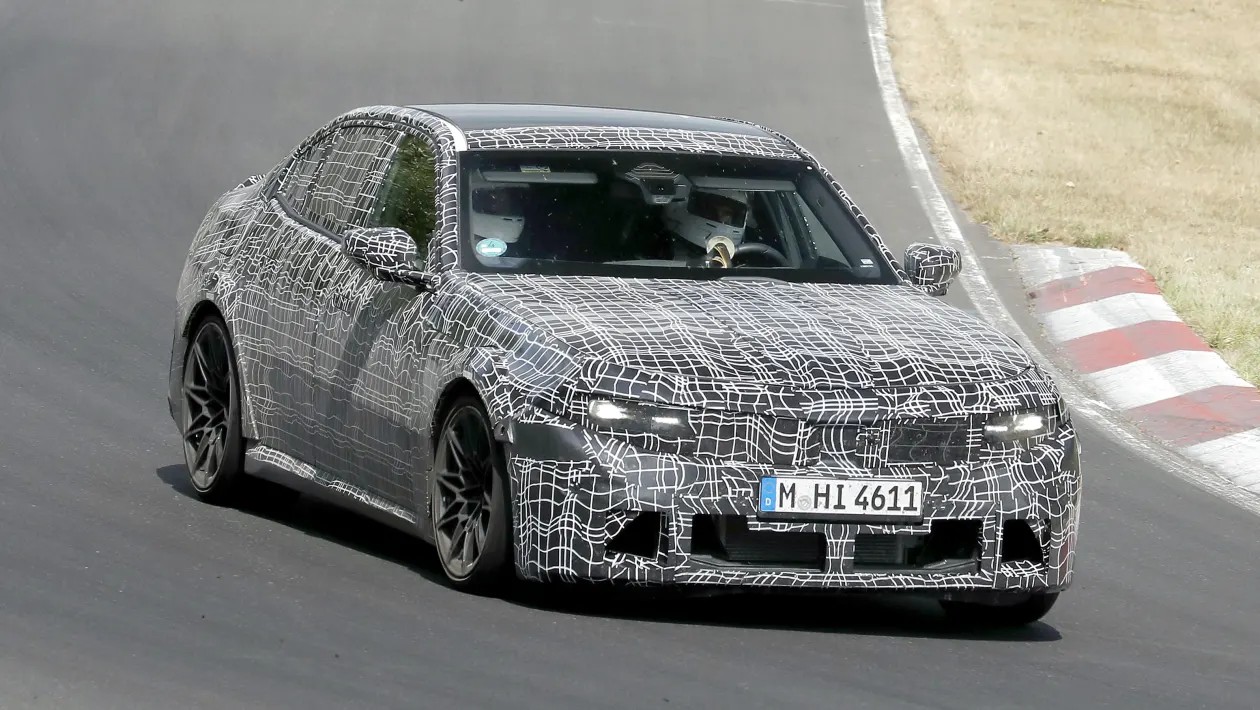
The electric future is coming. Fast. BMW’s Neue Klasse EV strategy is rolling out, with the electric i3 already hitting showrooms. But before the grid takes over the driving sport category, the internal combustion engine isn’t ready to quit yet. Spotted tearing around Germany’s Nürburgring Nordschleife is the next-generation BMW M3, running on petrol. Not plug-in. Pure combustion. It wears a mask, sure, but the shape underneath hints at the radical shift BMW is preparing for all its high-performance saloons.
For years, the M3 was a predictable evolution of its predecessor. Now? Things look different. The test mules share the ‘Neue Klasse’ design language seen on the EV concepts. Think blocky silhouettes, aggressive stances, and that polarizing twin-kidney front end which now integrates headlights directly into the blackened grilles.
But look closer. The petrol tester isn’t a carbon copy of the EV mule. There’s a distinct purpose behind the bumper’s additional cooling ducts, lower down. Why? Because a turbocharged inline-six generates serious heat. The wheelarches flare outward, housing larger brakes and wheels lifted directly from the current-gen M3. Out back, the familiar quad exhaust tips are mounted centrally. It’s a familiar sight for enthusiasts, mounted higher up than on the milder M340i, signaling exactly where you should direct your audio attention.
How the new BMW M3 handles Euro 7 regulations
This is the real story. The headline isn’t the styling—it’s the powertrain survival strategy. BMW has been quiet, but the evidence points to a continuation of the S58 straight-six, heavily modified to survive the Euro 7 emissions standards kicking in late 2024/2026 window (depending on exact legislative timing).
Enter “M Ignite.” It sounds like a sci-fi laser, but it’s actually a refined take on pre-chamber combustion. Here is how it works: each cylinder gets two spark plugs. One primary spark, one pre-chamber spark. This creates a hotter, more intense flame kernel entering the combustion chamber. Result? More efficient burning. Less soot. Less unburned hydrocarbons.
“Enables a significant reduction in fuel consumption” — BMW
Alongside the twin-spark setup, BMW has implemented variable turbine geometry in the turbos and raised the compression ratio. These changes allow the S58 engine to meet tighter regulatory hurdles without sacrificing performance. The base M2 makes 473 bhp; the CS versions of the M3/M4 push 542 bhp. Don’t expect massive horsepower jumps here. The goal is efficiency and compliance. Maybe some mild-hybrid assist will chip in, but the soul of the car remains that mechanical inline-six.
Why bother updating an engine instead of switching to hybrid or electric? Sound. Emotion. BMW M officials claim the new ignition system improves the acoustic character. Specifically at high revs and heavy load. The exhaust note reportedly gets “throatier,” more emotive. At idle or low load, it stays recognizable. This matters. To many drivers, the linear response and analog feel of the straight-six are non-negotiable.
What does the interior look like?
Inside, expect familiarity mixed with the new BMW interface trends. The bucket seats stick around. Thick-rimmed steering wheels remain standard issue. But the dashboard? Gone are the traditional split-screen instrument cluster setups found in current 3 Series models. The Panoramic iDrive display stretches across the base of the windshield. It’s wide, customizable, and dominant.
This isn’t just a gimmick. In a car where lap times, G-force data, and tyre temperatures are currency, having that data displayed clearly across the field of vision helps keep your eyes forward. You won’t need bespoke buttons for everything anymore; most functions migrate to touch or steering wheel controls, keeping the cabin relatively uncluttered. The driving modes—including things like the drift analyzer found in today’s M3—will likely integrate into this new digital ecosystem.
Pricing, competition, and the electric elephant
How much will this petrol dinosaur cost? Nobody knows yet. The electric BMW i3 First Edition starts at roughly £57,995 in the UK. The current M3 Competition xDrive kicks off at £91,455. Historically, inflation and technology upgrades add weight to the bill. A slight price increase is inevitable for the new petrol M3 compared to today’s outgoing model.
Then there’s the electric M3 shadow. The EV variant promises absurd power via a quad-motor setup. It will be lighter? Probably not initially, due to battery pack weight, though battery density improvements are real. The torque delivery will be instantaneous, brutal. The petrol M3 will rely on the S58’s linear power band and the newfound auditory thrill of M Ignite tech to justify its existence against an EV that can likely out-accelerate it off the line.
Which do you pick? The EV offers silence and snap. The petrol M3 offers drama, heat, and a connection to mechanical engineering history that Euro 7 didn’t quite erase. It’s a nuanced choice. One relies on software limits and regen braking; the other on carbon, steel, and combustion timing maps tweaked for survival.
Mercedes is playing the same game. They claim their entire internal combustion portfolio is ready for Euro 7, too. The arms race to save the gas-powered performance car is far from over. It has just entered its next phase.
So, will the petrol M3 disappear next year? No. The production schedule suggests late 2025/early 2026 launches. If you want that S58 rumble with updated tech, you might get another shot. Just prepare your wallet. The badge tax, combined with R&D for compliance, is stacking up. And unlike the electric model, the price tag won’t drop much before the curtain falls for good on the petrol era.
You can find cheaper ways into BMW performance. Older M2 models drop below £30,000 in some markets. But that’s the past. This mule on the ‘Ring is the bridge. Fragile, expensive, but burning with intent.