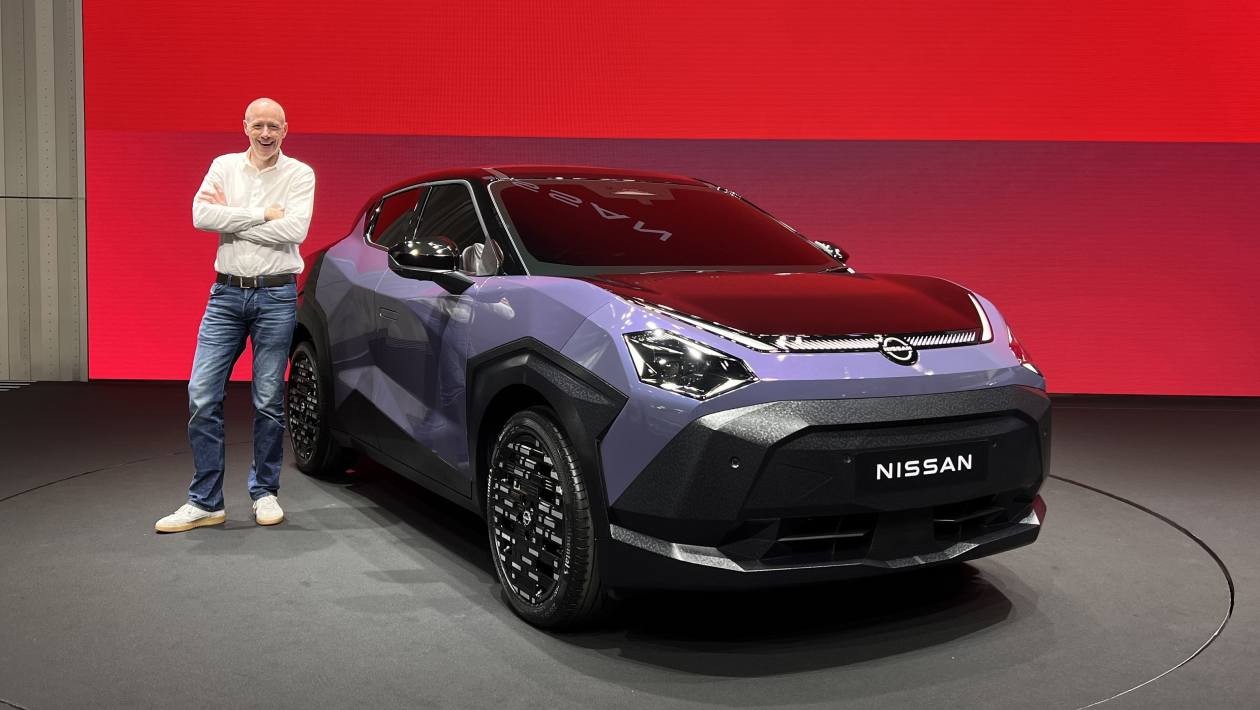
Nissan has officially pulled the covers off the third-generation Juke EV, marking a pivotal moment in the company’s attempt to reverse recent financial losses and declining sales. Revealed at a “Nissan Vision” event in Yokohama, the new electric crossover represents more than just a model update; it is a strategic effort to reclaim the “disruptive” identity that once defined the brand.
A Design Driven by “Origami” Geometry
The most striking feature of the new Juke is its radical aesthetic. Moving away from the softer lines of previous generations, the new model utilizes sharp, geometric surfacing inspired by Japanese origami.
This design choice was not without controversy. According to Nissan Europe Vice President Jordi Vila, the development process involved “polarizing” discussions regarding the car’s bold look. The complexity of the exterior—characterized by aggressive folds and creases—presented significant manufacturing challenges, yet Nissan has confirmed that the production version remains faithful to its high-concept origins.
Technical Foundations: Sharing DNA with the Leaf
While the Juke nameplate will continue to include petrol and hybrid variants, the EV version is a fundamentally different machine.
Unlike the current internal combustion models, the Juke EV is built on a modified version of the CMF-EV platform, the same foundation used for the Nissan Leaf. This shift in architecture allows for several key improvements:
- Enhanced Space: The dedicated electric platform allows for a more spacious cabin despite the car’s compact footprint.
- Battery Flexibility: The Juke is expected to utilize liquid-cooled NMC (Nickel Manganese Cobalt) battery technology, likely offering both standard and long-range options similar to the Leaf’s 52kWh and 75kWh configurations.
- Optimized Performance: While it will likely use a version of the Leaf’s integrated motor, inverter, and gearbox unit, the power output will be tuned specifically for a more “nimble” and “fun” driving experience suited to a smaller crossover.
Smart Tech and Connectivity
The interior is set to receive a significant digital overhaul. To compete in a rapidly evolving market, Nissan is integrating Google-powered software into the cabin. Key technological features include:
- Dual 14.3-inch displays for the driver and central infotainment.
- Over-the-air (OTA) updates to keep vehicle software current.
- Google Maps integration, specifically optimized to assist with navigation and minimize range anxiety by planning around charging stops.
Market Context: The Battle for the Small SUV Segment
The Juke EV enters an increasingly crowded and competitive landscape. It is positioned to go head-to-head with a new wave of electric compact SUVs, including the Renault 4, Kia EV2, Skoda Epiq, and VW ID. Cross.
By targeting “young families and empty nesters,” Nissan is attempting to capture a demographic that values both distinctive styling and high-tech utility. This move is critical for Nissan as it seeks to stabilize its market position following recent factory closures and economic headwinds.
Production Timeline
Pilot production for the Juke EV is scheduled to begin this week at Nissan’s Sunderland plant in the UK. While manufacturing is moving forward immediately, the vehicle is not expected to hit showrooms until Spring 2027.
The new Juke is a key model for Nissan Europe. We are proud we invented the crossover in Europe… this model helps us come back with a disruptive approach to the segment.
Conclusion
The new Nissan Juke EV represents a high-stakes attempt to blend avant-garde design with proven electric architecture. If successful, it could serve as the catalyst for Nissan’s broader brand recovery in the competitive small SUV market.