


Everyone loves a bargain.
I watched a guy worth hundreds of millions get genuinely giddy over free t-shirts once. So when I look at this year’s EV of the Year winner—the Bolt—I don’t see an engineering marvel. I see a deal. A massive, accessible one. But value isn’t a monolith. We threw a dozen cars around during our EV test, and several others screamed “good value” even if they didn’t win the trophy.
The average new car price is hovering near $50k these days.
Expensive EVs? Normal now. But the cars that actually got me excited weren’t the luxury flagships. They were the basics. The stripped-down versions that didn’t feel cheap. Just focused. It is surprisingly hard to build a cheap car that is actually good. Easier to dump money on chrome and screens until no one complains.
These contenders are all entry-level trims. Honest. Direct. They don’t scam you on range for the sake of a badge, but they don’t force you to cry when you hit the charging port, either.
A quick rulebook check. Our EV of the Year judging only allows cars present at the specific event. Previous losers stay dead. But for this list? I’m breaking the rules.
I want to highlight cars that echo the Bolt’s “less is more” philosophy. Some weren’t there. Some were. Doesn’t matter. Here is who else deserves a look.
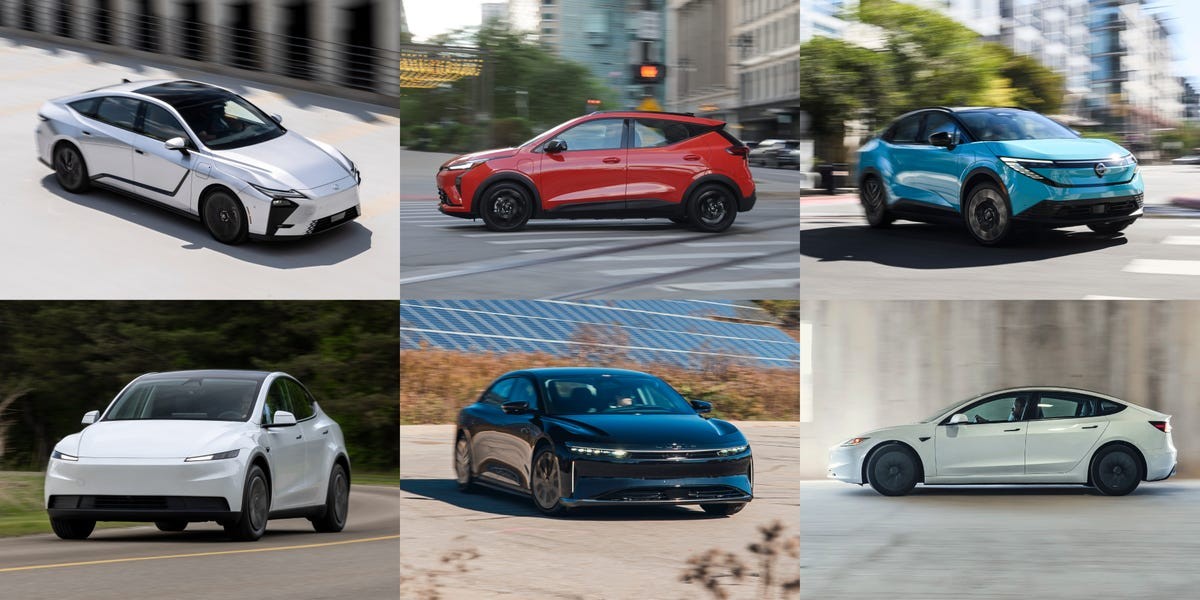
Tesla Model 3 RWD
I found genuine peace in this car.
It is the base Model 3. Rear-wheel drive, 300 hp, and it feels like it’s been refined to death—which is good, because it has been around for years. It’s light. It drives itself. The range is 321 miles according to EPA figures, and 60 mph hits in 5.4 seconds.
At $38,631, it feels like luxury goods marked down by mistake.
You don’t get a surprise here. It works. The amenities are there. It doesn’t feel like you are missing out by avoiding the pricier trims.
Lexus ES 350e
Did you expect Lexus to win on value? Neither did I.
The ES 350h (hybrid) isn’t the flashy one. It is the Premium trim. And it oozes class without screaming about it. Quiet as a grave, plush inside, and it glides like it’s on air cushions. It does 0-60 in 6.6 seconds, which isn’t fast, but it is polite. Range is 307 miles.
It costs $48,796 to start. That’s steep, sure. But for what you get? It’s almost a robbery if you look at it that way. Don’t upgrade to the ES 500e. It’s not worth it. The base model is the complete package here.
Nissan Leaf S+
New for 2026. This Leaf feels like the car the original should have been.
My favorite is the S+. Why? Price. $31,533.
Here’s the catch. Nissan didn’t bring the S+ to our test event. They brought the Platinum, which costs $40,587. So we drove the expensive one, but the idea of the cheap one is what I’m praising. 303 miles of range.
How does 300 miles for the price of a used SUV sound?
It sounds compelling. It sounds like Nissan finally learned the assignment.
Tesla Model Y RWD
The SUV version of the Model 3 logic.
Also not new. Also rear-wheel drive. Same minimalist interior that looks like a spaceship cockpit if you’re into that aesthetic. 321 miles range. 5.9 seconds to 60.
Costs $41,527. You do not need the dual-motor versions for most people. The base Y is capable enough for 99% of use cases. Stop overthinking it.
Lucid Air Pure
A rebel choice. This car wasn’t even at the event.
But I’ve had one for months. Long-term testing reveals something odd about the Lucid. People expect it to be the ultimate luxury toy. And yes, the Air Pure gets you to 420 miles per charge. The single rear motor pushes 430 hp, launching you to 60 in 4.3 seconds. It handles beautifully.
The price is $71,887.
That’s not cheap. It’s double the Bolt. But within the ultra-premium sedan market? It feels like the smart buy. The base Pure does the job. You’re paying for space and efficiency, not just status. It’s successful at exactly what it tries to do.
Maybe value isn’t about the lowest number on the sticker.
Maybe it’s about not regretting the purchase on the way to work. All these cars feel right in that way. The Bolt took the award. These five just made the road wider.
Is it enough?


