The early custom car culture was a minefield of compromises. You usually end up with one of two things: cars that look smooth from the side of the road but fall apart on closer inspection, or cars that are built with surgical precision but are somehow out of proportion. There’s a reason the first group got the derogatory nickname “leadsleds.” Their metalwork is often disorganized with excessive lead filling, hiding poor construction behind a smooth exterior. Group 2? The perfect body panel shape looks like it was drawn by someone who has never seen the actual car.
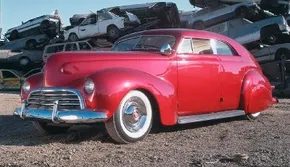
Then there is the Ohanesian 1940 Mercury.
Originally commissioned by Sacramento’s Harold “Buddy” Ohanesian, the convertible sedan completely avoided these early pitfalls. It possesses the rare combination that combines keen design with uncompromising craftsmanship. This project didn’t hit the show circuit in a box. It started in 1943 and evolved. Ohanesian actually drove the car in between fabrication sessions and lived with the machine while he lived with the machine.
Sourcing Parts and Sculpting the Body
The first redesign job came from Harry Westergard, an influential name in hot rod history. But after Westergard, the baton passed to Ohanesian’s high school friend Dick Bertolucci, who brought with him a new obsession with steel.
The front tells the story of a careful sourcing. The hood and front fenders were reshaped specifically to match the 1946 Chevrolet grille. Originally, Mercury headlight bezels were simply painted to match the body of the car, a common trick at the time. But by the mid-1950s, the look had modificationd. The headlights are a fully “frenched” design (recessed, frameless) with a subtle and attractive cove at the bottom.
Not even the roof line escaped the knife. The windshield was chopped by four inches. In order to maintain the proportions, the ventilation windows and the trim surrounding them were cut to a new height. All original chrome trim has been removed. Even the door handle is gone, its function replaced by a key solenoid mounted discreetly on the running boards.
“The highlight of this car is the beautifully crafted steel roof…a masterclass in hammer-welding and metalwork.”
Hybrid Anatomy and Hidden Details
Where did the rest of the parts come from? The rear fender skirts are lifted straight from a 1940 Packard, giving it a classic teardrop silhouette. These skirts are molded directly into the bodywork. The rear fender itself was modified to house taillights and a rear splash pan sourced from a 1942 Ford.
Bumpers are another example of hybrid engineering in action. Both were taken from a 1942 Chevrolet. The rear bumper has been reshaped specifically with exhaust outlets molded directly into the structure, ensuring that the vents do not protrude awkwardly.
The license plate also got a custom treatment. It is frenched mounted on the trunk lid and mounted behind a pane of glass. This is not just about aesthetics. Police at the time were often unhappy with this modification, perhaps because it made it harder to read license plates from a distance.
But while all of these body modifications are impressive, they’re only the beginning of this car’s true crown jewel. The roof.
This is a hand-formed steel top,
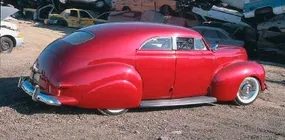
It is a seamless extension rather than an integrated frame that makes the ceiling a seamless addition to it. Achieving this required trimming the original trunk opening and completely redesigning the rear frame. It’s not a stock part anymore. This is a custom.
The ride height is where things get interesting. リアサスペンションは大幅に見直され、リアエンドは大幅に下がっさレ** C’dが使用されており、シャーシを低くするためにフレームレールが曲がtakajousi on kaarrettu, ja siinä on käänteiset silmukat ja pidemmät kahleet uuteen geometriaan. This setting lowers the ride height while maintaining the distance, but is clearly intended for a more aggressive position.
To protect the tank from high-speed road debris and collisions, a steel plate is welded to the bottom of the tank.
The front end wasn’t left out. A drop axle was installed and combined with straight springs to lower the front ride height in sync with the rear. The result is a cheaper stock Bronco with a custom hardtop that looks more factory than aftermarket.
「The top is removable, but the stitching is very good… It’s like a car’s solid parts.」
It’s not about comfort. It’s about style and presence. The suspension changes are drastic. The frame is cut. The springs are reshaped. The top is fused. This is a build that prioritizes appearance and stance over off-road performance, at least in its current form.
It’s not a question of whether it works. The question is why マロムを元时间すす.
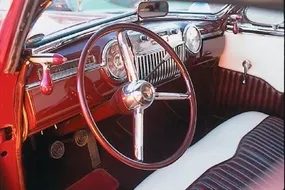
The interior renovation is extensive. Cruz removed the original dash and installed a 1947 Cadillac unit. This is followed by a custom interior that flatters the cabin, with the level of the surface hinting at careful design elsewhere.
The plan behind the scenes was simpler. Then the 1946 Mercury Flathead V8 was introduced. It becomes the heart of the machine.
Daily use and storage
Buddy didn’t consider it a museum piece for many years. He works as a daily driver for Merc. It also towed his 1933 Ford Coupe Bonneville race car. This abuse can tell something about the platform. Made to work.
In the end, the car was recovered. It remained in place until the early 1970s.
Sacramento natives Lewis Martin and Dennis Nash then took over the team. They partially restored it. It’s enough to get moving again. It is not a full recovery. A true awakening.
Hegarty’s era and extensive restoration
Ed Hegarty bought this car around 1975. He had a different take. He hoped for a full recovery. This process takes time. It took several months to complete.
The building was completed by 1996. The car debuted at the Oakland Museum’s Historic Hot Rods and Windmills exhibit. This is a big show. It takes the car to a serious stage.
Evaluation on the big stage
Mercury didn’t stay hidden forever. It appeared at the Sacramento Autorama 50th anniversary event in 2000. Bertolucci participated as a respected builder. The community recognized the effort.
Two years later, the car headed to Pebble Beach. This was Tulli’s first performance in the 2005 competition. Customs was a new category at that time. This car is also part of that history.
More info on custom cars and hot rods is below.
-
Hot Rod History
-
Customized car profile
-
hot rod profile