
In 2006, the National Highway Traffic Safety Administration released some sobering data. For every 100,000 cars on the road, about 13 are involved in fatal crashes. Motorcycles? This figure is more than 72. We all know that two wheels are more dangerous than four wheelers. This news is not new.
But this is a change. Riders are no longer helpless.
Better equipment can make a difference. High-tech body armor can reduce injuries and deaths. Let’s see what can protect you if something goes wrong.
Protect your elbows and knees
Your elbows and knees hit the asphalt first. If you want to keep using them, don’t leave them exposed. The basic jacket must have reinforced parts. This is the starting point.
If you are wearing a leather jacket, check the thickness. At least 1.2 mm? If not, you need more than just hide. Add armor over or under the jacket. This increases the distance the material has to slide before cutting into the skin.
Testing standards are more important than marketing claims. The National Highway Traffic Safety Administration has not set a gold standard for this gear. Europe does.
**CE-certified protectors. This applies to elbows, knees and other parts of the body. What does certification mean? When the testing body smacked the front part of the armor, the force measured on the rear part was on average less than 35 kilonewtons. This is a standard measure of force. Less force means less damage to bones.
Chest protector
Chest protectors aren’t just for motocross. Street riders also need body protection.
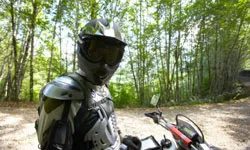

Chest protection mechanism
Stop thinking of chest armor as fashion. The sculpted “chiseled abs” you see on some high-end jackets are mostly aesthetic marketing. Real protection looks boring. It looks like a hard shell strapped over thick foam.
The physics are simple. A hard outer layer is needed to spread the impact over a wider area. There needs to be a dense cushion underneath to really absorb the energy. Jumping over the shell compresses the pads and puts pressure on the ribs. If you leave out the padding, the shell simply transmits the shock directly to your sternum.
You don’t need NASA-grade composite materials to do this. A basic hard plastic sheet works. Aluminum honeycomb. Even thick, dense foams work if supported with semi-rigid inserts. However, this combination is non-negotiable. Hard surface to disperse. Soft interior to dissipate.
“Make sure your chest protector has two things: a hard shell to distribute the force and a pad to absorb the force.”
Price doesn’t matter here. A $20 insert and a $200 integrated plate serve the same basic purpose. Don’t be swayed by marketing that claims a material is “superior” without explaining how it transfers kinetic energy. It’s not armor unless it’s solid on the outside and soft on the inside. It’s just upholstery.
8: Neck Collar
The neck is not just for holding the helmet in place. This is a structural weakness. While we worry about whiplash, the real victim in many low speed accidents is the clavicle.
Here is the anatomy of a mistake: You slip. Instinctively, you reach out to catch yourself. The impact is transmitted to the arm and all the energy is transferred to the clavicle. Snap.
Or you turn your shoulder into a curb. Direct impact. The collarbone breaks again.
Most armored jackets today include some form of neck or collar extension. Think of it like a ox yoke. It limits the distance your head can move forward and provides cushioning for the shoulders. It doesn’t stop the arm-extension break, it can help reduce direct impact on the shoulder.
The high-tech solution is stabilization. BMW and KTM have collaborated on a system designed to lock the cervical spine in place in the event of a crash. The idea is to prevent the gap between the hard helmet and the hard body armor from becoming a pivot point. If your head continues to move after your body stops, you may have a spinal injury. These systems aim to keep the head and shoulders to move as one unit.
Traditional neck rolls are low-tech. These are basically thick foam bumpers sewn into the collar. They won’t save your spine, but it reduces the range of motion. Less movement means less strain on ligaments and muscles. For most riders, the padded collar is sufficient for minor scrapes and low-speed tumbles. However, if things don’t go well, you have to rely on luck and the integrity of your collarbone.
7: Gloves
Gloves are the most overlooked piece of protective equipment. Buy expensive boots. We wear armored jackets. Next, wear thin leather gloves, or worse, no gloves at all.
This is a mistake. Hands are small, fragile and incredibly complex. Each hand has 27 bones. Tend

6: Legs
I know what to do. If you watch enough footage of high-speed wrecks, you know that. Riders spread their arms and legs like starfish and fly through the air. Next is the effect. Limbs just don’t bend. They snap. It’s visceral. Too ugly.
In the early days of motorcycle safety devices, engineers tried to solve this problem by turning the lower body into an exoskeleton. The goal? Restrict joint movement of the joint so that the leg can only bend in the anatomically intended way. They believe that rigid support prevents disintegrateage. They were wrong.
This is a counter-intuitive reality. Over-strengthening the legs can actually increase the rider’s overall trauma. Why? Due to the ejection dynamics and the torso pitch.
Picture this. You hit the pavement. If your legs are locked tight, they act as levers. Instead of bending to absorb kinetic energy, the stiff limbs throw the upper body like a rag doll. The force transfers upwards. You take a beating that could have been avoided if I had bent my knees a little.
Regardless, you still need armor there. Road rash are a danger that cannot be ignored. You need a material that won’t disintegrate on asphalt. Thick leather is standard. Kevlar blends are also work too. But materials alone are not enough.
Protecting the lower body requires a dual-layer approach. The hard outer shell spread the impact over a wide area. The soft padding underneath absorb what of the shell. Don’t skimp on this. Your femurs is not made of steel.
5: Boots
This is the tricky. Many riders consider boots an afterthought. They grab whatever fits and hope for the best. Bad move.
Crashes are more than just sliding. It’s about twisting. The ankle is a complex hinge. Not designed for lateral rotation. When you slide at high speed, your legs are pinned to pegs or the ground. The bike keeps moving. You don’t.
The result? A broken ankle. The most common injury in motorcycle crashes.
So what are you looking for? More than just style points. function.
First, check the ankle cup. It must be rigid. This is where carbon fiber inserts come in handy. They prevent that sideways roll, which can tear ligaments like a dry twigs. But don’t let it go so bulky that you can’t shift gears. You have to feel the pedals. You have to pivot.
Second, look at the toe box. It should be reinforced. Not only can it slide, but it can also be crushing. If you go over, the bike lands on you. A reinforced toe box distributes the weight. Prevents your toes from being pulverized.
Third, consider closure system. Zippers are very convenient. Velcro is easy. But what about the buckle? The lock stays in place. You don’t want your boots coming open when you’re skating 60 miles an hour. A secure lock keeps the armor in place.
Some boots have anti-slip pads on the calves or calves. These are all good things. The leather is not crushing as it is subject to wear and tear. Think of them as a sacrificial layer. It must be replaced after a crash. It is part of the cost of doing business.
There is also the issue of rigidity. The hard sole improves the precision of the gears. Transfers power directly to the pedals. But it can also be uncomfortable
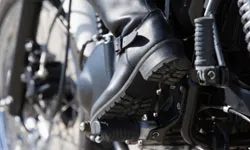
Boot construction: Plastic Triumph
Gear discussions often end at the knees, but start at the feet. Street riders and racers face different needs here. Competition shoes are made of hard plastic or composite shell. You can slide on the pavement without getting caught. Protect your ankles. Street boots are soft. Very comfortable. However, they offer less protection when sliding.
Plastic always wins over leather. You need stiffness. You need impact absorption. Flexible boots fail at a critical location. The high-tech composite material stabilizes your feet. This can help prevent twisting injuries that can put a rider out of action for months. Let’s go big. Go rigid.
Hip Armor Importance
Online forums often ask about the need for hip protection. The answer is simple. Protect the parts you want to keep. Hip fractures are the rank just behind after clavicle fractures. When the lower body hits directly, the force is transmitted directly to the pelvis. We slide more than we realize.
Watch the crash video. More than half of the riders end up dragging their rear ends. Jeans offer zero resistance to asphalt. Road rash penetrates fabrics like mist. You need hard armor. Riding pants with built-in hip pads work well. Separate hip inserts also work. Better to layer your protection than hope for luck.
Jacket material
Leather has a history. Look the part. It breathes. But it tears. Kevlar and Cordura fabrics have changed the game. They resist abrasion better. They are lighter. It dries faster. Modern jackets skillfully combine these materials.
Areas abrasion zones have been reinforced. Elbows and shoulders take the most strain. Armor placement is important. CE-rated protectors save bones in these areas. It doesn’t prevent all damage. But they reduce the severity. Soft lining adds comfort. The hard shell prevents sliding friction. The best jackets balance flexibility with rigid protection. Don’t sacrifice coverage for style.
The science of liquid armor
Maybe you already have a motorcycle jacket. If not, you should. The market is full of options from ridiculous to absurdly safe. You’ve probably seen denim jackets with leather elbow patches. Looks great on the poster. They offer no protection at all.
And then there’s the other end of the spectrum. Thick leather, reinforced with a carbon fiber subframe and a hard plastic shell. This is the starting point. But the real innovation isn’t inside the shell. It’s in the padding.
Enter a non-Newtonian fluid. Especially the polymers used in modern impact protectors. You know the cornstarch test. If you stir it gently, it flows. If you hit it with a hammer, it will immediately turn to stone. This is the principle. Materials such as D3O or similar viscoelastic polymers are flexible at rest. They don’t restrict movement. You can bend, twist and reach without feeling stiffness.
Then, boom.
Impact happens. The molecules lock together instantly together. The force is distributed over a wider area instead of being concentrated on one bone. This is not magic. This is chemistry. It’s available today. Don’t settle for just memory foam if you have adaptive rigidity.
Why does the thoracic vertebrae need hard armor?
A broken arm. My leg is broken. my collarbone snapped like a dry twig. finger? Forget it. Almost all bone injuries can heal except one. The spinal cord does not regenerate. Not yet. Not for a long while.
So you have to protect it.
Start at the neck. Neck guards are not negotiable. It limits hyperextension and keep head and shoulders aligned during impact. However, the neck is only the entrance. A really dangerous area is the mid-back.
A landmark study in 2002 revealed some grim statistics. The thoracic vertebrae is the most common site of spinal injury in motorcycle accidents. This area extends from the shoulders to just below the rib cage. It is the structural backbone of the body. If something goes wrong, the consequences are life-altering.
Soft armor alone is not enough for this. Foam compresses. Yes, it absorbs energy, but bottom out. Requires rigidity. A hard shell is needed to distribute the impact energy to the rib cage and vertebrae.
This armor comes in two forms. The integrated back protector is built directly into the jacket’s chassis. They stay in place. They don’t ride up. Then there is a strap-on back protectors. It looks like a small backpack with straps. They are easy to remove. They are easy to store. But they can shift. If the armor moves during the slide, it will expose the area you were trying to protect.
Helmet: your first and last line of defense
Let’s talk helmets. This is the only way to prevent your brain from turning into a pancake.
Most riders treat helmets as a commodity. They buy things that look good. They buy the one that fits. They rarely look at certification labels. However, not all helmets are created equal.
Understanding Certifications
You need to know what you are buying. The standards are very strict.
- DOT (Department of Transportation): The federal minimum. This is a self-certification process
Definitely number one priority
You can have a lot of likes and dislikes. Some may argue that leather jackets and reinforced boots count as “protective gear”, but foam lining and hard shells do not. But let’s be honest. If the list is sorted by survival probabilities, there is no argument. The helmet sits at the top. This is more than just a suggestion. It is the single most effective piece of gear you can wear.
Data doesn’t lie. It hits you in the face.
**Using a helmet reduces your risk of dying in a crash by 37%. **
This is no small benefit. This corresponds to almost two fifths of the lives saved. When the asphalt comes, that extra percentage point can be the difference between going home to your kids and the statistics on the coroner’s report.
Then came the financial blow. Do you think it will be covered by insurance? Let’s think again. Riders who suffer serious head injuries pay an average of $43,214 for hospitalization. Compare this to a tag of $15,528 for someone with a mild head injury. The delta is stark. The difference between a mild concussion and a catastrophic brain injury can cost about $30,000, not including lost wages and long-term recovery costs.
But the costs are not just financial. This is a social thing. Let’s see what happens when there are no rules. Even if states repeal helmet laws, the number of deaths just won’t increase. It skyrocketed.
Motorcycle deaths increased from 2,897 in 2000 to 5,154 in 2007.
This is an 78% increase.
Within 7 years. Almost twice as much. The correlation between the lack of mandatory helmet laws and the rapid increase in rider deaths is undeniable. This trend has been clearly documented by The Advocates for Highway and Auto Safety and researchers such as Wald and Workman. Science has figured it out.
This has nothing to do with fear. This is all about physics. Your skull is fragile. Your brain is soft meat floating in liquid. The helmet is a cushioning material. It absorbs energy that would otherwise be transmitted directly to the nerve tissue.
So why are you still reading this article?
If you’re not wearing a DOT approved helmet, you’re playing a game you can’t win. A helmet is the most important protection on a motorcycle. Period. There are no lower levels. There is no such thing as “maybe later”.
“A helmet is the most important protection on a motorcycle.”
The rest of the equipment is important. clearly. Boots, gloves, coats, they all have their place. Protects skin, calves and elbows. But what about the head? The head is the command center. If you lose it, the rest of the bike is irrelevant.
If you want to learn more about motorcycle safety technology, from airbag vests to advanced braking systems, there are plenty of resources. Don’t get distracted by the shiny new toys though. Let’s start with the basics. helmet.
It’s a no-brainer. literally.