There are almost as many four-wheel-drive architectures as there are vehicles equipped with them. Every manufacturer seems to have a preferred method for shunting power to the pavement. The marketing language is often murky. Before diving into the mechanics, we need to untangle the terminology. It’s a mess.
The term four-wheel drive is usually shorthand for a part-time system. You don’t use this on dry asphalt. It’s designed for low-traction scenarios. Snow. Ice. Mud. Engaging front and rear axles simultaneously on grippy roads can cause binding. That breaks things.
All-wheel drive tells a different story. Some call it full-time four-wheel drive. These systems are engineered to handle every surface. On-road. Off-road. They rarely let you switch them off. The goal is consistent power distribution regardless of conditions.
Both part-time and full-time setups can be judged by the same metric. The ideal system sends the exact right amount of torque to each wheel. Specifically, the maximum torque that won’t trigger a slip. That’s the limit. Exceed it, and you lose traction.
We’ll start with the fundamentals. Traction is the baseline. We’ll look at the components that make up these drivetrains. Then we’ll examine specific implementations. The Hummer, built for GM by AM General, offers a interesting case study.
Understanding torque is non-negotiable here. So is traction. And wheel slip. You can’t grasp the engineering without knowing how these forces interact.
The Grip Limit
Torque is the twisting force the engine generates. It’s the raw power that actually moves the vehicle. The transmission and differential gearsets multiply that torque before splitting it between the wheels. First gear multiplies more than fifth gear because the gear ratio is steeper.
Think of engine output as a bar graph. There’s a specific line on that graph representing the threshold of wheel slip. A good launch stays below that line. The tires stick. A bad launch exceeds it. The tires lose grip and spin. Once slip starts, torque delivery drops toward zero.
Here is the catch: in low-traction scenarios, the engine doesn’t dictate how much torque reaches the ground. Traction does. You could bolt a NASCAR engine into a sedan, but if the tires can’t stick to the pavement, that horsepower is useless.
We define traction as the maximum force the tire can transfer to the road. Or vice versa. It’s an action-reaction pair. Three main factors dictate that limit.
Weight on the tire. More load equals more grip. Weight shifts constantly. Turning pushes mass to the outside wheels. Accelerating sends it to the rear axle. Braking dumps it forward.
Coefficient of friction. This number relates friction force to the normal force holding surfaces together. It depends on the rubber compound and the road surface. A slick NASCAR tire on dry concrete has a massive coefficient of friction. That’s why they can carry insane speed through corners. Put that same tire in mud, and the coefficient plummets. Conversely, knobby off-road tires have mediocre grip on pavement but excel in dirt.
Wheel slip type. Tires interact with the road in two modes: static and dynamic.
- Static contact. The tire rolls without slipping relative to the road. Static friction is higher. This provides superior traction.
- Dynamic contact. The tire is sliding. Dynamic friction is lower. You lose grip.
Wheel slip happens when applied force outpaces available traction. Force comes from two directions.
- Longitudinal. The engine or brakes apply torque. This accelerates or decelerates the car.
- Lateral. Cornering creates sideways force. The tires must fight to change direction.
Imagine a powerful rear-wheel-drive car on a wet curve. The tires have enough lateral grip to hold the line. Floor the accelerator mid-turn. Now you’re dumping longitudinal torque into the rear axle. Add that longitudinal force to the lateral force. If the sum exceeds the total traction limit, you’ve got wheel slip.
Most drivers never exceed traction on dry asphalt. Maybe on flat, wet roads too. This is why four-wheel drive systems shine in low-traction environments like snow or slippery inclines.
The logic is straightforward. Using four wheels instead of two doubles the potential longitudinal force. It doubles the traction pool.
This helps in specific conditions:
- Snow. Pushing through snow requires massive force. Two-wheel-drive cars stall if the snow gets deeper than a few inches because each tire has minimal grip. Four-wheel drive utilizes all four tires to claw forward.
- Off-road. Mud, rocks, or stream crossings often leave at least one axle without grip. Four-wheel drive keeps power flowing to the tires that still have contact.
- Steep hills. Climbing requires sustained traction. All four tires working together pull the vehicle up where two might dig in.
Four-wheel drive isn’t a magic wand. It offers zero advantage for stopping on ice. That’s purely the domain of brakes and the anti-lock braking system (ABS).
Understanding the physics helps. Now let’s break down the hardware that makes it work.
Components of a Four-wheel-drive System
The Mechanical Heart of Traction
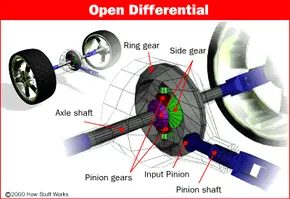
You can’t talk about getting power to the ground without starting with the differentials. Every four-wheel-drive setup relies on two of them: one sitting between the front wheels, another between the rear. Their job is simple in theory, complex in execution. They take torque from the driveshaft or transmission and hand it off to the wheels. But they do something else just as important. They let the left and right wheels spin at different speeds.
Think about a tight corner. The outside wheels have to travel further than the inside ones. If those wheels were locked together on a solid axle, the tires would scrub. They’d hop. They’d lose grip. The differential solves that geometry problem. It allows the speed difference between the inside and outside wheels without sacrificing power delivery.
In all-wheel-drive systems, handling the speed variance between the front and rear axles falls to the transfer case. We’ll get to that next. But for now, focus on the differential’s role in cornering. Without it, you’re dragging rubber down every turn.
Not all differentials are created equal. The type you have changes how your vehicle uses available traction. Some are open. Some lock. Some limit slip. This distinction matters more than most drivers realize. See How Differentials Work to see exactly how these components manage power split under load. The difference between a truck that plows through snow and one that just spins tires often comes down to this single mechanical choice.
Transfer Case Mechanics
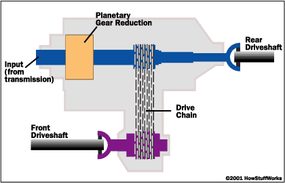
The transfer case isn’t just a box of gears; it’s the traffic cop for your powertrain. Its job is simple in theory: split torque between the front and rear axles. But how it manages that split defines whether your drive train survives or snaps.
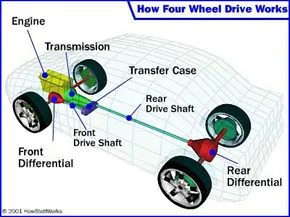
In an all-wheel-drive (AWD) setup, the transfer case must allow the front and rear axles to spin at different speeds. Why? Because the car is turning. If the front and rear wheels were locked together rigidly, the drivetrain would bind up the moment you hit a corner. To prevent this, the transfer case houses a center differential, a viscous coupling, or a similar gearset. These devices let the front and rear axles rotate at slightly different speeds while still sending power to both. It’s what lets AWD cars handle dry pavement without chewing through their own components.
Part-time four-wheel-drive systems work differently—and more brutally. Here, the transfer case locks the front and rear driveshafts together. They spin at the exact same speed. No slip allowed.
This seems fine until you hit a dry, high-traction surface like concrete. On dry asphalt, tires don’t want to slip. They want to grip. When you engage part-time 4WD on dry pavement, the wheels are forced to spin together while the car is turning. The inside wheel wants to travel a shorter distance than the outside wheel. Since the transfer case won’t let them rotate at different speeds, the drivetrain fights itself. You get “wind-up.” The result is jerky handling, binding, and rapid wear on tires and drivetrain parts. That’s why part-time 4WD is strictly for low-traction scenarios—snow, mud, gravel—where tires can slip freely to accommodate the difference in wheel speed.
Some transfer cases go a step further, offering a low range gearset. This isn’t for speed; it’s for torque multiplication. By engaging an extra set of gears, the system dramatically reduces output speed while boosting torque at the wheels. In first gear low range, you might crawl at a top speed of 5 mph (8 kph), but the force delivered is immense. It’s the difference between spinning out on a rock and crawling over it smoothly. Essential for steep climbs or technical off-road trails.
Locking Hubs: Decoupling the Drivetrain
Each wheel is bolted to a hub. In part-time 4WD trucks, that hub isn’t just a passive connector. It’s an active switch.
When you’re driving in two-wheel drive, the front wheels are still connected to the front differential, half-shafts, and driveshaft. That means those components are spinning even when they aren’t providing power. Friction. Heat. Wear.
Locking hubs fix this. They disconnect the front wheels from the drivetrain when 4WD isn’t needed. This stops the differential, half-shafts, and driveshaft from spinning in 2WD mode. The result? Less rotational mass to spin up, less wear on bearings and gears, and better fuel economy.
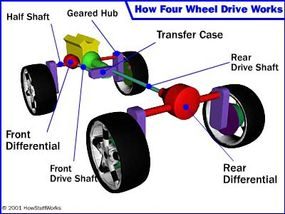
Older trucks used manual locking hubs. To engage them, you’d have to pull over, get out, and physically turn a knob on the front wheel until it clicked into place. It was a ritual. It ensured engagement before you even tried to move.
Modern trucks use automatic locking hubs. You flip a switch in the cabin, and a sliding collar inside the hub engages, locking the half-shaft to the hub. Often, you can do this while moving, though some systems still recommend stopping for full engagement. The mechanism is the same regardless: a sliding collar that physically locks the front half-shafts to the wheel hub, ensuring power gets to the tire only when you want it there.
The Electronic Brain
Hardware is only half the battle. Modern four-wheel and all-wheel-drive vehicles rely heavily on electronics to manage traction.
Many cars now use the ABS system for brake-traction control. Instead of relying solely on mechanical differentials or clutches, the computer detects when a wheel is starting to skid or lose traction. It then selectively applies the brakes to that specific wheel. This mimics a locking differential, sending power to the wheel with grip. It’s not as robust as a mechanical locker, but it’s effective for everyday slip conditions.
Other systems use sophisticated, electronically-controlled clutches. These can vary torque transfer between wheels in milliseconds, adapting to surface changes faster than a driver—or a mechanical viscous coupling—ever could. We’ll dive deeper into one specific advanced system later, but the trend is clear: electronics are taking over the mechanical heavy lifting.
Before we look at those complex systems, let’s ground ourselves in the basics. How does the most fundamental part-time 4WD system actually move power from the engine to the ground?
Four-wheel Drive Differential
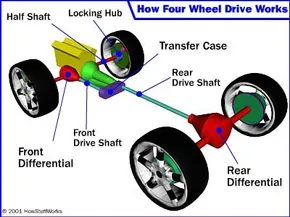
Most traditional four-wheel-drive pickups and older SUVs rely on a part-time system. These vehicles are fundamentally rear-wheel drive. The transmission connects directly to a transfer case. That case splits power between two driveshafts. One spins the front axle. The other spins the rear.
Engage four-wheel drive, and the transfer case locks the front and rear driveshafts together. Each axle gets half the engine torque. The front hubs lock simultaneously.
The front and rear axles use open differentials. This setup offers better traction than two-wheel drive. But it has two major flaws. You already know the first: you can’t use it on dry pavement. The locked transfer case forces the axles to spin at the same speed. That causes binding on high-traction surfaces.
The second flaw lies in the open differentials. An open differential splits torque evenly between the two wheels on an axle. If one wheel loses grip or lifts off the ground, torque to that wheel drops to zero. Because the split is equal, the other wheel also gets zero torque. Even if the other wheel has perfect traction, no power reaches it.
Part-time 4WD systems often fail because they send torque based on the wheel with the least grip.
The ideal system sends the maximum torque to each wheel without causing slip. This basic setup performs poorly by that standard. It limits torque to what the slipping tire can handle.
You can improve this. Swap the rear open differential for a limited-slip unit. This ensures both rear wheels receive some torque. A locking differential is another option. It locks the rear wheels together. Each wheel then accesses all incoming torque, even if one is off the ground. This boosts off-road performance significantly.
The Hummer’s Approach to Traction
We will now examine what might be the ultimate four-wheel-drive system: the one found in the Hummer.
How the Hummer’s Transfer Case Actually Works
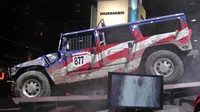
The AM General Hummer isn’t just a truck with a fancy coat of paint. It’s a mechanical beast that marries heavy-duty hardware with electronics to deliver what is arguably the most effective four-wheel-drive system on the market. And it all starts in the transfer case.
Most basic off-roaders use a system that locks the front and rear axles together automatically. The Hummer does something smarter.
Here’s the setup: transmission hooks to transfer case. From there, one driveshaft runs forward to the front axle. Another runs back to the rear. Simple enough. But here’s the twist. The transfer case doesn’t force the axles to spin at the same speed by default. Inside sits a set of open-differential gears. They can be unlocked. Or locked. By the driver.
When unlocked, the front and rear axles move independently. This means you can take the Hummer onto dry pavement without fighting the drivetrain. No binding. No breaking components. Just smooth driving.
But flip the switch. Lock it.
Suddenly, the open differential clamps down. The front and rear axles are tied together. Both get access to the engine’s torque. This is where the magic happens.
Imagine this scenario. You’re crawling over some gnarly terrain. The front wheels drop into a patch of quicksand. In a standard system, those wheels spin. Power is wasted. The Hummer changes the math. Because the differential is locked, the rear wheels grab the torque that the front wheels can’t use. The rear wheels push. The front wheels… well, they’re stuck in the mud. But the vehicle still moves forward.
It’s not just about power. It’s about distribution. The Hummer’s system ensures that every bit of torque is sent where it’s needed. If the front has grip, it gets torque. If the rear has grip, it gets torque. If only one end has grip, it gets all the torque.
This isn’t theoretical. It’s engineering. And it’s why the Hummer can go places other trucks can only dream of.
“If the front wheels are in quicksand, the rear wheels get all of the torque they can handle.”
That’s the key takeaway. The Hummer doesn’t just send power to all four wheels. It sends power to the wheels that can actually use it. The rest get left behind.
Is it complicated? Sure. The electronics read wheel speed, traction, and driver input. The mechanics translate that into action. The result? A vehicle that doesn’t just drive on the ground. It conquers it.
And it’s not just about going fast. It’s about going through. Over rocks. Through mud. Across sand. The Hummer’s system adapts. It doesn’t fight the terrain. It uses it.
Think about that for a second. Most four-wheel-drive systems are passive. They react. The Hummer’s system is active. It anticipates. It prepares. It waits for the moment when the front wheels lose grip. And then it strikes.
It’s a dance of torque and traction. And the Hummer leads.
The Torsen Advantage and Brake-Lock Logic
Both the front and rear axles in the Hummer use Torsen® differentials. This isn’t just marketing fluff. These units feature a specific gearset that reacts instantly to torque changes. When one wheel begins to slip, the system detects the drop in torque and shifts power to the wheel with grip. It can redirect torque at a ratio of two-to-one up to four-to-one. That is a massive leap forward compared to open differentials, which simply send power to the path of least resistance. But Torsen units have a hard limit. If a wheel loses contact with the ground entirely, the other wheel gets nothing. Power goes to the air. Zero traction. Zero forward motion.
To solve this dead-end scenario, the Hummer employs a brake-based traction control system. It’s a mechanical workaround for a physics problem. When the sensors detect slip, the brakes clamp down on the spinning tire. This serves two immediate functions. First, it stops the wheel from wasting energy spinning in the void. It forces the tire to bite into the surface. Second, it creates a load on that axle. That load tricks the Torsen differential into sending torque to the other wheel. The system multiplies that applied braking force, feeding two to four times the torque to the grippy tire. For the Hummer to truly get stuck, all four wheels must lose traction simultaneously. Any single point of contact is enough to keep moving.
Real-World Torque Distribution
The brake traction control doesn’t just moderate slip. It actively drives torque distribution. By applying significant braking force to a slipping wheel, the system forces the Torsen unit to react. The result is a massive surge of torque sent to the tire that actually has traction. In extreme cases, the system can channel nearly all available power to a single wheel. If that one tire holds, the Hummer moves. This behavior aligns closely with the theoretical ideal for four-wheel drive: a system that delivers the maximum possible torque to each tire based on its available grip. It’s not about equal split. It’s about effective split.
The engineering here prioritizes function over symmetry. Open differentials fail because they assume both wheels have equal grip. Locked differentials fail because they ignore the difference between road and trail. The Hummer’s hybrid approach uses braking to simulate a lock when needed, then relies on the Torsen gears to manage distribution under normal conditions. It’s a layered solution. The brakes handle the edge cases. The gears handle the everyday drift. Together, they create a drivetrain that stays mobile where others stall.
Why This Matters for Off-Road Capability
Most drivers never think about torque distribution until they’re stuck. Then they learn the hard way how fragile standard differentials are. The Hummer’s setup removes that vulnerability. By combining mechanical torque biasing with electronic braking intervention, it covers every failure mode. Wheel on a rock? Torsen handles it. Wheel in a mud hole? Brakes lock it up, Torsen routes power elsewhere. Wheel hanging in the air? Brakes stop the spin, Torsen pushes the grounded wheel. The system doesn’t just react. It anticipates. It calculates the path of least resistance and blocks it.
This isn’t just about getting out of a ditch. It’s about confidence. You can trust the drivetrain to find