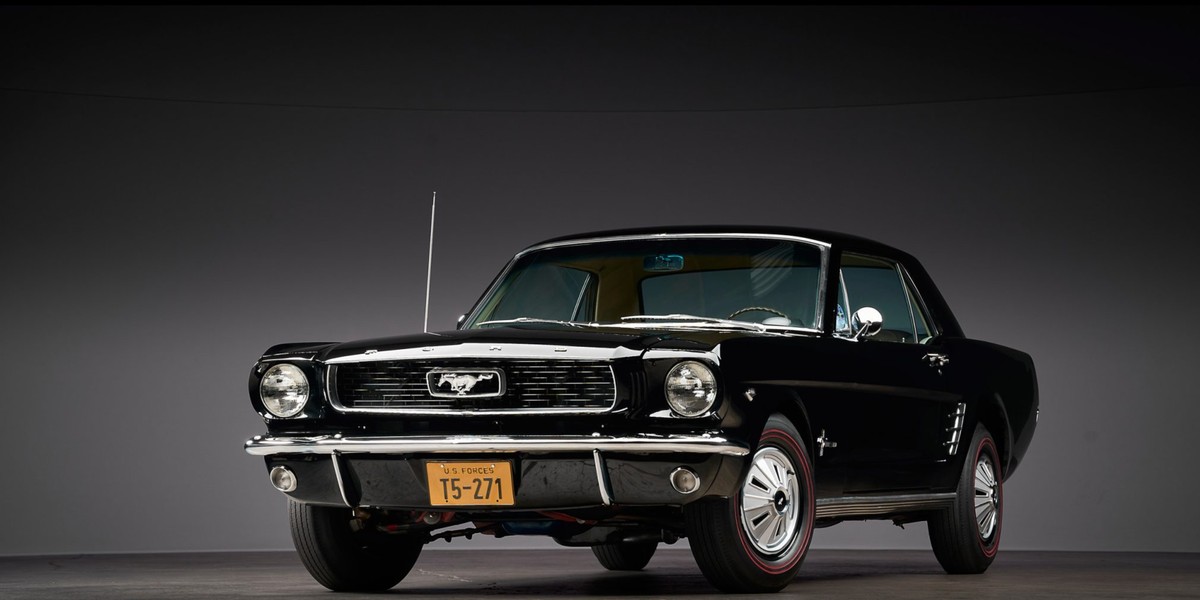
It looks like a classic American pony car. It performs like one, too. But if you look closely at the badging on this 1966 coupe, you will notice something missing: the word “Mustang.” Instead, it bears the cryptic designation T5.
This vehicle is a rare historical footnote—a Mustang built for a market that wouldn’t allow it to carry its famous name. Currently listed on Bring a Trailer, this specific example is not just a renamed car; it is a high-performance variant with a unique engineering pedigree and a compelling story about corporate trademarks and global branding.
A Trademark Battle in Post-War Germany
To understand the T5, you have to look at the geopolitical landscape of the mid-1960s. By 1964, the Mustang was an instant phenomenon in the United States. Ford saw potential in Europe, particularly in France, the UK, and Germany, where the brand already had a strong presence. The car’s credibility was already high; a Mustang had famously won the brutal Tour de France endurance race in its debut year, outlasting even Shelby Daytona coupes.
However, Ford hit a legal wall in West Germany.
The name “Mustang” was already trademarked by Krupp, a major German industrial conglomerate known for steel, arms, and heavy machinery. During World War II, Krupp factories had been targeted by P-51 Mustang fighter planes. In the post-war economic miracle, Krupp repurposed that aggressive name for a line of general-purpose trucks.
When Ford wanted to sell its new sports car in Germany, Krupp demanded $10,000 for the rights to use the name. Ford, unwilling to pay the licensing fee for a single market, made a pragmatic decision: they would sell the car under the internal project code used during development—T5.
More Than Just a Name Change
The T5 was not merely a Mustang with different badges. Ford made specific adjustments to suit European roads and regulations, creating a distinct variant:
- Suspension Tuning: The suspension was retuned for tighter European corners. Notably, it included a shock tower brace sourced from the Shelby GT350, adding rigidity and performance.
- Badging: The iconic galloping horse was removed from the steering wheel and replaced with “T5” emblems on the fenders.
- Market Specifics: These cars were essentially Mustangs in disguise, relying on the assumption that European enthusiasts would recognize the design immediately.
A High-Performance Rarity
The specific 1966 Ford T5 currently up for auction is particularly significant among collectors. It is equipped with the 289-cubic-inch “K-code” V-8 engine, a high-performance option that produced 271 horsepower from the factory.
This engine pairing is rare for a T5. According to the seller, this vehicle is believed to be:
1. The last T5 ever built with the K-code V-8.
2. The only T5 that left the factory in black.
The car was restored ten years ago and remains in exceptional condition, featuring a striking black-over-tan color scheme. Mechanically, it is ready to drive, having received a rebuilt carburetor, radiator service, brake overhaul, and new valve cover gaskets in recent years. The odometer reads 29,000 miles (estimated after rollover), and the speedometer remains in miles, reflecting its American origins despite its European identity.
Why It Matters
The Ford T5 represents a unique intersection of automotive history, international trade law, and engineering pragmatism. It highlights how global expansion often required creative solutions when local regulations or trademarks stood in the way. For collectors, the T5 offers the driving experience of a high-performance Mustang with the added allure of scarcity and a story that goes beyond horsepower.
As one observer noted, rolling up to a car show in this vehicle guarantees compliments—”Nice Mustang”—from admirers who don’t know any better. The owner’s response is always the same: a polite smile, and the quiet satisfaction of knowing they are driving a piece of automotive history that never quite got its name.
The auction for this unique 1966 Ford T5 ends on May 6.
The T5 serves as a reminder that sometimes, the most interesting stories in automotive history are found not in the models that defined an era, but in the ones that had to hide in plain sight.