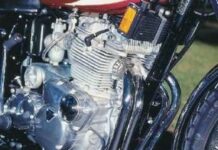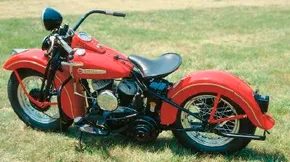
The 1948 Harley-Davidson WL was a workhorse disguised as a street bike. Although it shared the same visual DNA as the company’s larger flathead models at the time, it was built on a completely different philosophy. The Big Twin Flathead was its great big brother, but the WL relied on a understressed, bulletproof “45” engine. This particular street model ran from 1948 to 1951 and established itself as one of the most durable motorcycles ever produced by Harley.
To understand the importance of the WL, we have to look back to 1929, when Harley-Davidson introduced the first flathead V-twin, the Model D. At 45 cubic inches, it’s significantly smaller than the existing 61- and 74-cubic-inch F-head V-twins. The big engine was reclassified as a “big twin” to distinguish it from this new smaller engine.
The following year, the Big Twins switched to a flathead design. But there was a catch. These larger engines were not as reliable or durable as the smaller Forty-Fives. The smaller engine was understressed. It takes less effort to move the bike, which extends the life of your bike.
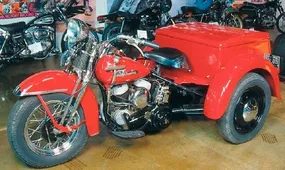
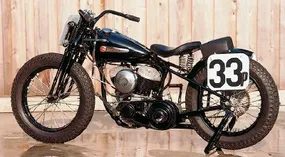
The Forty-five wasn’t a powerhouse. It’s not built for speed. But it is versatile. Its production lasted more than 40 years. During this time it worked on everything from street bikes to three-wheeled Servi-Cars (in use 1933-1973). It served in the military as a WLA in the 1940s. WR racing bikes also appeared on the tracks in the 1940s and 1950s.
By 1948, the WL became the dominant street model equipped with this engine. It looked a lot like the Big Twin Flathead of its time. What is the most obvious visual difference? Chains. In WL, the drive chain is on the right side. In Big Twins, it’s on the left.
1948 was the last year of the Big Twin flatheads. They are gone. But the WL persisted. It lasted until 1951. It was later replaced by the K series, which featured a redesigned 45-cubic-inch flathead V-twin. This meant that the engine and transmission were placed in the same housing, which was a significant engineering shift.
The Forty-Five proves that you don’t need brute force to rule the road. It just doesn’t have to break.
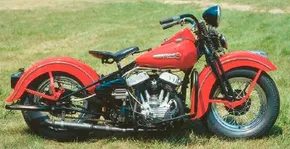
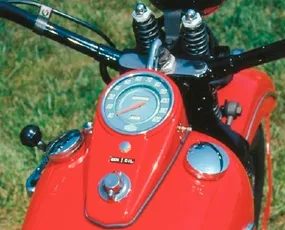
The 1948 Harley-Davidson WL was no lightweight. Powered by the massive 45-cubic-inch (745 cc) V-twin, it shared several design cues with its heavier siblings in the lineup. One of the most obvious was the instrument cluster. Unlike smaller models that might hide gauges, the WL mounted its speedometer and other indicators directly on the fuel tank. It was a practical choice for a machine built to carry serious weight over rough roads.
But the real quirks were hidden under the covers.
The Right-Side Chain
If you looked at the drive train, you would notice something unusual. Most motorcycles route their final drive chain on the left side. The WL did the opposite. Its drive chain sat on the right side of the bike.
Why? It wasn’t just stylistic. For a motorcycle meant to lug cargo or sidecars, keeping the chain on the right cleared the left side for kickstarts or other mechanical interventions. It also meant riders had to get used to a different maintenance routine. You couldn’t just hop off to the left to check tension or oil levels. You had to step around.
Reverse Shifting Logic
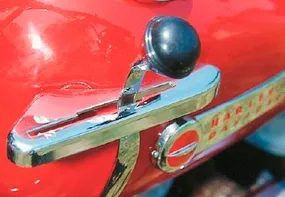
The transmission setup was even more counterintuitive. Harley flipped the standard hand-shift pattern for the WL street model. In most bikes, you lift your foot for first gear. On the WL, first gear was closest to the rider. That meant you pushed down to get going.
The clutch, meanwhile, was foot-operated but arranged to work with this reversed shift. First gear down. Higher gears up. It felt wrong to anyone used to a Honda or a BMW. But it was consistent with Harley’s design philosophy at the time. They prioritized robustness over ergonomic familiarity.
“First gear was closest to the rider.”
This wasn’t a mistake. It was a deliberate choice. A lot of riders complained. But the WL was built to work, not to comfort. If you needed to pull away from a stop with a heavy load, having first gear directly under your toe made sense. You didn’t have to fumble. You just stamped down.
Why It Mattered
The 1948 WL wasn’t just a motorcycle. It was a tool. The tank-mounted instruments kept the rider informed without cluttering the handlebars. The right-side chain protected the drivetrain from debris kicked up on the left. The reverse shift ensured immediate torque delivery.
It wasn’t pretty. It wasn’t intuitive. But it worked. And in 1948, that was enough.
Where can I find more content about motorcycles
If you want to delve deeper into the world of two-wheelers, there are some particularly prominent corners of the internet.
Classic Motorcycles remains the go-to resource for retro enthusiasts. This is not just nostalgia. This is a detailed archive of engineering history, restoration techniques, and introductions to era-defining machines. The focus here is on preserving the mechanical soul of motorcycles from the mid-20th century.
For those who want to know more, we explain the technique in detail in How Motorcycles Work. It covers everything from suspension kinematics to engine thermodynamics and offers a technical perspective that goes beyond the usual marketing gibberish. This is for readers who want to understand “why” Ducati’s desmodromic valvetrain not only exists, but works the way it does.
Of course, there’s the elephant in the room: Harley-Davidson motorcycles. This section is especially intended for lovers of heavyweight cruisers. We cover the latest models of the Milwaukee brand, the custom culture and the constant conversation between tradition and modernity. Whether you want the Softail chassis or the new Revolution Max engine, this is a dedicated space for a specific community.