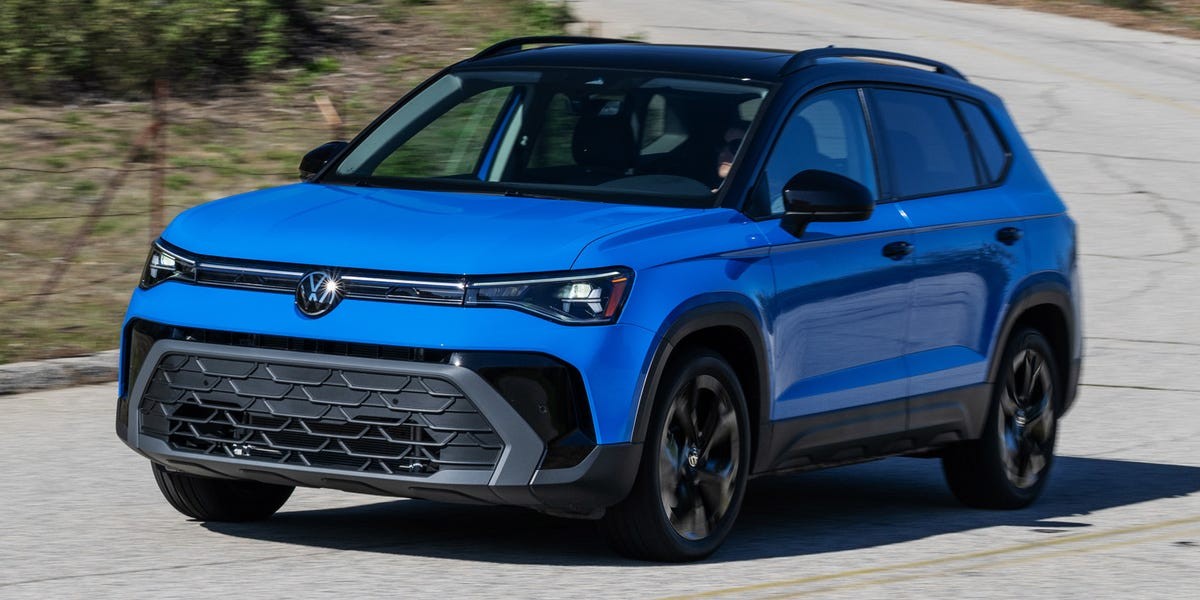
The Volkswagen Taos sits at the bottom of the pile. It is the smallest SUV Volkswagen makes, tucked under the Tiguan and dwarfed by the Atlas. You can tell it is a VW from twenty feet away though. Same chunky body lines. Same aggressive front and rear light bars. Inside, the cabin feels like a direct transplant from those larger siblings. It is tidy. Purposeful. And annoyingly practical.
It doesn’t win drag races. That isn’t the point. It offers a 174-horsepower turbocharged four-cylinder that sends power forward, or out to all four wheels if you pay the premium. The magic trick here isn’t speed, it’s the mileage. We watched a front-drive Taos sip gasoline at a blistering 40 mpg during our 75 mph highway test. For a car that looks like a brick, that is impressive.
What Changed in 2027
Volkswagen did the bare minimum this year. Good thing, too, because the new Sport trim actually has some personality.
Sitting just above the base S, the Sport trim ditches chrome for gloss black. You get 18-inch black wheels. A black roof rail. A black spoiler on the liftgate. Even the exhaust tips are painted a dull gunmetal gray. Inside, they added yellow stitching and embossed black cloth to signal its attitude.
The base S trim also got a small boost. Satellite radio is now included. So is voice control and two extra speakers, bringing the total count to six. Keyless entry joined the party too. Small upgrades, sure, but they help the base model feel less bare-bones.
Expert Tip: Love the look but need more hip room? Go look at the Tiguan. It is literally the same car, just stretched. And more expensive.
Engine and Drive
Under the hood lies a 1.5-liter turbocharged inline-4. It pushes 174 hp.
The transmission is an eight-speed automatic. It shifts quietly. You rarely notice it there, which is good for a city commuter. The drivetrain setup gets interesting when you pick between front-wheel drive and all-wheel drive. They use completely different rear suspensions.
- FWD: Uses a torsion beam. It is stiff, utilitarian.
- AWD: Gets a multilink setup. Much more sophisticated. Better ride.
The Taos isn’t quick. We clocked a 0-60 time of 8.2 seconds. To put that in perspective, a Honda HR-V took 9.4 seconds. A non-turbo Mazda CX-30 managed 8.1 seconds. The turbo CX-30 obliterated them all with 6.2 seconds, but the Taos holds its own against the mainstream compact class.
You don’t drive the Taos for excitement. You drive it because it doesn’t make noise, it doesn’t complain in corners, and it handles bad weather with surprising grace thanks to that AWD multilink suspension.
Fuel Economy
This is where the Taos earns its keep.
EPA ratings for the front-drive model sit at 28 city / 36 highway / 31 combined. Add all-wheel drive, and that drops to 25 city / 33 highway / 28 combined.
Real world testing tells a better story. We averaged 40 mpg on our standardized highway route. That is significantly better than the Honda HR-V’s 32 mpg in the same test, or the turbo Mazda CX-30’s 31 mpg. If fuel prices keep climbing, this number matters. More than the acceleration numbers do.
Interior and Space
The front seat is decent. Digital gauges are standard across the board. Cloth is standard too, but leather and leatherette are options. You can spec out heated and ventilated seats. Ambient lighting. A panoramic sunroof. It feels nice, even if the materials aren’t luxury-grade.
The infotainment screen is 8.0 inches. It runs Apple CarPlay and Android Auto wirelessly. It connects to the internet. There is a wireless charging pad, or you can use the two fast-charging USB-C ports. One 12-volt outlet is included. It works, but we wish VW had put physical knobs back on the dashboard. Touchscreens are slippery in winter.
The back seat is tricky. Legroom is only 0.8 inches short of the much larger Tiguan. That is wild for a subcompact. However, the bench is narrow. Three adults? No chance. The center passenger gets squashed.
Cargo space is respectable. You get 28 cubic feet behind the seats. Fold them flat and it opens up to 66 cubic feet. We stuffed nine carry-on bags in there. Twenty-five total with the seats down.
Safety and Warranty
Standard safety tech includes forward-collision warning. Automated emergency braking is included too. You get blind-spot monitoring, rear cross-traffic alert, and adaptive cruise control with lane-keeping. It covers the basics well.
The warranty is… complicated. Volkswagen offers 4 years/50,000 miles for both the basic limited warranty and the powertrain. That is above average.
But check the maintenance. Volkswagen provides complimentary scheduled maintenance for 2 years/20,000 miles. That matches Toyota’s excellent coverage. Most competitors leave you alone after year one. VW keeps you covered longer than usual, which saves cash on oil changes and inspections.
Which One To Buy?
We used to recommend the mid-level SE trim. Not anymore.
Get the new Sport trim. It looks better with its dark accents and yellow stitching. And add all-wheel drive. The reason isn’t snow. It is because the AWD system comes with the independent multilink rear suspension. It makes the car handle better and ride smoother. You are paying for comfort as much as traction.
Price-wise, expect to start around the high thirties with options and AWD added.
The Specs
| Spec | Detail |
|---|---|
| Vehicle Type | Front-engine, FWD/AWD, 5-pass, 4-door SUV |
| Price | $32,070 (Base S) – $38k+ (Fully Optioned Sport) |
| Engine | 1.5L Turbocharged 4-Cyl, 174 hp, 184 lb-ft torque |
| Transmission | 8-Speed Automatic |
| 0-60 mph | 8.2 seconds |
| Braking 70-0 | 179 feet |
| Weight | 3,313 lbs (FWD tested) |
| Wheelbase | 105.5 inches |
| Length | 175.9 inches |
The Taos doesn’t try to be exciting. It doesn’t need to be. It is a tool. A small, efficient, surprisingly spacious tool. Whether that is enough depends on who sits in the back seat. And whether you value stopping at gas stations less, or going fast more.
Probably less gas stations.