


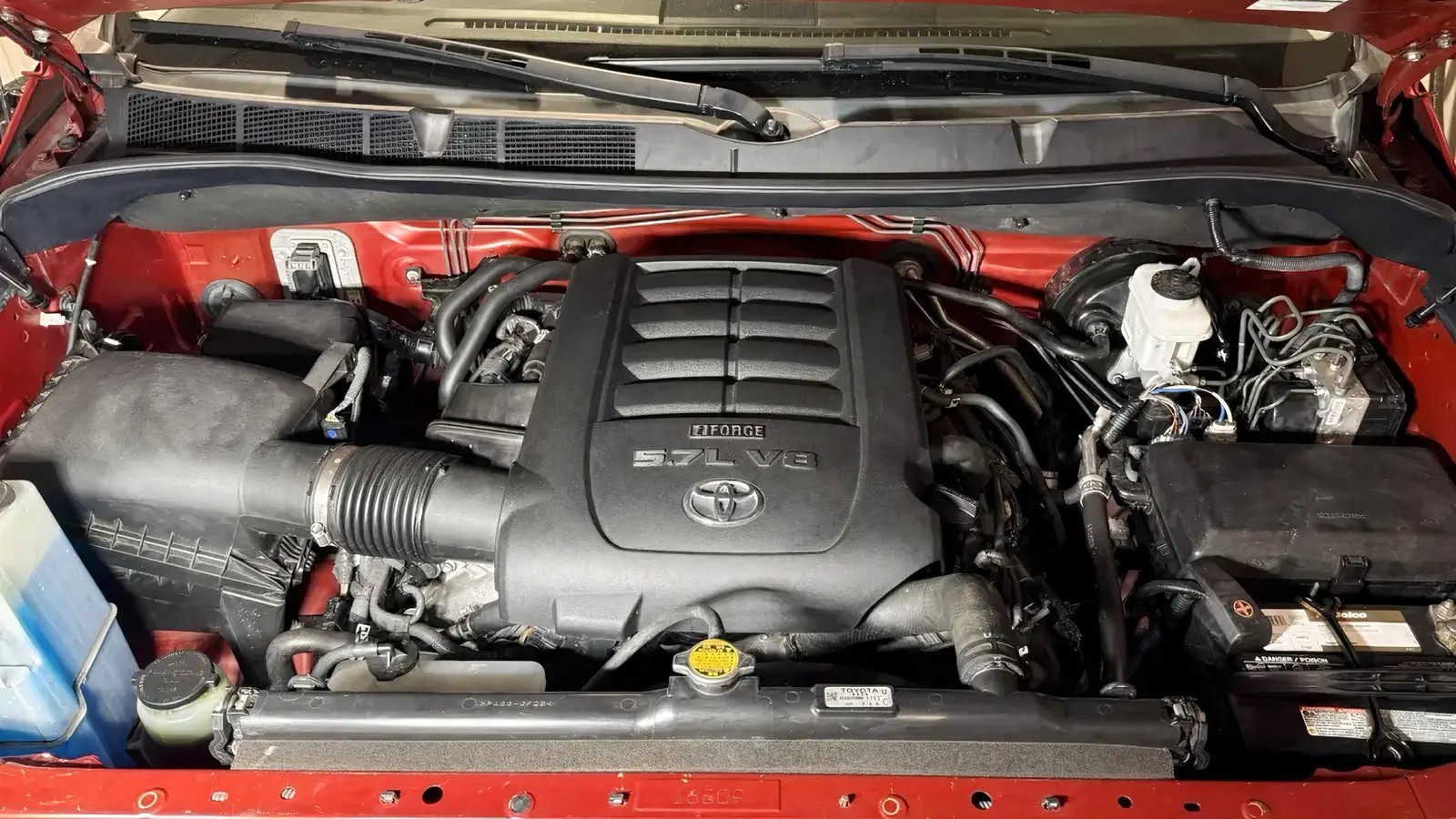
Toyota just tore down a 5.7-liter V8 engine that clocked a million miles. The result? It looked almost brand new. This isn’t marketing fluff. It’s engineering reality. And it casts a harsh light on the company’s current V6 situation.
The engine in question is the legendary 3UR-FE. It powered the Tundra from 2007 to 2021. Toyota’s engineers pulled it apart after fourteen years of hard driving. They didn’t find catastrophic wear. They didn’t find melted pistons or scored cylinders. They found a machine built to last.
“The biggest blemish… was a slight mark on a bearing.”
That sentence changes everything.
How Toyota’s Million Mile Engine Withstands the Test of Time
Most engines don’t last this long. By the time a car hits six figures, it’s usually rebuilt or scrapped. Getting a factory-original V8 to seven figures is rare. It requires disciplined ownership. It requires a documented service history. It requires luck.
But when that truck exists, it tells the truth.
The 3UR-FE is a dual-overhead-cam engine. It makes 381 horsepower. It delivers 401 lb-ft of torque. Simple design. No turbochargers. No direct injection. Just mechanical simplicity. That’s the secret. Fewer parts means fewer failure points. Over time, that adds up.
The teardown team checked the internals. Here’s what they found:
- Carbon buildup on valve stems? Minimal.
- Cylinder wall cross-hatching? Still visible.
- Crankshaft journals? No wear marks.
- Head and block specs? Not within factory tolerance. But nothing abnormal.
Engineers noted that blocks and heads won’t stay within spec after a million miles. That’s physical reality. Materials fatigue. The point is, the wear was normal. The engine didn’t fail. It just aged.
Toyota gave this teardown a 99 out of 10 for quality. Think about that. An engine that drove a quarter-million kilometers across a decade and still scores near-perfect on durability metrics.
The Twin Turbo V6 Recall vs The 5.7 V8 Legacy
This story isn’t just about nostalgia. It’s about today’s trucks.
Toyota recalled roughly 250,000 new Tundras in 2022. These models use a twin-turbocharged 3.5-liter V6. The issue? Engine debris contamination. The explanation from Toyota hasn’t sat well with independent mechanics. Many suspect different things. The debate keeps the issue in the spotlight.
Here is the uncomfortable truth: The million-mile engine was the old one. The naturally aspirated V8. Toyota replaced it with the twin-turbo V6 for more power. The V6 is efficient. It’s quick. But is it as durable?
We don’t know yet. The V6 has only been on the road for a couple of years. The V8 has a decade-plus of proof.
For buyers looking at used trucks, this matters. If you want proven reliability, the 2021 and older Tundras with the 5.7L are the safe bet. If you want modern torque and efficiency, the 2022+ models are the choice. But you are gambling on longevity. The recall data suggests that gamble might have cracks in it.
Which Toyota Tundra Should You Buy Today?
The market is split. And the split is based on philosophy.
Buying a Pre-2022 Model
If you shop the used market for a Tundra with the 5.7 V8, you have options. High-mileage examples exist. Lots of them. The teardown confirms what long-haul owners already knew: these engines survive. They don’t thrive on drama. They thrive on maintenance.
When you look at a high-mileage 5.7, check the records. Look for oil changes. Look for timing service. The engine can take the abuse if you feed it properly. The teardown shows the internals can handle the punishment. Your job is to keep the fluids clean and the belts tight.
Buying a 2022 or Newer Model
The twin-turbo V6 is different. It shares a nameplate, not an architecture. It’s a complex machine. High performance comes at a cost. That cost might be long-term reliability. Or it might be nothing. We just don’t have the data yet.
The current recall is a red flag. Whether it’s a manufacturing quirk or a fundamental design flaw, it’s a sign to pay attention. Independent mechanics are watching. Fleet buyers are hesitating. If you buy new, you get the latest tech. But you’re also the guinea pig for the next million-mile debate.
The Verdict on Toyota’s Reliability
Toyota’s reputation was built on boring engines that refuse to die. The 5.7 L V8 is the avatar of that philosophy. It’s not exciting. It doesn’t break records for speed. But it breaks the odometer and keeps going.
The teardown proves that conservative engineering still wins the endurance game. Turbocharging and downsizing offer performance. They offer emissions compliance. They do not offer the same level of mechanical simplicity.
So, what’s the takeaway?
If you drive a Tundra for a million miles, do it with the V8. It will thank you. If you buy the V6, buy it with eyes open. Know the trade-offs. The data doesn’t lie. The older engine is built to last. The new one is built to perform.
Time will tell which one is smarter. Until then, the million-mile V8 stands alone. A relic. A benchmark. A reminder that sometimes the best technology is the technology you don’t see.
You still hear those V8s idling on highways. Rumbling. Unbothered. Just ticking off miles while the turbocharged stuff worries about debris.


