The Volkswagen Golf R is a perennial favorite among enthusiasts, and for good reason. We’ve just added a 2026 model to our long-term fleet for 40,000 miles of testing—and it comes with a few quirks right out of the gate. This isn’t just another car review; it’s a real-world evaluation of a performance vehicle under daily use, including its flaws.
Price and Customization
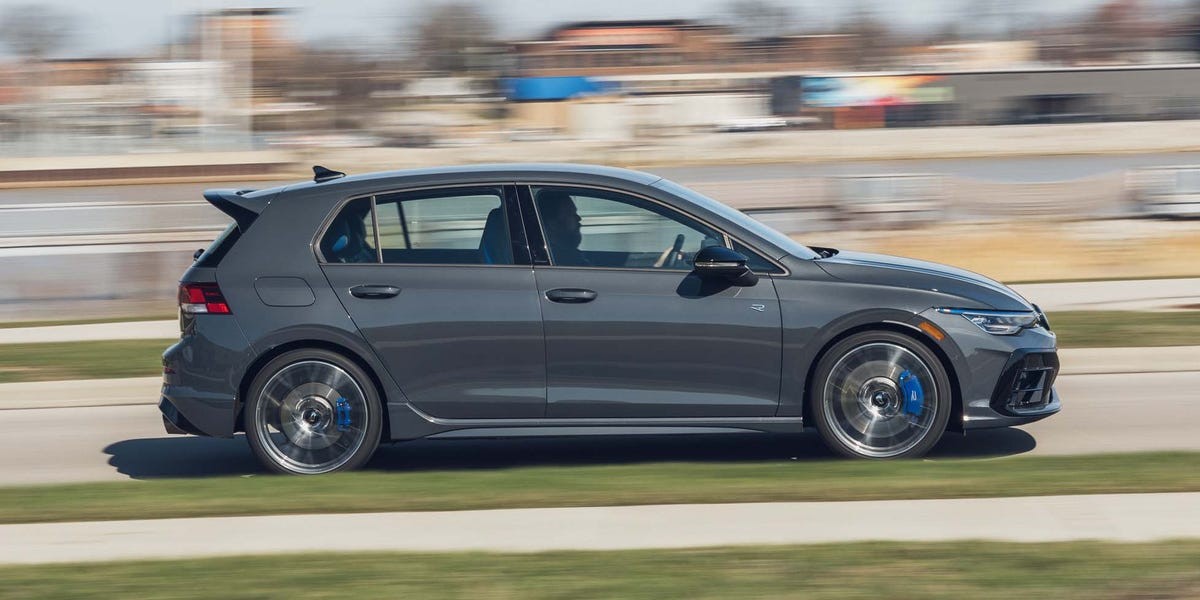
The 2026 Golf R starts at $50,730, a figure that already feels steep for a compact hot hatch. Our test vehicle is further inflated by the $455 Graphite Gray Metallic paint and the $3795 Euro Style package. This package swaps the standard black leather for blue-plaid cloth inserts, deletes the sunroof and ventilated seats, but adds a high-performance Akrapovič titanium exhaust. The final price: $54,980. While not outrageous, it’s a reminder that fully equipped performance cars don’t come cheap.
Performance Upgrades and Transmission Issues
The 2026 Golf R builds on the 2025 updates, which included a modest power bump to 328 horsepower (torque remains at 295 lb-ft) and infotainment improvements. However, the biggest change—and a source of immediate frustration—is the removal of the manual transmission. The only option now is a seven-speed dual-clutch automatic (DSG).
Initial impressions are not favorable. Even in its mildest settings, the DSG exhibits aggressive behavior, lurching forward when releasing the brakes. This jerkiness persists even in Comfort mode, and Sport mode only amplifies the issue. The problem is noticeable enough that we’re exploring potential fixes. The transmission has proven to be a source of annoyance, though we will investigate if this can be resolved.
Practical Concerns
Beyond the transmission, the Golf R lacks a spare tire, relying instead on an emergency inflation kit. Given the condition of roads in many areas, this is a gamble. There isn’t even room for a temporary spare in the trunk, which is already occupied by a subwoofer. The only solution we’ve considered so far is carrying a fifth wheel and tire on long trips, though this isn’t ideal for passengers or cargo.
Track Performance
The Golf R performs well when pushed. Equipped with Bridgestone Potenza S005 summer tires, it hit 60 mph in 4.0 seconds with launch control, though real-world starts take 5.1 seconds. The quarter-mile was clocked at 12.5 seconds at 111 mph. The car also gripped the skidpad at 0.99 g, despite testing conditions in Michigan’s notoriously unpredictable March weather. Braking was solid, stopping from 70 mph in 152 feet and from 100 mph in 299 feet.
First Impressions and Early Damage
Despite the initial issues, the Golf R offers a raw, engaging driving experience. However, it hasn’t been without incident: the windshield already cracked, requiring a replacement. We’re eager to see how the car holds up over the next 40,000 miles, but this early damage sets a concerning tone.
The Golf R is a capable machine, but its quirks—from the jerky transmission to the lack of a spare tire—highlight the compromises often made in performance vehicles.
Months in Fleet: 2 months
Current Mileage: 2252 miles
Average Fuel Economy: 23 mpg
Fuel Tank Size: 14.5 gal
Observed Fuel Range: 330 miles
Service Costs: $0
Normal Wear: $0
Repair Costs: $0
Damage and Destruction: $0