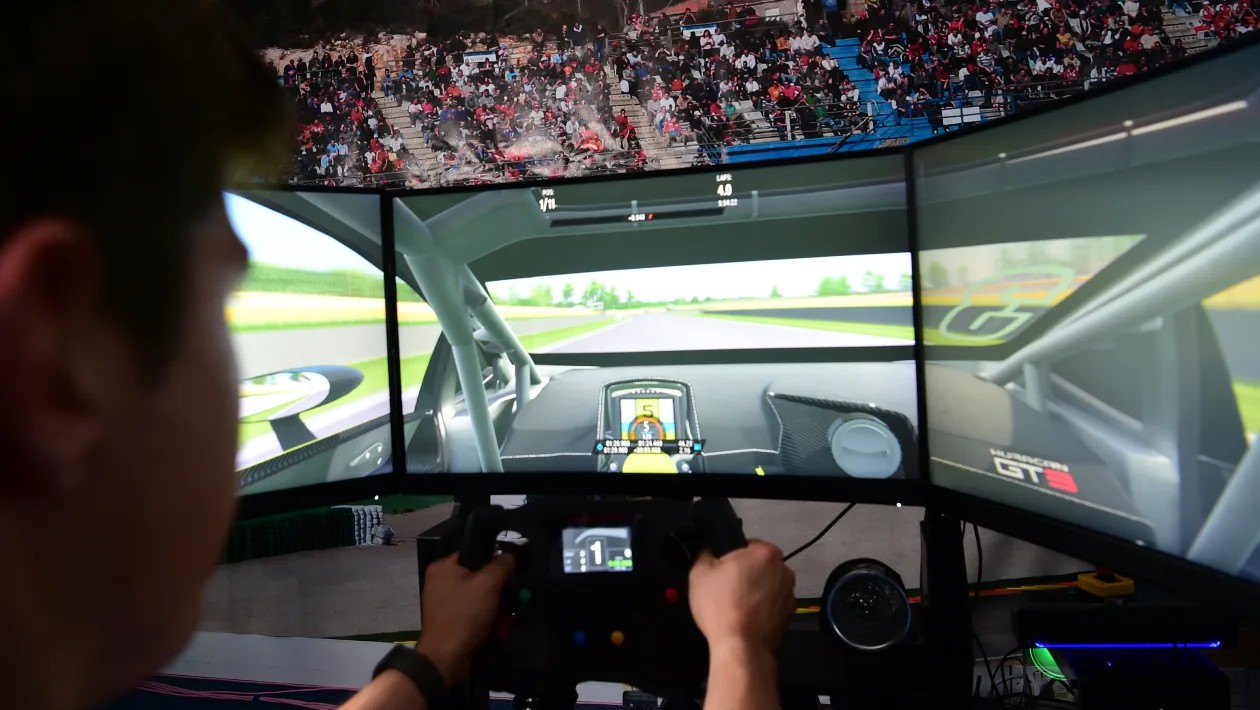
For over 150 years, motor racing has been about one core principle: speed. Whether powered by steam, gasoline, or electricity, the fastest vehicle wins. But while the fundamentals of real racing remain consistent, the world of competitive driving has undergone a radical transformation. Today, millions participate in sim racing – a hyper-realistic form of digital motorsport that bridges the gap between video games and professional racing.
This isn’t just a fad. Sim racing has evolved into a legitimate pathway for aspiring drivers, offering a cost-effective alternative to traditional motorsport, and even opportunities to transition into real-world racing. To understand how, we visited the Gran Turismo World Series in London to explore the phenomenon firsthand.
What Exactly Is Sim Racing?
Sim racing isn’t merely playing car-racing video games. It’s about immersion: striving for the most realistic experience possible, racing against others online or in person. Platforms range from consoles like PlayStation and Xbox to high-end gaming PCs, with titles such as Gran Turismo, Assetto Corsa, F1 25, and Rennsport hosting major championships with substantial prize pools – and the potential for real-world racing seats.
The level of realism is staggering. Modern sim racing games boast photorealistic graphics and physics engines designed to accurately replicate vehicle performance and handling. Drivers must contend with factors like track telemetry, car setup, and even tire wear – just like in professional racing. Penalties for cutting corners or collisions are enforced by virtual stewards, adding another layer of authenticity.
How Realistic Can It Get?
Valerio Gallo, a former FIA GTC Nations Cup World and Olympic Virtual Series champion, emphasizes the dedication required: “You have to consider things like track telemetry, while there’s also each car’s set-up to bear in mind.” He points out that even the physics vary between games; the same car will handle differently in Gran Turismo versus Assetto Corsa. The World Series demands adaptability, forcing drivers to master a wide range of vehicles, from high-performance race cars to everyday road models.
But how does it stack up against the real thing? Kazunori Yamauchi, creator of the Gran Turismo series, admits that the competition has evolved: “Back when I started the GT Academy, I was ranked 50th in the world… Today, the level of driving has gotten so high that no matter how hard I try to set a lap time, World Series contenders are usually about a second faster than me.”
The lack of physical risk also alters the dynamic. Gallo notes, “In a game you can pause and restart which, of course, you can’t do in real life.” Yet, strategy, racecraft, and managing contact with other drivers remain crucial.
The Economic Advantage
The financial barrier to entry in sim racing is significantly lower than traditional motorsport. While a high-end setup (cockpit, wheel, pedals) can still cost several thousand pounds, it pales in comparison to the tens or hundreds of thousands required for real-world racing. This accessibility has opened doors for talented drivers who might otherwise be excluded.
In fact, many real-world racing drivers now use sim racing to hone their skills. Max Verstappen and Lando Norris, both Formula One stars, regularly practice on virtual tracks and even run their own e-sports teams. Verstappen himself acknowledges the intensity of the competition: “Everyone always thinks that sim racing is just a game and it’s fun, easy going. But I would say the competition is just as hard, or even harder, to nail – to win – than in real life.”
Getting Started: Top Games and Gear
Entering the world of sim racing is easier than ever. A console (PlayStation or Xbox) or gaming PC, paired with a compatible steering wheel and pedals, is all you need. Here are some leading titles:
- Assetto Corsa Competizione: Focuses on GT racing with realistic physics and sound.
- Gran Turismo 7: The long-running series known for its stunning graphics and diverse car roster.
- F1 25: The official Formula One game, offering immersive simulations of modern F1 racing.
- Le Mans Ultimate: A new title replicating the World Endurance Championship with accuracy.
- iRacing: Highly realistic, but requires real-money purchases for cars and series.
From there, practice frequently and consider using racing line guides to learn track layouts. Investing in a quality wheel and pedals with direct-drive technology can further enhance the experience.
Sim racing has emerged as a legitimate pathway for aspiring drivers, offering both a competitive outlet and a potential springboard to real-world motorsport. Whether you’re a hardcore gamer or a seasoned racer, the virtual track has never been more inviting.