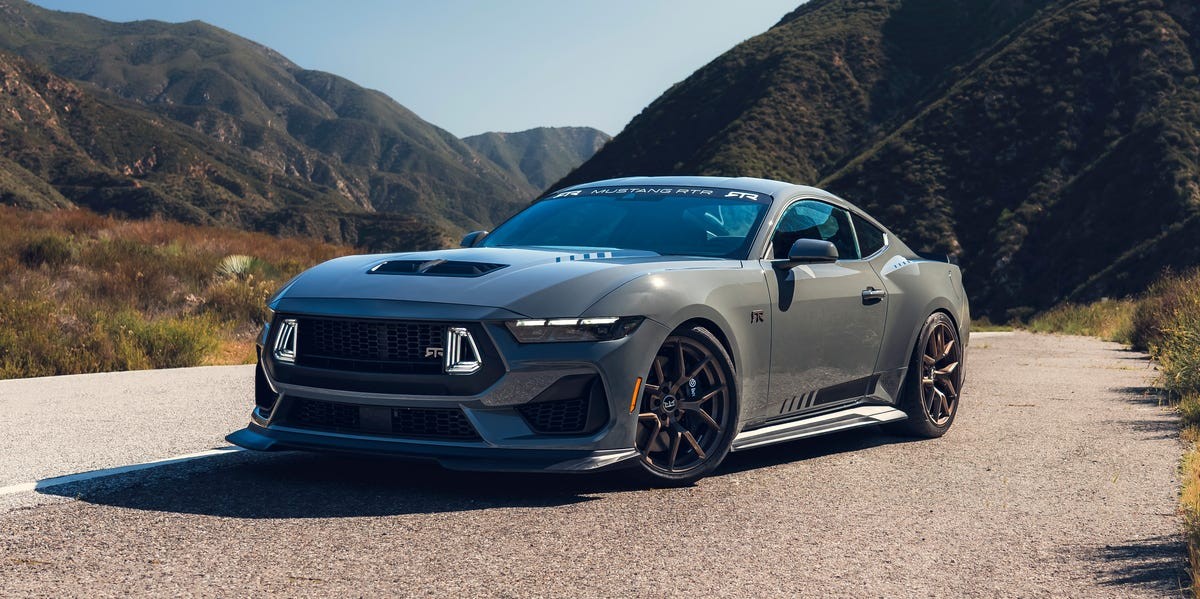
In the world of American muscle, names like Shelby, Roush, and Saleen carry immense weight. They represent a long tradition of Ford partnering with specialized tuners to push the Mustang beyond its factory limits. The latest contender in this high-stakes arena is RTR Vehicles, led by professional drifter Vaughn Gittin Jr.
While RTR’s lineup ranges from subtle cosmetic tweaks to massive 870-hp widebody monsters, their mid-tier offering—the Spec 3 —promises a compelling proposition: massive power, aggressive styling, and racing pedigree. However, real-world testing suggests that more horsepower doesn’t always translate to better performance.
The Power Paradox: Too Much Engine, Not Enough Grip
On paper, the Spec 3 is a beast. By adding a 3.0-liter Whipple supercharger from Ford Performance to the standard 5.0-liter V-8, RTR boosts output to a staggering 810 horsepower and 615 lb-ft of torque. This is a massive leap over the stock Mustang GT.
Yet, in practice, this power becomes a liability rather than an asset. Because the Spec 3 was tested with a six-speed manual transmission and lacks a heavy-duty upgraded clutch, the car struggles to translate that energy into forward motion.
The Performance Gap:
* Acceleration (0–60 mph): The Spec 3 takes 4.7 seconds, actually slower than the stock manual GT’s 4.2 seconds.
* Quarter-Mile: The RTR finishes in 12.7 seconds, while the stock GT clocks in at 12.5 seconds.
* Handling & Braking: The car struggles to find traction on the skidpad (0.92 g vs. the GT’s 0.99 g) and requires significantly more distance to stop from 70 mph.
The takeaway: The Spec 3 suffers from a fundamental imbalance. It has the “bark” of a supercar but lacks the “bite” required to actually use its power effectively on a track or a drag strip.
Style vs. Substance: The Aesthetic Appeal
If performance isn’t the primary selling point, what is? The answer lies in the visual presence. RTR has mastered the art of the “head-turner.”
The Spec 3 offers a level of personality that a standard GT simply cannot match. With LED-accented grilles, custom aero kits, satin-black additions, and bronze-painted 20-inch RTR Tech 5 wheels, the car looks purpose-built for competition. It carries the “cool factor” associated with Gittin Jr.’s drifting career, complete with signature branding on the dash and floor mats. For a buyer who wants a car that looks like a champion at a car meet or in a driveway, the Spec 3 delivers.
The Technical Compromise: Why the Weak Link?
A glaring question arises: Why didn’t RTR upgrade the clutch to handle 800+ horsepower?
The reason is a strategic choice regarding warranty protection. RTR maintains Ford’s factory warranty by using Ford Performance components and parts designed in partnership with Ford. Because Ford Performance does not currently offer a heavy-duty clutch option for this engine, RTR cannot include one without voiding the very warranty they promise to protect.
This leaves the owner with a difficult choice:
1. Buy the RTR: Get a beautiful, cohesive, and warrantied vehicle that struggles to put its power down.
2. Build your own: Buy a stock GT and add the same parts yourself (including a beefier clutch and stickier tires) for potentially less money, but without the official warranty or the RTR prestige.
Value Proposition
The cost of entry for the Spec 3 is steep. Adding the package to a 2025 Mustang GT brings the total price to roughly $81,550, though a fully optioned test model reached over $109,000. When a much cheaper, stock Mustang GT can outrun it in almost every measurable metric, the value proposition becomes difficult to justify for performance enthusiasts.
Conclusion:
The Mustang RTR Spec 3 is a masterclass in automotive styling that falls short in mechanical execution. While it offers unmatched curb appeal and a premium “tuner” feel, its inability to manage its massive power makes it a beautiful, but ultimately unbalanced, driving machine.