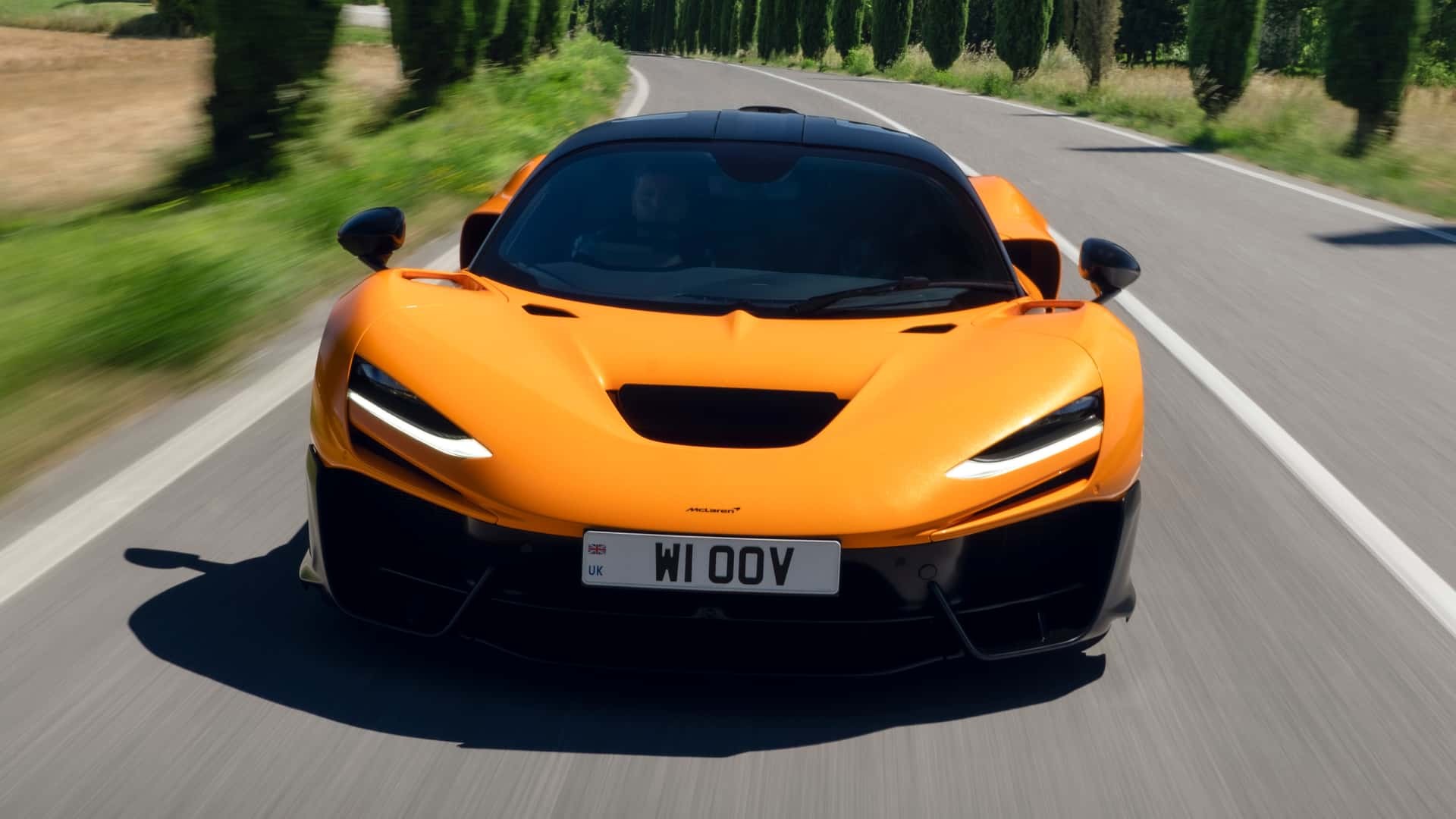
Bruce McLaren wanted a road car. He never saw it happen. The M6GT stayed a prototype. Two decades later, the McLaren F1 changed everything.
That car still holds the record for the fastest naturally aspirated engine on a road-legal machine. Then came the P1. The “Holy Trinity.” Now there’s the W1.
It’s named for McLaren’s first F1 title. A hat tip. Since then, they’ve won twenty-three championships. Driver or constructor. It doesn’t matter.
The price? $2.1 million.
Competitors? The Ferrari F80 at nearly $4 million. The Aston Martin Valhalla. The Mercedes-AMG One. But the W1 isn’t just trying to beat them. It’s trying to be a monument to radical engineering.
The Numbers That Don’t Lie
A 4.0-liter twin-turbo V8. A hybrid system. Sounds familiar. Right?
Don’t be fooled.
1,258 horsepower. 988 lb-ft torque. Zero to sixty in 2.0 seconds. Zero to 124 mph in 5.8. These aren’t just specs. They are declarations of intent.
The electric motor alone pushes 342 hp. It weighs only 44 pounds. The battery is tiny, 1.4 kWh. Enough for 1.6 miles of EV range. The motor spins to 24,000 rpms. The engine hits 9,200. The eight-speed dual-clutch even drives power through two gears at once for a split second.
It feels less like a hypercar and more like a high-end watch mechanism. Complex. Precise. Lighter than the P1 by 88 lbs.
“The W1 is a relative featherweight at 3,084lbs dry, compared to the 3,362lb Ferrari F80.”
The Ferrari uses three motors. McLaren uses one. And here’s the kicker: McLaren sent it all to the back.
Rear-Wheel Drive in a Hybrid World
Most exotics send the electrons to the front wheels. McLaren refused.
All that torque? All those horsepower? To the rear 335-series Pirelli PZeros.
Why? Feel.
Hydraulic steering. Hydraulic brakes. No electronic power steering. No brake-by-wire. In an era where everything is digital and clinical, this feels analog. Raw. It keeps the front wheels focused on steering, not pulling.
It creates a challenge, sure. Managing nearly 1,000 lb-ft on the back end without all-wheel traction? Scary. Exciting. Human.
The Theater of Entry
No dihedral doors. Not anymore.
The aerodynamics get in the way. Instead, the door hinges are fixed. It sweeps up. You slide in. The seat stays put. The wheel moves. The pedals move.
It’s weird. It works. It saves weight. No rails. No motors.
The view inside is stark. Carbon fiber everywhere. The seats blend into the sills. You are wrapped in the chassis. A touchscreen angles toward you. Two buttons on the wheel: ‘Aero’ and ‘Boost’.
Hold the ‘Race’ button for five seconds.
The car drops. 1.5 inches in the front. 0.7 in the back. It looks aggressive. Hunkered. It won’t let you drive at this height on the street. GPS locks it down. You want to show off at a car meet? Do it manually. But leave it low, and it stays fast only on a track.
Mugello Heat
Tuscan hills. 90 degrees Fahrenheit. The track demands precision.
The steering feels alive. Every bump, every change in tire load, transmits through the column. It’s not information you read on a screen. It’s something you feel in your hands.
The acceleration is urgent. Not jerky. Controlled. The downforce pins the car at high speeds. You turn in late, you stay in the corner. The exit is crisp.
Braking? Terrifying.
The six-piston Brembos with 15.4-inch discs grab instantly. I found myself stopping too early. Before the apex. Like the old Senna. The rear wing helps, but the brakes do most of the work.
Engage ‘Sprint’. The car livened up. The hybrid system dumped more power rearward. It felt faster than 1,258 HP should feel. Wilder.
Then I pressed the ‘Dynamic’ button. Stability control relaxed. The tail stepped out. Easily. Controllably. You steer with the throttle. It feels irascible, unpredictable, yet entirely under command.
A strange duality. Nuclear power wrapped in lightweight titanium and 3D-printed dampers. It punishes mistakes. But it doesn’t hide them. The car is transparent. You drive the limit.
One moment of drama: a “Hybrid Fault” message appeared. Limp mode engaged. An engineer said it’s just thermal calibration. They’re still tuning it. Deliveries later this year should be smooth. I didn’t see it again.
Limited Supply
There will be only 399.
Add the 106 Fs and the 375 Ps. That’s less than 1,000 “1” models total.
They were sold out before the public even looked at the steering wheel.
Will the W1 surpass the F1 in legend? The P1?
History will judge. It’s a gamble on analog soul in a digital age. It keeps driver engagement at the center. Not AI. Not convenience.
You just wonder. Will this spirit trickle down? Will the cheaper Macs get a hint of this wildness?
Only time tells.