For many families, the ideal vehicle isn’t about speed or luxury, but about making daily life easier. Reliability, efficiency, and comfort are paramount. The Hyundai Tucson Hybrid quietly excels in this role, offering a smooth, functional experience without unnecessary complexity. It’s a vehicle designed to fit into a family’s routine, not demand adjustments from it.
Why Hybrid SUVs Are a Smart Choice for Families
Hybrid SUVs are gaining traction because they bridge the gap between traditional gas vehicles and fully electric options. They provide the space and versatility families need, with improved fuel economy and no range anxiety. This is critical: families don’t want to plan trips around charging stops.
Hybrids reduce trips to the gas station, operate quietly in traffic, and don’t require home charging setups. The electric motor assistance provides smoother acceleration than many small turbocharged engines, making daily driving less stressful.
The 2026 Hyundai Tucson Hybrid: Everyday Efficiency
Hyundai offers the Tucson Hybrid in select markets to deliver improved efficiency without sacrificing practicality. The powertrain combines a 1.6-liter turbocharged engine with an electric motor, producing around 231 horsepower. The focus isn’t on raw performance, but on effortless driving.
Electric assistance provides immediate torque at low speeds, making urban traffic more relaxed. EPA estimates put the 2026 Tucson Hybrid at 36 mpg combined, with the Blue trim achieving 38 mpg. The plug-in hybrid (PHEV) variant gets 77 MPGe for those prioritizing maximum fuel economy. This translates to fewer gas stops and lower running costs for busy families.
Engine Specs and Smooth Performance
The Tucson Hybrid pairs a 1.6-liter turbo four-cylinder with an electric motor and lithium-ion battery, delivering 231 hp and 271 lb-ft of torque. It uses a six-speed automatic transmission, offering a more traditional driving feel than many hybrids with CVTs. Electric assistance fills in low-speed torque gaps, improving responsiveness in stop-and-go traffic.
Acceleration is deliberate, not aggressive, prioritizing consistency over sportiness. This suits the vehicle’s role as a family SUV, improving fuel economy without compromising drivability.
Design: Bold Without Compromising Functionality
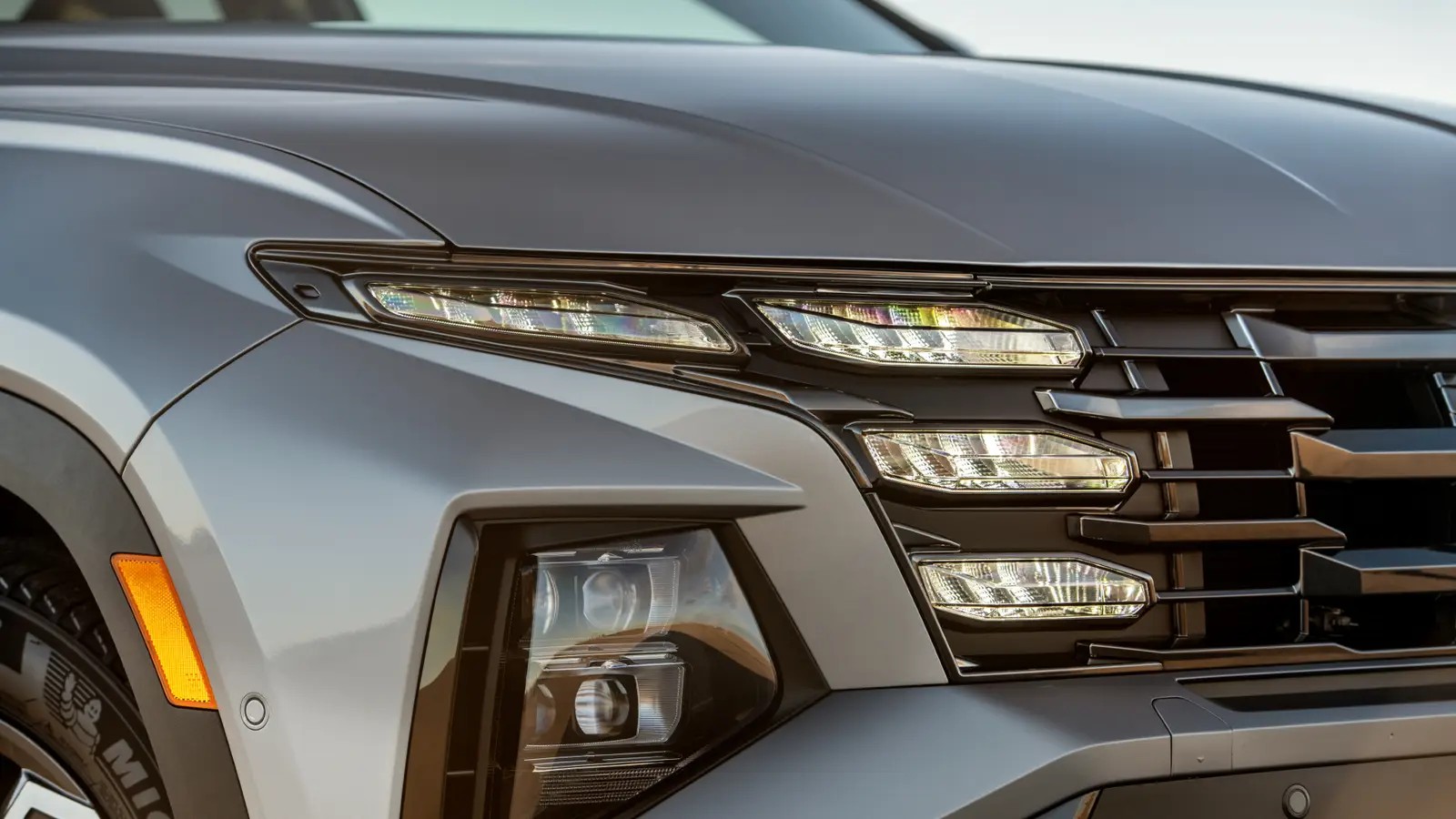
The Tucson Hybrid features Hyundai’s modern design language, with integrated parametric grille elements and bold LED daytime running lights. The angular body lines add visual impact without excessive bulk. It’s confident without being ostentatious.
Visibility is good thanks to an upright stance and well-sized pillars. The large rear liftgate makes loading cargo easy, and roof rails are available for additional carrying capacity. The Tucson maintains practical dimensions, avoiding the dramatic, coupe-like rooflines of some competitors.
A Cabin Designed for Comfort and Convenience
The Tucson’s interior is clean and uncluttered. Higher trims feature a curved panoramic display with two 12.3-inch screens for the instrument cluster and infotainment. Hyundai keeps controls organized and easy to use, unlike some competitors hiding features in touch-only menus. Wireless Apple CarPlay and Android Auto, plus multiple USB ports, are standard.
The seats are comfortable, with available heating and cooling. Rear legroom is generous for the class. Advanced driver-assistance technologies—adaptive cruise control, lane-keeping assist, blind-spot monitoring, and rear cross-traffic alert—operate seamlessly in the background, reducing driver burden.
How It Stacks Up: Tucson Hybrid vs. the Competition
The Tucson Hybrid competes with the Honda CR-V Hybrid, Toyota RAV4 Hybrid, and Ford Escape Hybrid. The CR-V Hybrid offers a refined ride and spacious interior, but the Tucson has a more striking design. The RAV4 Hybrid remains the gold standard for reliability and fuel economy, but its interior feels dated compared to the Tucson. The Ford Escape Hybrid prioritizes fuel efficiency, but the Tucson may offer a more premium interior and greater rear passenger space.
The Tucson Hybrid stands out with its balanced approach: bold styling, technology integration, and an intelligently designed cabin, all combined with competitive fuel economy. It doesn’t dominate any single category, but it performs well across comfort, efficiency, practicality, and design.
The Bottom Line: A Low-Stress Family SUV
The 2026 Hyundai Tucson Hybrid doesn’t reinvent the family SUV. It improves on the formula. It provides hybrid efficiency without lifestyle changes, useful space without excessive size, and modern technology without overwhelming the driver. For families who want a car that quietly supports their daily routines, the Tucson Hybrid is a smart, reliable, and understated choice.