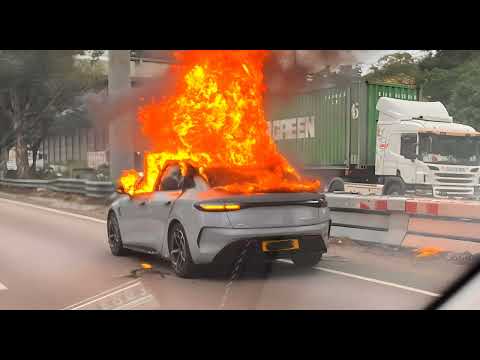
A fire involving a BYD Seal electric vehicle on Hong Kong’s Tuen Mun Road on March 3, 2026, caused traffic disruptions but was traced to an external power bank, not the car itself. The incident underscores the importance of safe charging practices even as EV technology improves.
Incident Details
At approximately 2:01 p.m., a silver BYD Seal caught fire while traveling towards Hung Shui Kiu. The driver safely exited before the flames intensified, and firefighters extinguished the blaze by 2:19 p.m. Initial reports suggested a possible vehicle fault, but a subsequent inspection by BYD revealed that a portable charger left on the passenger seat short-circuited or experienced thermal runaway, igniting the fire.
Battery Integrity Confirmed
Despite severe damage to the cabin, including melted plastics and glass, the vehicle’s Blade Battery pack remained intact. This is largely due to the LFP (Lithium Iron Phosphate) chemistry used in the battery, which requires significantly higher temperatures (over 500°C) to undergo thermal runaway compared to traditional NMC (Nickel Manganese Cobalt) batteries (around 200°C). The battery’s honeycomb aluminum structure also acted as a thermal barrier.
“The Blade Battery’s design prioritizes thermal stability, minimizing the risk of catastrophic failure even under extreme conditions.”
BYD’s Structural Approach
The BYD Seal utilizes Cell-to-Body (CTB) technology, integrating the battery directly into the vehicle’s chassis for enhanced structural rigidity (40,500 Nm/°). This “sandwich” design, featuring high-strength aluminum panels, shields the battery cells from external heat. The Seal also incorporates advanced safety features like a centre airbag and an automatic eCall system.
Market Positioning
In Hong Kong, the BYD Seal competes with the Tesla Model 3. BYD delivered an estimated 4,200 units in 2025 versus Tesla’s 5,800. While both hold 5-star Euro NCAP ratings, BYD emphasizes the thermal stability of its LFP Blade Battery, whereas Tesla employs both LFP and high-nickel NMC cells. The Seal also maintains a price advantage, starting at roughly $30,000 USD with local incentives, compared to the Model 3’s $34,500 USD.
This incident highlights that while EV battery technology is advancing rapidly, external accessories and improper charging practices remain potential fire hazards. Ensuring proper handling of portable chargers and understanding vehicle-specific safety features are crucial for safe EV operation.