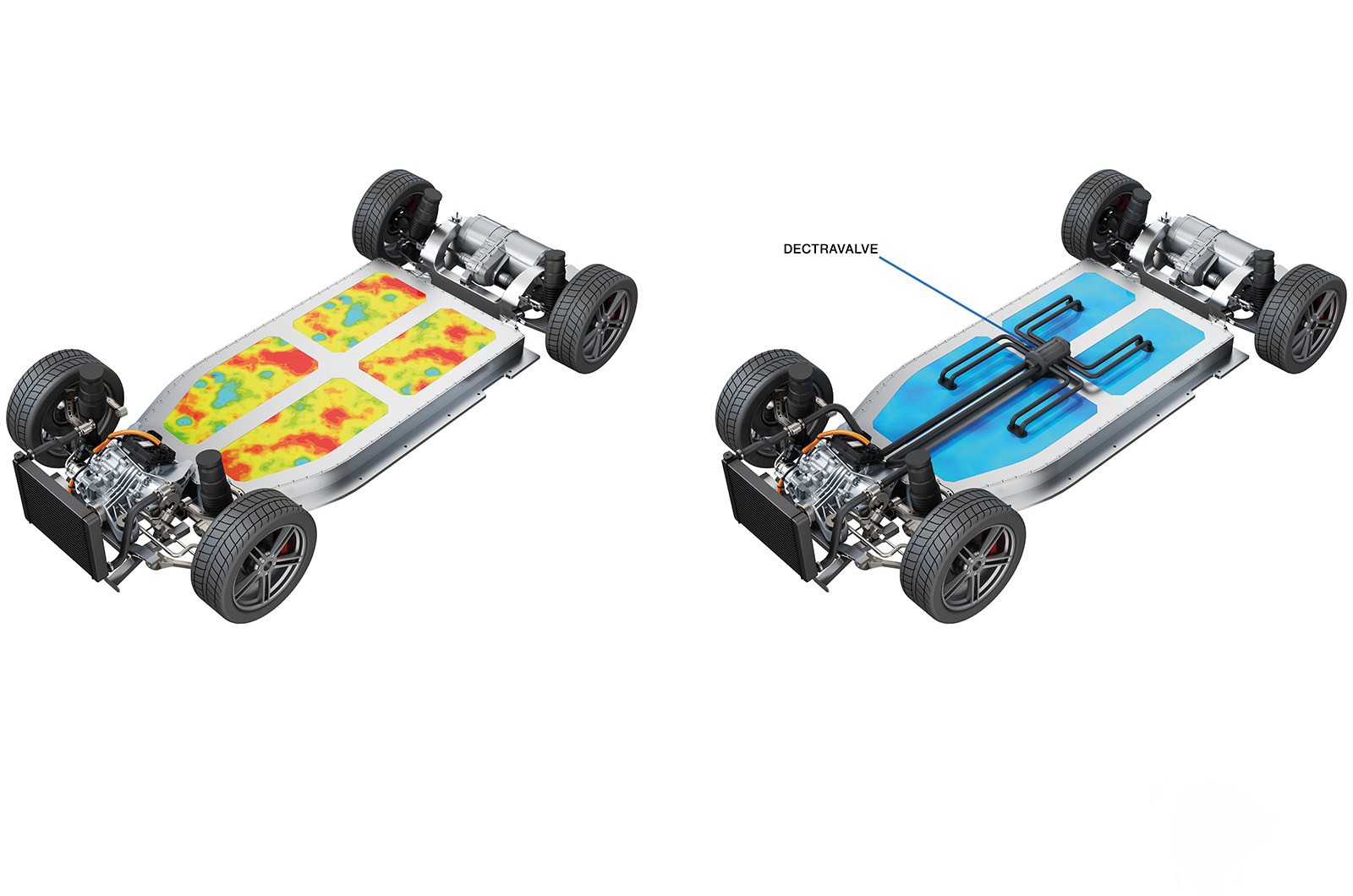
A new liquid-cooling system developed by British startup Hydrohertz promises to dramatically speed up electric vehicle (EV) charging, reducing the time to replenish a 100kWh battery from 30 minutes to just 10 at a 350kW charging rate. This innovation could eliminate a major obstacle to wider EV adoption: long wait times at charging stations.
The Problem with Fast Charging
Rapid charging generates heat. Current EV batteries struggle to dissipate heat effectively during fast charging, forcing manufacturers to slow down the process to prevent damage and preserve battery life. This limitation is a key bottleneck in the transition to electric vehicles. When cells exceed 50°C, charge rates must be reduced, extending charging times considerably.
How Dectravalve Works
Hydrohertz’s patented Dectravalve technology solves this issue by providing precisely controlled liquid cooling. Unlike existing systems where cooling zones are managed collectively, Dectravalve regulates coolant flow to each battery section individually.
- In traditional battery packs with modules, Dectravalve can split the pack into four zones and control each cooling loop separately.
- For newer “cell-to-pack” or “cell-to-chassis” designs where cells are mass-installed without modules, Hydrohertz employs a “rainbow cooling” approach. This involves nested cooling loops, with circuits running from the battery perimeter towards the center for maximum temperature control.
During independent testing by the Warwick Manufacturing Group (WMG), Dectravalve maintained the hottest cell below 44.5°C, with a temperature difference of just 2.6°C across the entire pack. This allows EVs to sustain peak charging rates without overheating.
Benefits Beyond Speed
The impact extends beyond faster charging:
- Increased Range: By keeping cells at optimal temperatures, Dectravalve boosts efficiency by up to 10%, adding approximately 30 miles of range to a mid-size EV.
- Cost-Effectiveness: The system is designed to be affordable, avoiding the need for expensive new battery pack designs.
- Practical Implications: A 100kWh battery can gain 245 miles of range in the time it takes to buy a coffee.
The Future of EV Cooling
The Dectravalve system adapts to evolving battery architectures, ensuring its applicability even as EV designs shift away from traditional modules. The technology’s precision cooling capabilities position it as a critical component for unlocking the full potential of next-generation electric vehicles.
The Dectravalve breakthrough is not just about faster charging; it’s about making EVs more efficient, reliable, and convenient for drivers.