


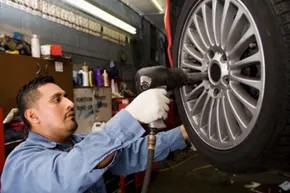
Car manufacturers have pushed tire rotation as a standard maintenance chore for decades. You see it listed right next to oil changes and fluid flushes. The logic seems simple enough. Each tire wears differently. Rotating them evens out that wear. This, theoretically, extends the tire’s life to its full designed limit.
That logic held water when tires were mostly generic tubes of rubber. Today? It’s more complicated. Modern tires come in bewildering arrays. Different constructions. Asymmetrical tread patterns. Directional designs. Cars have evolved too. Rear-wheel drive. All-wheel drive. Heavy performance models. The physics haven’t changed, but the application has grown messy.
Heat is the enemy. Think about a burnout. Smoke pouring off the sidewalls. The rubber is literally cooking. That same process happens every time you drive. Friction and pressure generate heat. Just less visibly. The problem is that heat distribution is uneven.
Front-wheel drive vehicles pull the front tires. That axle works harder. It generates more heat. Rear-wheel drive cars do the opposite. The rear tires take the load. This heat differential causes uneven wear between axles.
Turning makes it worse. Steering wheels wear faster than following wheels. The turning radius matters too. Each wheel traces a slightly different arc. Slightly different speed. Slightly different wear rate.
Then you add braking. Acceleration. Road surface texture. Ambient heat. Tire pressure. Suspension geometry. Alignment angles. A curb scrape. A pothole damage. The list of variables is endless.
Given this chaos, uneven wear is a guarantee. So is the argument that rotation helps. But many skeptics call it a costly, unnecessary procedure. Their point? You can’t predict or control all those variables. Tires will last as long as they last. Rotation might not change the outcome.
Consider the Chrysler Crossfire. That short-lived sports car had different tire sizes front and rear. You could only rotate side-to-side on each axle. Add directional tires with asymmetrical treads, and rotation becomes impossible. The engineering constraints are real.
Does rotation serve a purpose? Yes. It equalizes wear. Instead of one section wearing down while another stays pristine, you spread the load. Does it make the tire last longer? Yes. But only up to the manufacturer’s rated mileage.
Take a 60,000-mile (96,561-kilometer) tire. Without rotation, it might fail at 50,000 miles (80,467 kilometers) due to uneven wear. With rotation, there’s a good chance it hits the full 60,000-mile mark. Given the right conditions, you get what you paid for.
The bottom line? Rotation provides a safer, smoother ride. It might not add miles in a vacuum. But it ensures you extract the maximum value from the rubber under your feet. Is it worth the labor cost? For most drivers, probably. Especially if they want to avoid a sudden imbalance at highway speeds.
The debate won’t end soon. As tires get more specialized, rotation rules get more restrictive. Yet the core principle remains. Even wear means safer handling. That’s worth considering.


