Towing is rarely relaxing. You are dragging dead weight through traffic, the physics of your gear change instantly. Suspension sags. The braking distance increases. You feel every pothole twice as hard. But what are the activities that really make the driver sweat? Backing up.
It is awkward. It’s unpredictable. If you do it wrong, you can crumpled bumper or damaged tow bar.
There are three things you need to consider before considering reverse gear. The first is visibility. If you can’t see the rear corners of your towed vehicle, you’re flying blind. Large side-view mirrors are not a luxury here. They are requirements. Second, capability. Read the user manual. Know your vehicle’s Gross Vehicle Weight Rating (GVWR) and towing capacity. Exceeding these limits will not only void your warranty, but also make your vehicle unstable. Third, equipment. Make sure hitch, safety chains and breakaway cables are properly attached. A loose gear is a projectile waiting to happen.
Select the towing method
Not all towing setups handle reverse motion the same way. There are usually three options, each of which has its own risks.
4 wheels down (Dinghy Towing)
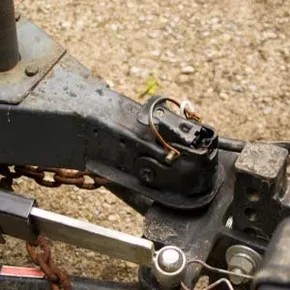
Here, the towed vehicle rolls on its own tires and connects to the towing vehicle via a tow bar and hitch. RV owners love this way of “towing” their vehicle behind their RV. It’s efficient. It’s very simple. However, this is not universal. Especially in front-wheel drive vehicles, the transmission can be damaged if the drivetrain isn’t designed to rotate while driving. Check the user manual. If dinghy towing is not specifically permitted, do not attempt it.
Tow Dolly (Two-Wheels-On, Two-Wheels-Off)
The trailer is lifted off the ground using the trailer’s front axle. Rear tires roll. The front wheels rotate freely in the dolly. This reduces wear on the tires of the towed vehicle. However, the dolly towing only applies to front-wheel drive or neutral-transmission configurations. Rear- or all-wheel-drive vehicles generally cannot be towed this way without damaging the drivetrain.
More importantly, never back up with a tow dolly. Due to the geometry of a dolly, steer accurately in reverse is almost impossible. There is a risk of jackknifing or snapping the dolly’s coupler. If you want to back up, detach the car and back it up yourself. Period.
4 wheels up (trailer towing)
This is the safest option for backing up. The entire towed vehicle is on a trailer. The wheels do not touch the road. There is no stress on the drivetrain stress. A trailer is heavier than a dolly, so the towing vehicle may feel heavier, but handling are predictable.
dolly backing is too dangerous to explain in the guide, so we’ll focus on the two methods you can use: 4 wheels down and 4 wheels up.
The Physics of Backing Up Towed Vehicles
Back to the core problem: reversing a long, articulated rig.
When you move forward, the towing vehicle pushes the trailer. The trailer follows. Simple.
When you reverse, the tow truck pulls the trailer. But here’s the twist. Use the “front wheels” of the towing vehicle to steer and the “rear wheels” of the towing vehicle to push the attachment point. This creates a tipping point that behaves the opposite of what you expect.
Do you want to turn the steering wheel to the left? The rear of the tractor turned to the right. A trailer attached to the back follows the swing. The longer the trailer, the slower the response, but the wider the arc. The short car in the cart reacts so quickly it almost jerks. A long motorhome with four wheels mounted downwards moved slowly, like a giant ship circling a channel.
The most important thing is to minimize the angle between the tractor and the trailer. If it’s moved at a sharp angle, turning it over will reinforce that angle. You can fold the knife. You lose control.
So what can you do to prevent it? Start by aiming your vehicle as straight as possible. Use observers if possible. Back away slowly. Small control corrections are made. If the trailer starts drifting to the left, correct it by steering to the left. Opposite? Yes. Effective? completely.
Training is important. Find an empty parking space. Place the cone. Feel the arc. Learn how your car can handle weight. Because when you’re on the freeway and there’s traffic behind you,
Backing up on a dolly or flatbed is more than just a backup. This is a mechanical negotiation.
You are dealing with length. You are dealing with weight. You are dealing with leverage.
The towed vehicle extends the setup. The extra length swings wide. It swings tight. Don’t worry about your parking space.
Next is mass. All the weight is behind the rear axle of the tow vehicle. Unless you mount the hitch backwards (which would be a disaster) it will shift your center of gravity backwards. This changes the position of the tow vehicle. The way we deal with it has changed.
Next is the pivot. The hitch is the fulcrum. When the towing vehicle turns, the towed unit just doesn’t follow. It reacts. It pushes. It pulls. These two vehicles became one awkward system. Acceleration, braking and cornering all feel different. The feedback loop through the steering wheel is no longer direct.
Doing this safely requires knowledge of physics. It’s not an engineering degree. Just the basics.
The Physics of the Push
Inertia is the first hurdle. Inertia is the resistance of a physical object to changes in velocity. It’s simple enough. But here the object is heavier. It’s much heavier.
Objects with greater mass also have greater inertia. It resists starting. It refuses to stop. It resists turning.
The tow vehicle engine has to work harder. This inertia must be overcome. This resistance to changes in motion is acceleration. Acceleration is a vector quantity. It has direction and magnitude. In reverse, the direction is the backward. The magnitude is the how fast you’re going.
You have to press the gas pedal to move. careful. Press too hard and you’ll lose grip. Even worse, the hitch breaks.
Once rolling, the speed must be maintained. Why? friction.
Friction is a force opposing motion. The tires rolling on the pavement. The Axles rotates in bearings. It’s always there. If you take your foot off the accelerator, friction wins. The cars slow down. they stop. Moving them requires constant gentle force.
Braking, inertia bites back. If you move, you resist being stopped. With two vehicles locked together, that resistance is significant. You need more brake pressure. More distance. More patience. Slamming the brakes can cause sway if you press the brakes too hard. Or jackknifing.
Techniques for Backing Up Towed Vehicles
Physics determines technique. You cannot force the towed car to move to a designated location. You have to guide it.
Start with a wide turn. The tow vehicle wedges into the car. If you turn it too tight, the towed car will run over the towed unit. In reverse, the towing device may collide with the towing vehicle.
Use smaller control inputs. Big shocks can cause vibrations. Towed vehicles may sway. You will probably have a hard time dealing with it. You lose control.
I look out the back window. It’s not just a hitch. En route. The towed vehicle follows different curves. Follow the flight path. every time.
If the tow vehicle starts to push the trailer, the trailer will push from the inside of the turn. We have to fix it. Small fixes. Don’t oversteer.
If it is pulled outwards, the rotation is too sharp. Release the throttle. Keep the wheels direct.
Practice in an open space. before you go into town. before entering the queue. Feel the weight. delay. turning point.
There is no one right way. Every setting is different. Every driver is different. But physics hasn’t changed. Inertia doesn’t care about your confidence. Friction doesn’t care about your schedule.
Back away slowly. I will fix it carefully. Always check the mirror.
Practice makes perfect before you go
Towing a car is more than just moving extra weight. Physical changes occur with every turn, braking and climb. You now control two vehicles instead of one. The extra length creates blind spots and delays. If you don’t practice, you gamble with safety.
Find a large, empty space. Abandoned school or church parking lots work well. Bring a spotter. Relying on the rearview mirror alone is dangerous when backing up a trailer or moving a vehicle.
The Six O’Clock Steering Technique
Backing up is the hardest part. Use specific hand positions to maintain control. Place one hand on the bottom of the steering wheel. This is the 6 o’clock position.
This is where the logic reverses. Moving the hand to the right rotates the wheel counterclockwise. The towed vehicle reacts by moving to the right. This may sound counterintuitive, but it works.
Make small adjustments. A small movement of the wheel can cause a lot of wobble in the rear end. If you turn the handle too much, you could jackknife or hit something. Keep it slow A gentle curve is much safer than a sharp turn. This improves visibility and control.
Scanning the Environment
When you’re on the road, the stakes are even higher. Scan everything before you reverse. Don’t just look at the pavement. look up Low-hanging branches and road signs can catch load.
Speed is the enemy here. Keep it slow It gives you time to identify and react to hazards. If you can reverse in a straight line, do so. It removes the complexity of steering entirely. But if you must turn, remember that small inputs and the results are big.
Communication with Your Spotter
Shouting wind and engine noise won’t help. It leads to mistakes. Agree on the hand signals before you start moving. These standard hand gestures tell you to stop, go and change direction. Keep the process smooth and safe.
“A slow and steady approach helps prevent accidents and vehicle damage.”
It’s not just about getting from point A to point B, it’s also about keeping your equipment intact. Practice in the lot until the six o’clock feel becomes second nature. Then carefully go to the street. The road is unpredictable. Your preparation shouldn’t be.