


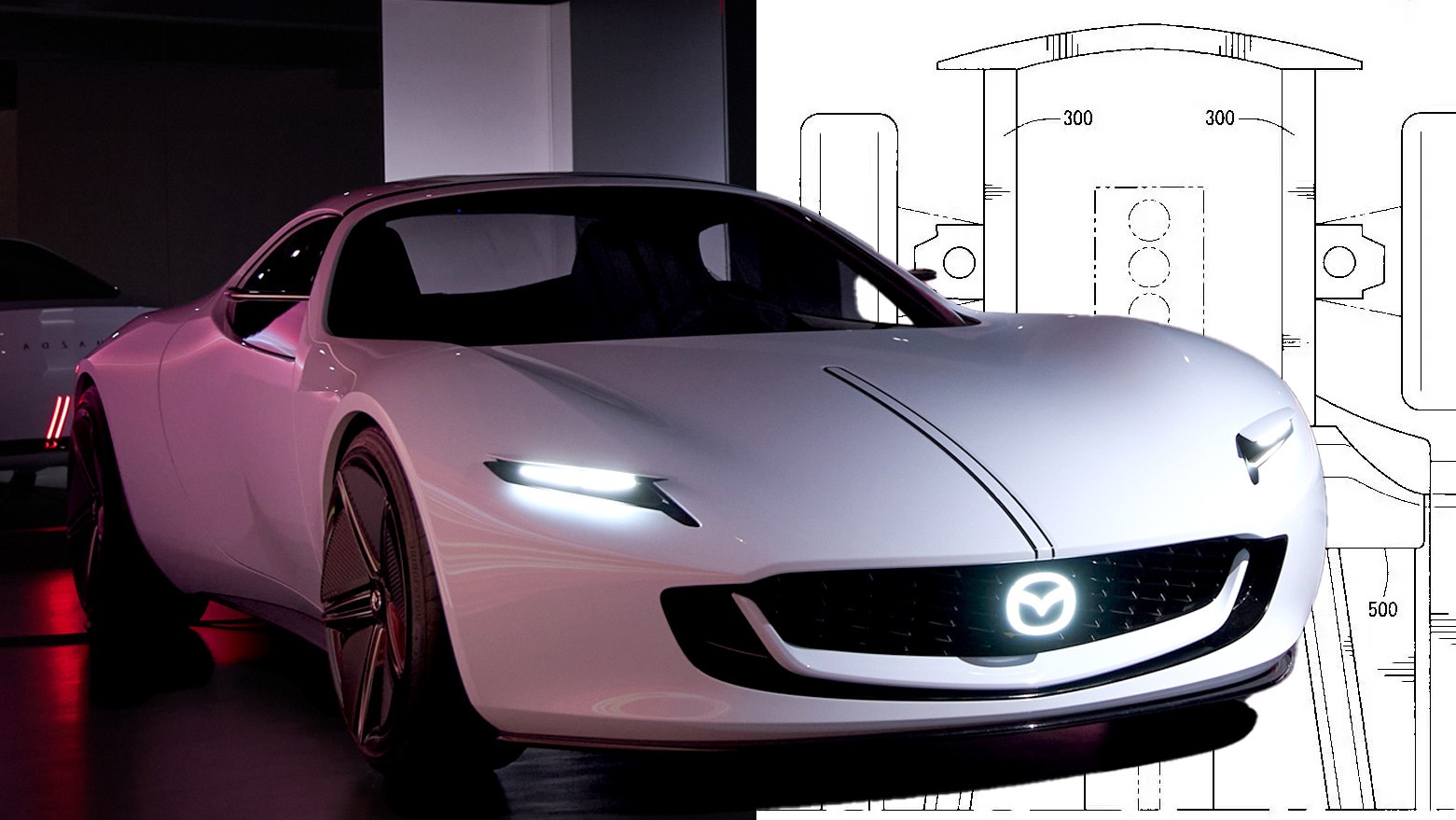
Two fresh patents filed by Mazda just popped up online. No name tags attached. Just sketches of a tiny, front-engine, rear-wheel drive convertible. The doors are the giveaway. They’re butterfly style.
This narrows the suspect list to exactly two cars.
How Mazda Plans To Make Butterfly Doors Work On A Convertible
The current MX-5 is great. Everyone agrees. Mazda is already building its successor. It’ll be lightweight. Gas-powered. Just like the old reliable recipe. But there’s that other thing: the Iconic SP concept car. Mazda said they wanted to build that, too. These filings prove driver-focused cars are still on the table.
The sketches were spotted by Carbuzz. They show a longitudinal four-cylinder engine sitting right at the front.
The first filing is boring on paper but interesting in practice. It’s all about the hinge pillar. How do you mount huge doors that flip up and out without the roof flying off in the wind? You don’t just bolt it on. You engineer it.
Mazda hasn’t put butterfly doors on a production model before. Now they seem intent on changing that.
The patent describes the mechanism as a “flip-up side door” where the rear section swings both outward and upward. It works like a hybrid of scissor and butterfly doors.
The engineering solution is clever. They’re pulling the A-pillar closer to the shock towers. Why? Chassis rigidity. You can’t have a flexible tub when you’ve got doors this heavy swinging around.
They also mention “bracing reins.” Think of these as tension rods. They transfer the load from the suspension mounts into that reinforced pillar. It handles the stress of a convertible top moving in and out.
Then there’s the “apron frame.” It’s a stamped-metal brace. It connects the front corners of the chassis straight to the firewall. It adds stiffness without the weight penalty. Weight is the enemy, right?
Which Car Gets The Rotary Replacement?
The second patent looks at crash structure. Where does the force go when you hit a tree? It channels the load through the firewall, along the side sills, and to the back of the car. Occupants survive.
Here’s the kicker.
The drawings show a traditional transmission tunnel. They also show a longitudinal four-cylinder powertrain.
The Iconic SP concept didn’t have a tunnel. It ran a rotary range-extended hybrid. No big gear tunnel. This patent clearly shows the mechanical hump for a conventional transmission.
So what’s going on?
- Radical MX-5 update. The next Miata gets butterfly doors. It loses its soft-top simplicity.
- The Iconic SP goes production, but with a regular engine. They drop the rotary plan entirely for this model.
- Shared platform. Both cars use the same architecture underneath. The patents just show the common bones.
Most people suspect it’s number two. Or maybe a mix of one and three.
Why put butterfly doors on the MX-5? It’s supposed to be the affordable entry point. Simple. Accessible. Butterfly doors are flashy. They cost money. They complicate ownership.
Does that fit the MX-5 philosophy?
Maybe not. But the Iconic SP? Sure. That thing looks expensive. It looks complex. Giving it a four-cylinder engine instead of the promised rotary might be a pragmatic choice. The rotary is hard. Reliability is hard. Maintenance is expensive for a niche crowd. A proven four-cylinder is cheaper. It’s lighter in some contexts. It fits the chassis.
We’re left with questions.
Is this the death knell for a new rotary roadster? Or just a detour? The patents don’t lie, but they don’t tell the whole story.
We’ll see if Mazda builds a sports car that looks like a supercar but drives like a daily. Or if they keep the rotary dream alive somewhere else. For now, the blueprints suggest a return to basics. With very fancy doors.


