


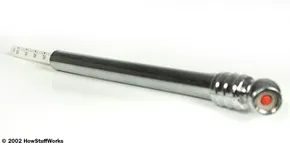
You probably have one of those plastic stick gauges in your glovebox. They are ubiquitous. The design is almost always the same: a cylindrical body, a small circular window on the side, and a sliding scale. You might have wondered why the mechanism doesn’t just blow out the open end when you press it against a valve stem. Or maybe you just want to know how it actually works.
The answer lies in basic physics and a simple spring.
The Physics of Pressure
To understand the gauge, you first need to understand what pressure actually is. Think of a one-inch by one-inch block of wood that is three feet long. If that block weighs one pound and you stand on it, you are exerting one pound per square inch (psi) on your foot. The force is distributed over that single square inch of area.
If you take a 30-foot version of that same block, the weight increases proportionally. Standing on a 30-foot column would exert 10 psi. A 300-foot column would exert 100 psi.
This principle applies to liquids too. Water that is one foot deep exerts about 0.43 psi. If you were a mile underwater, the weight of the water column above you would be roughly 2,270 psi. A one-inch square column of water stretching a mile high would weigh 2,270 pounds.
Air behaves the same way. The atmosphere is roughly 50 miles “deep.” At sea level, a one-inch square column of air 50 miles high weighs 14.7 pounds. This creates 14.7 psi of atmospheric pressure. Our bodies are pressurized to match this, so we don’t feel it.
Pressure drops as you go higher. Here is how atmospheric pressure changes with altitude:
- Sea level: 14.7 psi
- 10,000 feet: 10.2 psi
- 20,000 feet: 6.4 psi
- 30,000 feet: 4.3 psi
- 40,000 feet: 2.7 psi
- 50,000 feet: 1.6 psi
How Gases Create Force
Inside a tire or a balloon, pressure is created by collision. Gas atoms are in constant motion. They ricochet off the interior walls of the container. The speed of these atoms is dictated by temperature.
At absolute zero (0 Kelvin), atomic motion stops. As temperature rises, the atoms move faster. Faster atoms hit the walls harder and more frequently. This creates outward pressure.
You can increase pressure in two ways:
1. Raise the temperature.
2. Add more atoms.
When you pump up a tire, you are doing the second option. You are forcing more air molecules into a constant volume. A car tire typically holds 30 psi. A bike tire might need 60 to 100 psi. The pump doesn’t use magic; it simply packs more gas into the same space. The increased number of collisions raises the pressure.
The Mechanics of the Stick Gauge
So how does a simple plastic tube measure this force?
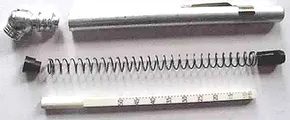
Most stick gauges use a simple spring-loaded piston. Inside the cylinder, there is a movable plunger connected to a spring. The tip of the gauge has a valve that opens when you push it against the tire’s valve stem.
When you press the gauge against the stem, air from the tire rushes into the tube. This air pushes against the plunger. The air pressure exerts a force on the surface area of the plunger.
The spring resists this movement. The plunger moves until the force from the air pressure equals the resistance of the spring. At that equilibrium point, the plunger stops moving.
The position of the plunger corresponds to a specific pressure. The sliding scale on the side of the tube aligns with the end of the plunger. You read the number where the plunger stops.
The reason the scale doesn’t blow out is because the spring provides a counter-force. The spring is calibrated to match the pressure range of typical tires. If the pressure is too high, the spring compresses further, but it is designed to withstand the maximum expected pressure without failing. If the pressure is too low, the spring pushes the plunger back out.
The accuracy depends on the spring’s calibration and the friction of the plunger. Cheap gauges have more friction, leading to inconsistencies. Better gauges use low-friction materials and tighter tolerances.
The next time you check your tires, remember that you are balancing atmospheric force against mechanical spring tension. It is a simple, elegant solution.
Why Accuracy Matters
Most

How to Actually Read a Tire Pressure Gauge
Most digital or analog dials share the same mechanical soul. Inside that plastic or steel shell sits a simple mechanism designed to measure force. You aren’t guessing. You are measuring.
The process is three steps. It’s not rocket science, but people mess it up constantly.
First. Find a steady stance. If you’re wobbly, your seal will be weak. Lean in. Make sure you can apply consistent pressure without jerking the tool.
Next comes the contact. You’re not just touching the valve stem. You are sealing against it. Press the gauge’s nozzle firmly onto the valve core. You’ll hear it. That hiss is air escaping the tire and moving into the gauge’s chamber. Inside the tool, a pin pushes against the valve pin inside the stem. This action depresses the core, allowing pressurized air from your tire to equalize with the gauge’s internal sensor. If you don’t hear that quick burst of air, you haven’t sealed it. Try again.
Finally. Look at the numbers. If it’s a dial, wait for the needle to stop shaking. If it’s digital, wait for the digits to lock. Don’t read it while the gauge is still connected and air is still venting. That reading will be inaccurate.
The hiss you hear isn’t the tire going flat. It’s the gauge doing its job.
Many drivers skip this because they think it’s tedious. They use the “kick test” instead. That’s not how physics works. A loose grip on the gauge introduces error. A slanted angle breaks the seal. Both lead to under-inflation.
Under-inflation kills fuel economy. It wears out tires unevenly. It increases the risk of a blowout at highway speeds. The gauge doesn’t lie. You just have to hold it still long enough to let it speak.

The Mechanical Heart of the Gauge
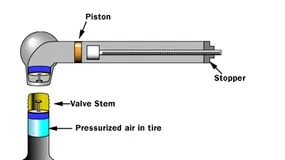
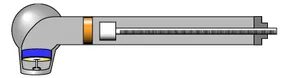
Inside the housing, the mechanism is deceptively simple. Think of a bicycle pump cylinder. There is a piston sliding inside a tube. The tube walls are polished to a mirror finish. The piston itself is soft rubber. It presses firmly against the metal. Light oil coats the interior. This lubrication reduces friction. It also ensures a tight seal.
If you look at the assembly, the piston sits at one end of the travel. A stop defines the limit at the other end. Between them lies a spring.
The compressed spring pushes the piston toward the left-hand side of the tube.
This spring is constant. It is always under tension. It forces the piston left. This creates a baseline position. The gauge relies on this mechanical return. Without the spring, the piston might stay stuck. Accuracy would drop to zero. The system needs that push back. It needs the tension to reset. Every time pressure drops, the spring takes over. It drives the piston home. This movement is what you see on the dial. Or rather, what the dial measures.

The mechanics of the dial
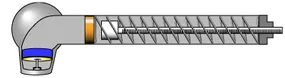
The spherical protrusion on the left isn’t just for show. It’s hollow, specifically engineered to fit over a tire’s valve stem. Look closely at the opening and you’ll spot two critical components: a rubber seal and a small fixed pin.
The seal does its job by pressing against the valve stem’s lip. This creates an airtight barrier so pressure doesn’t leak out while you’re trying to measure it. Meanwhile, the pin acts as a trigger. It depresses the valve inside the stem, opening the gate for air to flow.
That air travels around the pin, moves through the hollow core of the sphere, and enters the piston chamber.
How pressure moves the needle
Once the gauge is locked onto the valve stem, the action is immediate. Pressurized air from the tire rushes in and shoves the piston to the right. The distance that piston moves correlates directly to the tire’s pressure.
It’s a simple tug-of-war. The air pushes the piston right. A spring pushes back left.
The gauge is built to handle a maximum pressure. Let’s assume that limit is 60 psi for this example. The spring is calibrated precisely for this range.
– At 60 psi, the air pressure overcomes the spring completely, moving the piston to the far right of the tube.
– At 30 psi, the force is halved. The piston stops halfway.
– Lower pressure? The piston doesn’t travel as far.
Release the gauge from the valve. The air flow stops. The spring takes over instantly, snapping the piston back to its resting position on the left.
Reading the data
To make sense of the piston’s movement, there is a calibrated rod inside the tube:
The Max-Hold Mechanism Explained
The visual diagram omits the internal spring, but it’s there. A calibrated rod sits nestled inside it. The rod doesn’t attach to the piston. It just rides on top. The fit between the rod and the stop is tight. Almost friction-heavy.
Watch the sequence. Piston moves right. It pushes the calibrated rod forward. Simple physics. When pressure drops, the piston recoils left. The rod? It stays put. Locked at its maximum point. This allows you to read the peak pressure after you’ve disconnected the gauge.
Why Your TPMS Light Triggers When Tires Look Fine
You check the tires. They look inflated. The dashboard still screams. Why?
Cold weather is the usual suspect. Air contracts in the chill. The sensor trips. The light turns off later, once you drive enough to warm up the internal pressure. But don’t trust the dashboard alone. Check your tire pressure with a manual gauge. Verify it’s safe to drive before ignoring the warning.
Where Are JACO Tire Gauges Made?
Quality control matters. All JACO products are manufactured in the U.S. They test every unit for accuracy before it hits the shelves. If you’re looking for where JACO tire gauges are made, the answer is domestic.
What Should My Tire Pressure Gauge Read?
Tire Pressure Monitoring Systems (TPMS) have a programmed tolerance range. For direct monitoring, that sweet spot usually sits between 28 and 35 pounds per square inch (psi). Anything outside that window triggers the system.
If your gauge reads lower than 28 psi, you’re underinflated. Above 35? You might be overinflated. Stick to the range for optimal performance and safety.
Do Major Retailers Carry These Tools?
Walmart sells tire pressure gauges. You can browse and shop directly on their website. It’s one of the easiest places to find a basic mechanical or digital model.
More on Pressure and Physics
If the mechanics of inflation interest you, dig deeper.
- How Tires Work
- How Hot Air Balloons Work
- How SCUBA Works
- How Atoms Work
- How do 30 pounds of air in your tires hold up 2 tons of car?
- Why don’t they use normal air in race car tires?
- What does it mean when a barometer is rising or falling?
- Can you explain pressurized airplane cabins?
Further Reading
- Pressure and Gases
- Pressure
- TireSafety.com
- How to check tire pressure
- GM Goodwrench Videos


